HUGINN & MUNINN — THE RAVENS ODIN FEARS TO LOSE
Every god has an instrument. Thor has a hammer. Heimdallr has a horn.
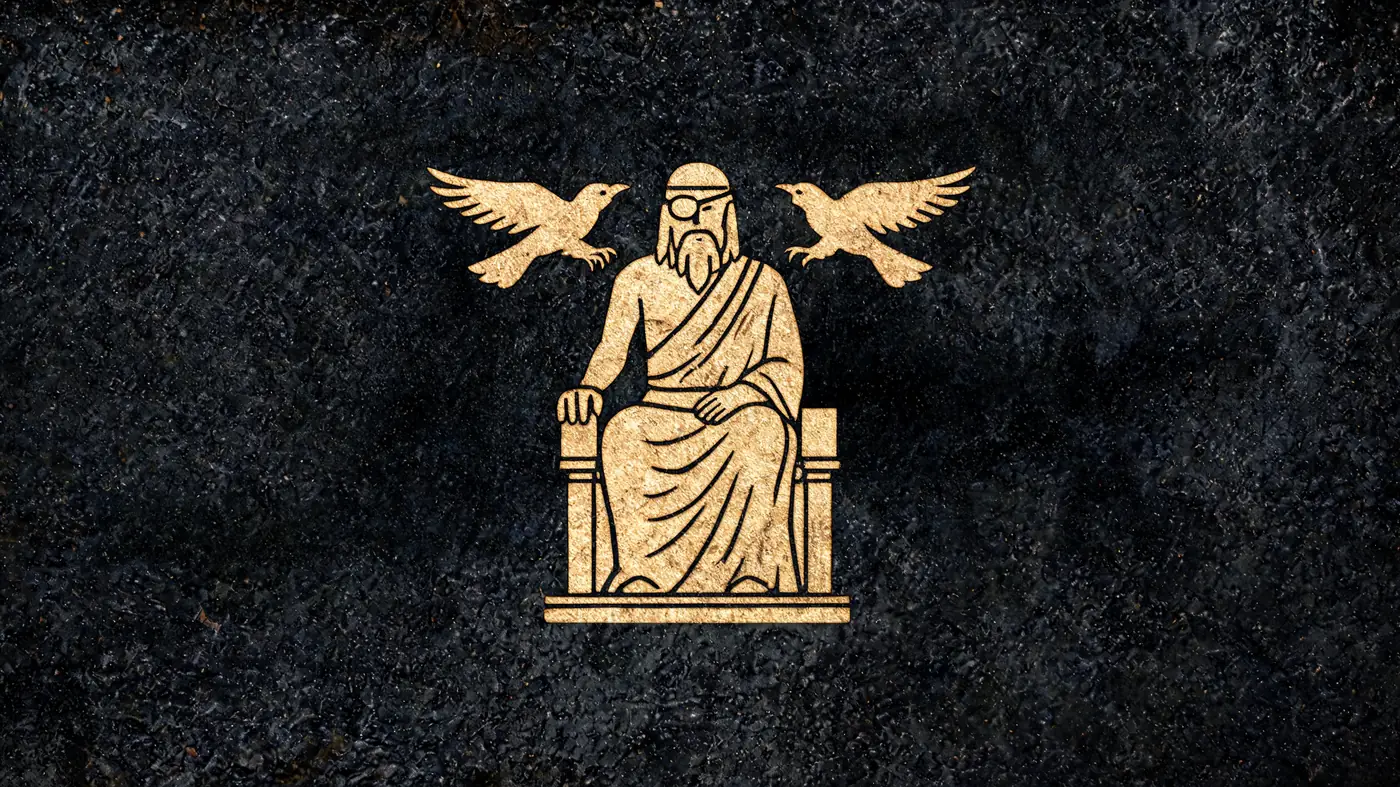
Odin — the god of wisdom, war, and knowing what he should not — has two birds.
Every morning they leave his shoulders and cross the nine worlds. Every evening they return and speak into his ear. Nothing important has happened anywhere that Odin does not hear about by nightfall — and the old poems say the thing he fears most in all the worlds is the evening the birds don’t come back.
Their names are Huginn and Muninn.
THE GOD WHO PAID FOR SIGHT
To understand the ravens, start with the eye Odin doesn’t have.
The Allfather is a one-eyed god by choice. At Mímir’s well, beneath a root of the World Tree, he was offered a drink from the waters of wisdom — and the price was an eye. He paid it without bargaining. One eye, traded for the ability to see what eyes cannot.
That is the pattern of Odin’s whole existence: he trades pieces of himself for knowledge. He hung nine nights on the World Tree, wounded by his own spear, to seize the runes. He gave his eye for wisdom. And for the daily knowledge of everything that moves in the nine worlds, he keeps two ravens — and pays for them in a currency crueler than flesh.
Fear.
THOUGHT AND MEMORY
The names are the myth. Huginn is Thought. Muninn is Memory.
The Grímnismál, one of the oldest poems of the Poetic Edda, gives Odin’s own words: Huginn and Muninn fly each day over the wide world. “I fear for Huginn, that he come not back — yet more anxious am I for Muninn.”
Read that again. The god of wisdom fears losing Memory more than losing Thought.
Thought can be regenerated. A mind can think new thoughts tomorrow. But memory is the only place the past exists at all. Lose it, and everything you have seen, everyone you have been, every lesson paid for in blood — gone, not hidden. A god can survive without thought for a day. Without memory, there is no one left to survive.
The Norse put the deepest truth about minds into a god’s anxiety about two birds: seeing is cheap. Keeping is everything.
WHY RAVENS
The choice of bird was not poetic accident.
Ravens follow armies. Wherever men marched in the old North, the black birds gathered ahead of the battle, patient, already certain of the outcome. The skalds called battle “feeding the ravens” — and they called Odin Hrafnaguð, the Raven God, the one the birds report to. Viking warlords carried raven banners into battle for a simple reason: the raven sees the field before anyone in it, and belongs to the god who decides how it ends.
And ravens are watchers by nature. They remember faces. They pass knowledge to their young. They arrive early, stay high, and miss nothing. The Norse looked at the most intelligent bird in their sky and understood exactly what it was: not a scavenger, but a collector.
Odin did not choose messengers. He chose witnesses.
BY NIGHTFALL, IT IS TOLD
Think about what the ravens actually mean for everyone else in the nine worlds.
Whatever you did today — in the open, in the dark, in the places you were certain no one watched — two black shapes crossed the sky above it. They did not stop. They did not judge. They noted it, the way memory notes everything, and by nightfall it was spoken into the ear of a god.
Nothing in Norse myth escapes this. Kings and thralls, gods and giants — all of them live inside the ravens’ daily circuit. The Norse did not imagine an all-seeing eye glaring down in judgment. They imagined something quieter and far more unsettling: a system that simply records, every day, without exception, and reports to the one being who forgets nothing on purpose.
You were seen before you turned around. You were remembered before you knew it mattered.
WHAT THE RAVENS ACTUALLY MEAN
Strip away the feathers and the god, and Huginn and Muninn are the two halves of every mind that has ever tried to know anything.
Thought ranges. It flies out, tests, imagines, risks. Memory returns. It carries home what the ranging found and keeps it, or there was no point in the flight. A mind that only thinks scatters itself across the nine worlds and comes back with nothing. A mind that only remembers never leaves the shoulder it sits on.
Odin’s daily ritual is the discipline every sharp mind runs on: send both birds, every day, and fear the evening either one fails to return.
One sees. One remembers.
You are in both.
THE NEOLITHIC CONNECTION
At Neolithic Store, One Sees. One Remembers. is the piece in our Norse Saga collection for those who understand that attention is the oldest form of power.
The One Sees. One Remembers. tee carries the ravens the way the myth does — quietly, and from two directions. The chest bears the pair marked in ember: one head turned forward, one turned back. Thought looks ahead. Memory looks behind. The back bears what the world meets: a single eye, vast and patient, surfacing out of the black. It does not watch. It collects. Whoever stands behind you is already in it.
The ravens report to Odin.
The eye reports to no one. We put it on black.
Available now at neolithicstore.com.
Forged from ancient bloodline. Worn by the modern warrior.
Neolithic Store is a premium mythology-inspired streetwear brand rooted in the stories that shaped human civilization. Every design begins with research, every piece carries a story, and every stitch is made for those who wear their beliefs on their skin.
[…] Every morning two ravens leave Odin’s shoulders and cross the nine worlds. Huginn is Thought. Muninn is Memory. By nightfall they return and tell him everything they saw. Odin confessed one fear: not war, not the end, but that the ravens might not come back. The chest carries the pair in ember, one head turned forward, one turned back. The back carries a single vast eye.See the design · Read the story […]