RUDRA — THE ROARER BEFORE THE FIRST STORM
Before Shiva had that name, the Vedas were already afraid of him.
They called him Rudra — the roarer — and they approached him the way you approach something that has not yet decided what it will do to you.
THE GOD THE HYMNS APPROACH CAREFULLY
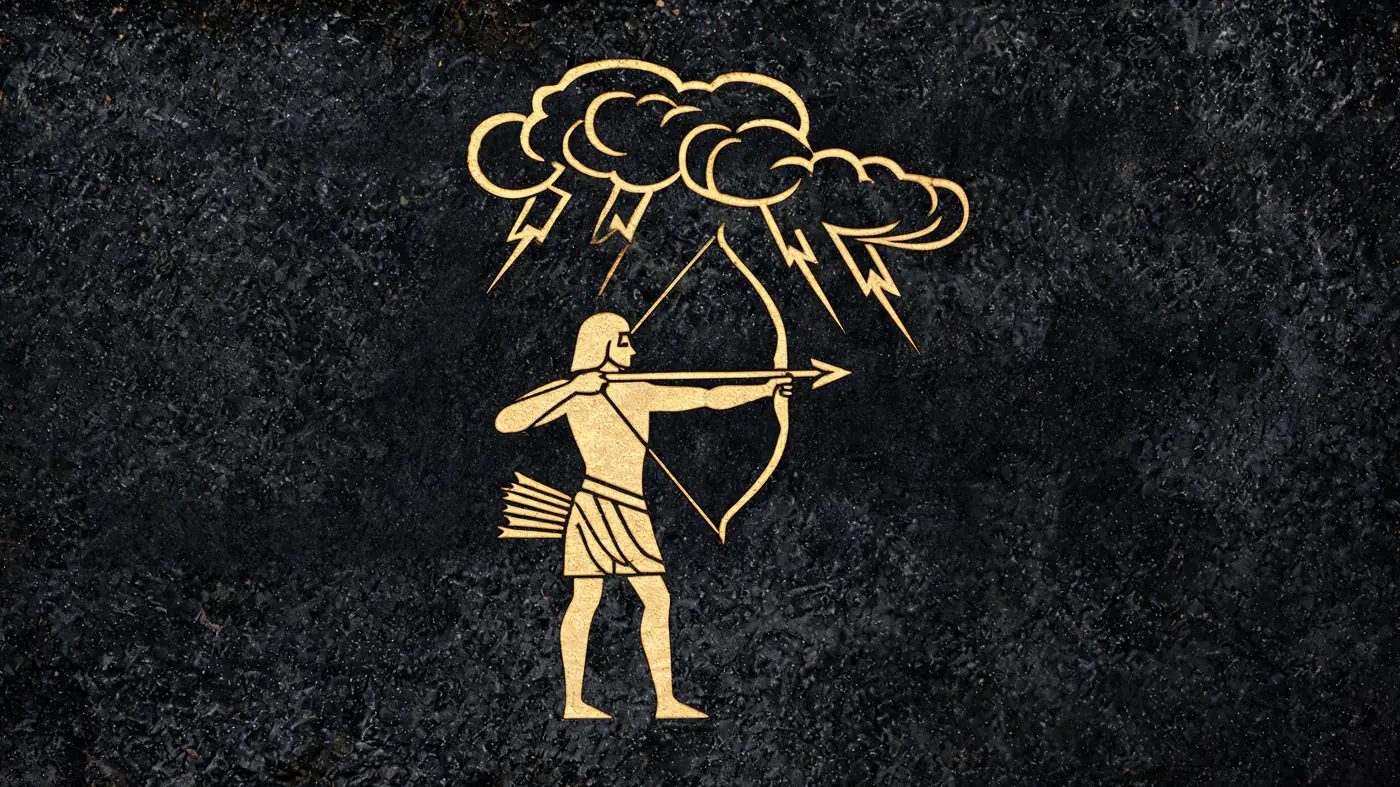
In the Rig Veda, Rudra is the wild one. The hymns praise him and, in the same breath, beg him to keep his arrows turned away — to spare their children, their cattle, their men.
Most Vedic gods are invoked for what they give. Rudra is invoked for what he might, if unpersuaded, take.
THE ROARER AND HIS STORMS
Rudra is the storm before form — the intensity that precedes sound and light. He is the father of the Maruts, the howling storm-gods who ride at his side across the sky.
It is not chaos. It is force held at the edge: power that has not yet been asked to become anything, and could become anything at all.
THE ARROWS AND THE MEDICINES
The same hand that carries arrows carries the greatest of medicines. Rudra wounds, and Rudra heals — the fever and the cure kept by one god.
The Shri Rudram, the ancient hymn to him, calls him again and again shiva — the auspicious, the kind. The terror and the blessing were never two beings. They were one, addressed carefully.
FROM RUDRA TO SHIVA
Over centuries, the fierce Vedic Rudra becomes the Shiva of later Hinduism. The name Shiva — “the auspicious” — began as a way of addressing Rudra gently, in the hope that the kindness would answer instead of the storm.
The god the world now calls Shiva started as the god the Vedas did not dare name directly.
THE THREE CITIES AND THE ONE ARROW
One story shows what the roarer does when he finally moves. Three demon brothers, the sons of Tarakasura, held three flying cities, one of gold, one of silver, one of iron, drifting through the sky and untouchable. Their boon was exact: the cities could be ended only by a single arrow, shot once, in the instant all three stood in one line.
The gods could not answer the cities, so they went to Rudra, the god no one else would stand in front of. He did not spend himself in a thousand attacks. In the tellings he waits, as only he can wait, until the three cities slide into alignment. Then he looses one arrow, and the cities burn together. That is why Shiva carries the epithet Tripurantaka, ender of the three cities.
It is the same god, seen from the other side. The stillness the Vedas feared and the single arrow are one force. The storm was not absent. It was aiming.
THE NEOLITHIC CONNECTION
In the Vedic Legends collection, this is Three Cities. One Arrow.
The back carries the strike: three cities strung along one arrow over a red burn, the fortresses breaking apart. The chest carries Rudra’s eye in close shot, a red seam opening between three lines of ash. Ink and oxblood with a thread of gold, on Bone White.
The storm is not absent. It was aiming.
Available now at neolithicstore.com.
Forged from ancient bloodline. Worn by the modern warrior.
Neolithic Store is a premium mythology-inspired streetwear brand rooted in the stories that shaped human civilization. Every design begins with research, every piece carries a story, and every stitch is made for those who wear their beliefs on their skin.
[…] Rudra is the howler who fires the arrow. Kalagni is the fire that arrow lights. Same force, two faces. (Read: Rudra — The Roarer Before the First Storm.) […]