SERQET — THE GODDESS WHO COMMANDS THE VENOM
The scorpion kills by stopping your breath.
Its venom seizes the nerves, closes the throat, and takes the one thing no living creature can bargain away. The Egyptians, who lived and slept and raised children on the scorpion’s ground, knew this intimately. Their answer to it was not a poison, or a prayer against the desert.
It was a goddess with a scorpion on her head.
Her name was Serqet — and her name means she who causes the throat to breathe.
Read that again. The goddess of the scorpion is named for the exact thing the scorpion takes away. That single fact contains everything Egypt believed about power, danger, and healing.
THE GODDESS WHO WEARS THE DANGER
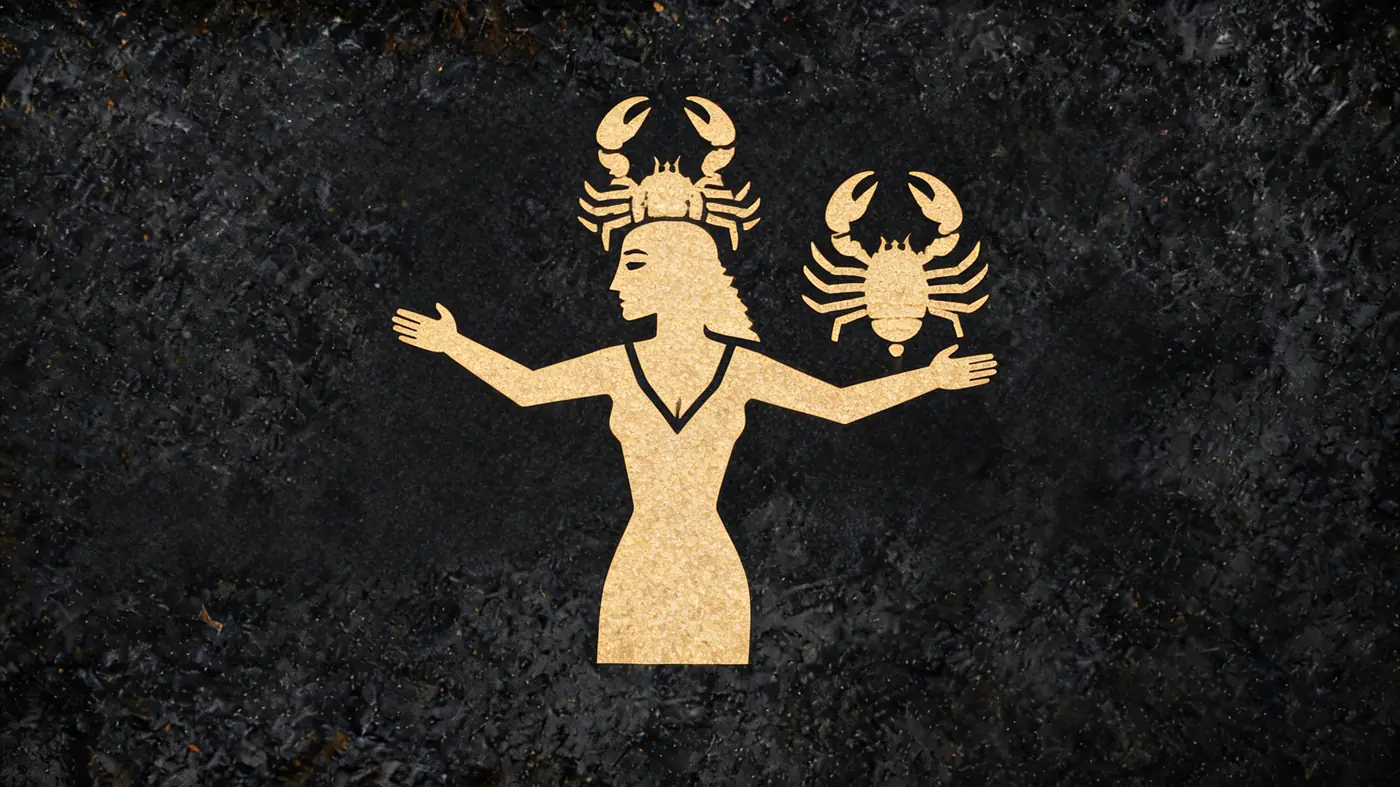
Serqet appears in Egyptian art as a woman crowned with a scorpion, its tail raised above her head like a diadem.
Look closely at the ancient images and you find a detail that is easy to miss and impossible to forget: the scorpion she wears is often drawn without its stinger and without its claws. The Egyptians believed that images had power — that a picture of a dangerous thing could act in the world. So when they drew Serqet’s scorpion, they disarmed it on purpose. The danger is present, displayed, worn openly as a crown.
And it is under control.
That is Serqet’s entire nature. She is not a goddess who protects you from venom by being far from it. She is venom’s own mistress. What she commands cannot harm you — because it answers to her first.
SHE WHO LETS THE THROAT BREATHE
Serqet is one of Egypt’s oldest deities — she appears already beside the earliest kings, and in the Pyramid Texts she stands among the protectors of the dead ruler.
Her domain was precise: stings, bites, and the breath they steal. Scorpion venom, snake venom, the poisons of the desert’s small and patient killers — all of it belonged to her, in both directions. She could send it. She could call it back.
Her priests were not only ritualists. The kherep Serqet — “the one who has power over Serqet’s creature” — was ancient Egypt’s scorpion doctor: part healer, part magician, summoned when someone was stung, armed with spells, incisions, and remedies. Medicine and magic were one practice, and Serqet was its patron. For an Egyptian farmer whose child had just been stung in the dark, she was not an abstraction. She was the difference between breathing and not.
THE SEVEN SCORPIONS OF ISIS
Serqet’s most famous act of guardianship comes from the darkest chapter of the Osiris myth.
When Set murdered Osiris and hunted the pregnant Isis, she fled into the marshes of the Delta to bear her son in secret — the infant Horus, the most endangered child in Egyptian mythology, the heir Set needed dead. Serqet sent her escort: seven scorpions, marching around Isis like bodyguards, three ahead, two beside, two behind.
The story that follows says everything about how Egypt understood her. A wealthy woman slammed her door in the fugitive Isis’s face. The scorpions pooled their venom into one of their number, who slipped under the rich woman’s door and stung her son nearly to death. And then Isis — a mother who could not watch another mother’s grief, whatever the insult — spoke the words of power that drew the venom out, naming each scorpion in turn, and the child breathed again.
Venom sent, venom recalled. Punishment and mercy from the same sting. Those healing spells were recited over scorpion stings in Egypt for a thousand years — with Serqet’s creatures at the center of every telling.
GUARDIAN OF THE DEAD
Serqet’s protection did not end at death. It intensified.
She is one of the four great guardian goddesses of the Egyptian tomb — with Isis, Nephthys, and Neith — the four who stand at the corners of the coffin and the canopic chest, arms outstretched, shielding what the dead will need again. Serqet’s own charge was the canopic jar of the intestines, under the falcon-headed son of Horus, Qebehsenuef.
If you have ever seen a photograph of the treasures of Tutankhamun, you have probably seen her and not known it: the four gilded goddesses surrounding the boy king’s canopic shrine, each standing guard with her face turned watchfully to the side, are among the most beautiful sculptures Egypt ever made. One of them, scorpion on her head, is Serqet.
Three thousand years later, she is still standing there. Still on duty.
In the underworld texts she guards even the gods — binding the serpent Apep, the great enemy of the sun, with her power over every venomous thing that strikes in the dark. The deadliest road in the Egyptian cosmos, and she is the one posted along it.
WHAT SERQET ACTUALLY MEANS
Egypt had gods of overwhelming force. Serqet is something rarer.
She is the principle that the thing which can harm you is the thing that can save you — that venom, mastered, becomes medicine, and danger, commanded, becomes protection. She does not destroy the scorpion. She wears it. Its power is not denied but redirected: away from the innocent, toward whatever threatens them.
The Egyptians did not pray to Serqet to make the desert safe. The desert was never going to be safe. They prayed to her because she proved that what stings can also stand guard — that the sharpest defense is a danger that has chosen your side.
She takes the breath. She gives it back.
Both are hers.
THE NEOLITHIC CONNECTION
At Neolithic Store, Serqet stands in our Egypt Mythos collection as the guardian she has always been.
The Guardian of Venom tee carries her scorpion across the back in cream and gold, tail arched before a temple gateway — rendered with the detail of an artifact, not a graphic — with the curve of her sting on the chest. It is a piece for those who understand her oldest lesson: that true protection is not the absence of danger, but danger that answers to you.
The scorpion takes the breath.
She gives it back.
Available now at neolithicstore.com.
Forged from ancient bloodline. Worn by the modern warrior.
Neolithic Store is a premium mythology-inspired streetwear brand rooted in the stories that shaped human civilization. Every design begins with research, every piece carries a story, and every stitch is made for those who wear their beliefs on their skin.
[…] the crew fights back. Isis and Serqet bind the serpent with their spells — Serqet with the same power over venom that makes her the […]