RA AND APEP — THE BATTLE FOR EVERY SUNRISE
Egypt did not believe the sun would rise. It believed the sun would be defended. Every evening Ra went down into the Duat with a night to cross and an enemy waiting in it.
Egypt did not believe the sun would rise.
It believed the sun would be defended.
Every evening Ra set in the west and went down into the Duat, the underworld, with a night to cross and an enemy waiting in it. Every morning he came up in the east. The Egyptians never treated that as a law of nature. They treated it as a victory — one that had to be won again, in the dark, before dawn, every single night.
THE SUN THAT DIED EVERY EVENING
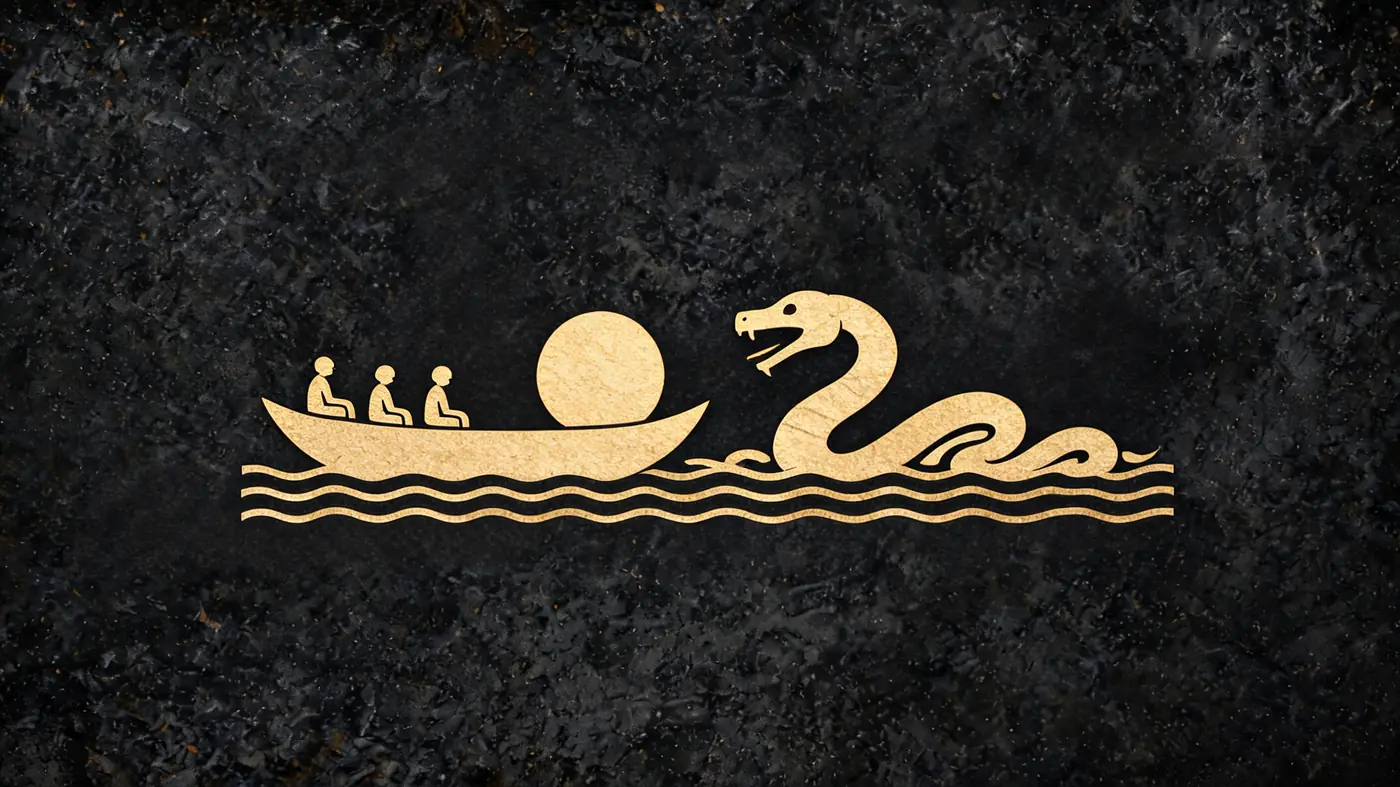
At sunset Ra stepped from his day boat, the Mandjet, onto his night boat, the Mesektet, and sailed into the underworld. Behind him the sky went dark. Ahead of him lay twelve hours, each with its own gate, its own guardians and its own dangers.
The kings of the New Kingdom had the route carved into their tombs. The text is called the Amduat — “That Which Is in the Duat” — and it reads like the map of a country the living were never meant to see. The river bends. The gates are named. The way through belongs only to those who know the words.
And the dead were waiting. As Ra’s light passes through each hour, the Amduat says, the sleepers wake — they cry out, they breathe, for as long as the light is among them. Then the boat moves on and the dark closes behind it. For the dead, his passing was the nearest thing to morning they would ever have.
THE CREW
He did not sail alone. In the boat stood the powers that make a crossing possible: Sia, perception, who sees the way. Hu, the spoken command that makes a thing so. Heka, magic, which holds the whole voyage together. In some texts a serpent called Mehen coils around Ra’s shrine to shield him.
Knowledge, command, magic, and a snake for armour. Egypt knew exactly what it took to cross a night.
THE ENEMY WITH NO TEMPLE
Egypt built temples for almost everyone. For crocodiles. For scorpions. For the god of chaos himself. It never built one for Apep.
Apep — the Greeks wrote Apophis — was a serpent of the dark, the opposite of Ma’at: the order the Egyptians held to be the shape of the world, the same order whose feather is weighed against the heart in the judgment of Anubis. Apep was not the god of anything. He ruled no region and no season. He was what would happen if the rest of it stopped: the end of the river, the end of the light, the end of the order that held the sky up.
He had no cult. He had no worshippers. He had only rites made to destroy him.
THE SEVENTH HOUR
Every night he rose. The texts place the worst of it in the seventh hour, where the serpent’s coils lie across the river itself and the water drains away beneath the boat, leaving Ra stranded in the dark.
Then the crew fights back. Isis and Serqet bind the serpent with their spells — Serqet with the same power over venom that makes her the guardian of Egypt’s tombs. And at the prow stands the one god who can hold Apep’s gaze without flinching: Seth, spear in hand, driving it home so the boat can move.
Chaos, aimed. Venom, commanded. Magic, spoken. The serpent is bound, the river runs, and the boat floats free.
THE FIGHT EGYPT JOINED
Here is what sets this myth apart from almost any other: the people were not spectators.
A text called the Book of Overthrowing Apep, preserved on a papyrus copied in the fourth century BC, gives the rite. The priest wrote Apep’s name in green ink, or modelled the serpent in wax, and then destroyed it piece by piece: he spat on it, trampled it with the left foot, cut it with a flint knife, and burned it in the fire — reciting, as he did, that the serpent was bound and broken.
He did it because the battle in the Duat was never finished by one night’s victory. It would be fought again tomorrow, and the temple’s work was part of the fight. The sunrise was not a gift. It was a shared labour — gods below, priests above.
THE CAT UNDER THE TREE
One tradition gives the battle a face. In the Book of the Dead, Ra himself becomes a great cat, fights beside the sacred tree at Heliopolis, and cuts off the serpent’s head.
The cat is the sun. The tree is the world. The blade is the day.
THE DAWN HE NEVER STOPPED EARNING
At the twelfth hour the boat reaches the horizon and Ra rises — not as the old sun but as Khepri, “he who comes into being,” the scarab pushing a fresh disc up into the sky. The serpent is cut, scattered, bound. The Egyptians knew precisely what happens next: he will be whole again by evening.
Apep was never killed. That is the most important line in the myth. Egypt did not tell a story where the monster dies and the world is safe. It told one where the monster returns — and so does the sun, and so does the fight.
WHAT RA AND APEP ACTUALLY MEAN
Most mythologies end their great battles. Egypt wrote one that does not.
Order, in this story, is not something the world has. It is something the world does — every night, in the dark, at a cost, against an enemy that does not tire. The sun is not a promise. It is a result.
There is a harder comfort in that than any ending could give. Because the fight does not stop, no single fight has to be the last. You do not have to win forever. You have to be at the prow when the serpent rises, spear in hand, until the light comes up.
Then again tomorrow.
THE NEOLITHIC CONNECTION
Four pieces in our Egypt Mythos collection stand inside this voyage. The Sigil of Contained Chaos carries Seth — the god posted at the prow of the sun boat, chaos turned on the one enemy that matters. What the Eye Became carries Sekhmet, the Eye of Ra, the cobra at the sun god’s brow. The Guardian of Venom carries Serqet, who bound the serpent in the seventh hour. And the Scarab — Pendant of Becoming holds Khepri, the form the sun takes when the night is over and the fight is won for one more day.
The night voyage is now a tee. The Seventh Hour carries the sun boat, the rearing serpent and the spear at the prow on the back, and a gold scarab on the chest.
Behind all of them stands the order the serpent comes to unmake — the feather in Lighter Than The Feather.
— Neolithic Store