
NÍÐHÖGGR — THE DRAGON THAT GNAWS AT THE ROOTS OF THE WORLD
Every mythology has a monster at the end of the world.
The Norse put theirs at the bottom of it.
Beneath the nine worlds, beneath the halls of the gods and the lands of men, beneath even the realm of the dead, something lies coiled in the dark among the roots of the World Tree — and it is chewing. It has always been chewing. It will still be chewing when everything above it is gone.
His name is Níðhöggr.
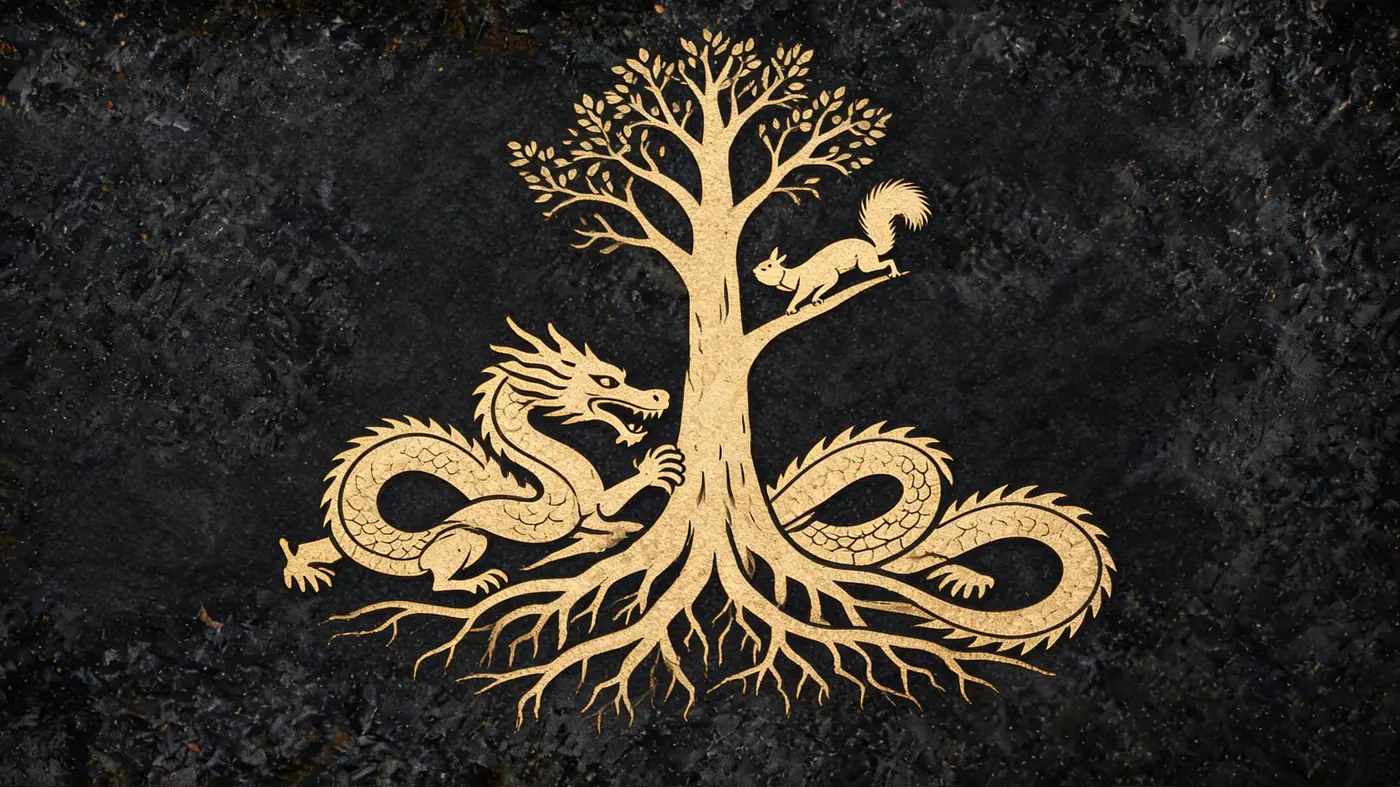
THE TREE THAT HOLDS EVERYTHING — AND WHAT FEEDS ON IT
To understand Níðhöggr, you have to understand what he is eating.
Yggdrasil, the great ash, is not a tree that grows in the Norse cosmos. It is the Norse cosmos. Its branches hold up the sky; its trunk passes through the world of men; its three vast roots reach into the wells of fate, wisdom, and the frozen dark. Gods hold their councils beneath it. The fates of all living things are carved at its base. If the tree stands, everything stands.
And at the deepest root — the one that reaches into Niflheim, the primordial world of ice and mist, above the roaring spring Hvergelmir from which all rivers rise — the Norse placed a dragon, gnawing at the foundation of existence itself.
Not attacking the gods. Not storming the walls of Asgard. Just patiently, endlessly, eating the thing that holds everything up.
Most cultures imagine their apocalypse as a war. The Norse imagined it as rot in the roots — slow, unseen, and already underway.
WHO NÍÐHÖGGR IS
His name is usually rendered as Malice Striker — the one who strikes with níð.
That word matters. In old Norse society, níð was not ordinary evil. It was disgrace beyond forgiveness — the state of a person who had broken the bonds that held the world of honour together. An oath-breaker. A murderer of kin. A betrayer. To be declared níðingr was to be cast out of humanity itself.
Níðhöggr is that outcast state given fangs. He appears in the oldest Norse poems — the Völuspá and Grímnismál of the Poetic Edda — as a dragon coiled in the dark beneath the third root of Yggdrasil, in the cold that existed before the world was made. Snorri Sturluson, writing the Prose Edda in the thirteenth century, places him among countless serpents in Hvergelmir — but Níðhöggr is the one the poets name, again and again, when they want to speak of the deep dark that never stops working against everything that stands.
He does not scheme like Loki. He does not rage like Fenrir. He simply endures, and consumes, and waits.
THE SHORE OF CORPSES
The tree’s root is not all he eats.
The Völuspá describes a hall on Náströnd — the Corpse Shore — far from the sun, its doors facing north. Its walls are woven from the spines of living serpents, and venom drips through the roof in rivers. Through that hall wade the worst of the dead: oath-breakers, murderers, betrayers — the níðingar, the ones who committed the crimes the North could not forgive.
And there, the poem says, Níðhöggr sucks the corpses of the dead.
This is the detail that separates him from every other dragon in the northern world. He is not a hoarder of gold like Fáfnir, not a coiled enemy waiting for a hero. He is a punisher. The worst of the dead are not merely exiled — they are fed to the thing at the bottom of the world. The dragon gnawing at existence is also the dragon devouring those who betrayed it.
The Norse did not waste their deepest monster on the innocent.
THE FEUD CARRIED BY A SQUIRREL
At the crown of Yggdrasil sits an eagle, wise and watching, with a hawk perched between its eyes. At the bottom coils Níðhöggr. Between them, running the whole height of the World Tree, is a squirrel named Ratatoskr — and his only job is to carry insults.
Up and down the trunk of the universe, endlessly, the squirrel ferries the eagle’s contempt to the dragon and the dragon’s malice to the eagle. The highest thing in creation and the lowest, locked in an eternal exchange of hatred they can never settle, because they will never meet.
It sounds almost comic. It isn’t. It is the Norse picture of the cosmos in miniature: the world above and the dark below, permanently opposed, permanently connected — and the tree bearing the strain of both. The Grímnismál says it plainly: the ash Yggdrasil suffers more hardship than men know. The stag bites above, the trunk rots at its side, and Níðhöggr tears from beneath.
Even the tree that holds everything is under siege. Especially the tree that holds everything.
THE DRAGON THAT OUTLIVES RAGNARÖK
Here is the part most people never hear.
At Ragnarök, everything ends. Odin is devoured by the wolf. Thor falls to the serpent’s venom. The sun is swallowed, the stars vanish, the earth sinks into the sea. The entire divine order — every god, every hall, every oath — burns.
Then the world rises again, green and washed clean. The Völuspá ends with a vision of renewal: fields growing without sowing, the surviving gods gathering in the new dawn, a hall roofed with gold.
And in the very last stanza of the poem — the final image of the greatest prophecy the North ever produced — a dark dragon comes flying from below, glittering, with corpses caught in his wings.
Níðhöggr survives.
The gods die. The world drowns and is reborn. And the thing from beneath the roots is still there, still flying, still carrying the dead. The Norse looked at their own vision of paradise regained and refused to pretend the dark was gone from it. Whatever rises, something will always be gnawing at its roots.
WHAT NÍÐHÖGGR ACTUALLY MEANS
Strip away the venom-halls and the corpse-strewn wings, and Níðhöggr is the North’s answer to a truth every civilization eventually learns: nothing stands unopposed. Not a tree, not a kingdom, not a life.
Decay is not a failure of the world. It is a resident of it — built into the foundations, older than the gods, patient beyond all endings. The Norse did not hide that force or promise its defeat. They gave it a name and a place at the deepest root, and then they went on living above it anyway — building, swearing oaths, raising halls — in full knowledge of what was working beneath.
That is not despair. That is the coldest kind of courage: to know the roots are being gnawed, and to stand tall regardless.
The dragon is always beneath.
The tree stands anyway.
THE NEOLITHIC CONNECTION
At Neolithic Store, Níðhöggr is the piece in our Norse Saga collection for those who know that what endures beneath is stronger than what shines above.
The Norse Níðhöggr tee carries the root-gnawer in ink and oxblood on Bone White — a claw at the chest, and across the back the dragon of the deepest dark, winged and crouched on the roots beneath the World Tree, the force that outlasted the gods themselves. It is not a design for those who need the light’s approval. Like the dragon it carries, it works in the dark, and it does not stop.
The gods fell at Ragnarök.
Níðhöggr kept flying. We put him on bone.
Available now at neolithicstore.com.
Forged from ancient bloodline. Worn by the modern warrior.
Neolithic Store is a premium mythology-inspired streetwear brand rooted in the stories that shaped human civilization. Every design begins with research, every piece carries a story, and every stitch is made for those who wear their beliefs on their skin.