
HECTOR — THE MAN WHO STOOD BETWEEN TROY AND THE END
Every war has a man who fights for a cause he did not choose and cannot walk away from. In the Iliad, that man is Hector — crown prince of Troy, its greatest warrior, and the one Trojan who never wanted this war at all.
His brother Paris started it by taking another man’s wife home to Troy. Hector inherited it. For nine years he held a city together with nothing but his own body between it and a thousand Greek ships — knowing, more clearly than almost anyone else in the poem, exactly how the story would end.
Achilles is Homer’s storm. Hector is the man who stands in front of his home and does not move.
THE SON WHO DID NOT START THE WAR
Hector was the eldest son of Priam, King of Troy, and Queen Hecuba — heir to the throne, and by the time the Iliad opens, the city’s last real line of defense. Priam had many sons, but it is Hector the Trojans look to when the fighting reaches the walls, not Paris, whose choice to take Helen from Sparta is the reason there is a war to fight in the first place.
Homer draws the contrast without ever needing to state it outright. Paris fights when he feels like it and hides in his bedroom when he doesn’t. Hector goes to the field every day the war demands it, whether he feels like it or not. He is, by every account in the poem, the better man carrying the worse brother’s mistake.
THE MAN AT HOME
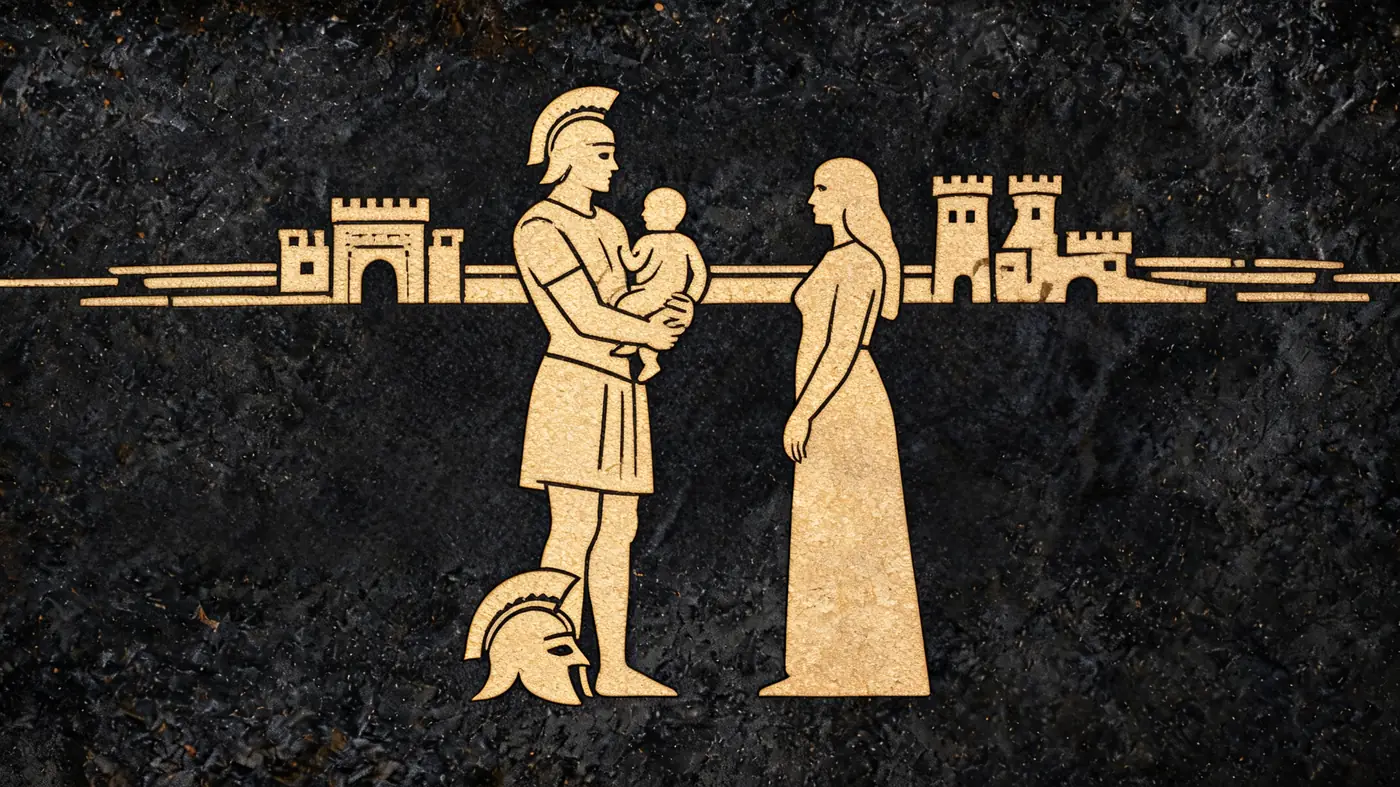
The Iliad‘s most quietly devastating scene belongs to Hector, not Achilles. Book Six finds him briefly off the battlefield, walking through Troy to find his wife Andromache and their infant son Astyanax. Andromache begs him to stay inside the walls — she has already lost her father and seven brothers to Achilles in earlier fighting, and Troy is all the family she has left. Hector cannot promise her that. He knows what a Trojan defeat means for a soldier’s wife and a king’s grandson, and he says so, plainly, without softening it.
He reaches for his son before he leaves, and the baby cries — frightened by the horsehair plume on his father’s helmet. Hector laughs, removes the helmet, holds his son, and prays aloud that Astyanax will grow up to be a better man than his father, not merely an equal one. Then he puts the helmet back on and returns to a war he privately believes Troy cannot win.
THE KILLING OF PATROCLUS
For most of the Iliad, Hector is winning. With Achilles sitting out the war over his quarrel with Agamemnon, Hector drives the Greeks back toward their own ships — his high-water mark as a soldier and as Troy’s defender. Then Patroclus enters the field wearing Achilles’ armor, and Hector, believing he is finally facing the man the prophecies feared, kills him.
It is, by the rules of the world the poem lives in, a fair kill in open combat. Hector even takes the armor as a soldier’s rightful prize. But Patroclus, dying, tells him plainly that this victory will cost him his life — that Achilles’ wrath is already on its way, and Hector’s death “stands hard by.” Hector’s own end is set the moment he wins his greatest fight.
THE LAST WALK AROUND THE WALLS
When Achilles returns to the field burning for revenge, the Trojan army retreats inside the city walls — all of it except Hector, who stays outside alone, despite his parents calling down to him from the walls, begging him to come in. He tells himself he will hold his ground. When Achilles actually appears, armored in gold by a god’s own hands, Hector’s nerve breaks and he runs — three full laps around the walls of Troy, the greatest soldier the city has, fleeing the one man he cannot beat.
Athena tricks him into stopping by disguising herself as his brother Deiphobus, standing at his side as if to help him fight. Hector turns to face Achilles believing he finally has support. He has none. He dies alone, asking only that his body be returned to his family for proper burial rites — a request Achilles refuses, in the poem’s cruellest moment, tying Hector’s corpse to his chariot and dragging it in the dust before the eyes of the walls he died defending.
A FATHER KNEELING IN THE ENEMY’S TENT
What redeems the poem’s ending is not a Trojan victory — Troy still falls, in the stories that come after this one — but an old man’s grief crossing a battlefield at night. King Priam sneaks alone into the Greek camp, kneels before Achilles, and kisses the hands that killed his son. He asks for Hector’s body back with the plain, unbearable authority of a father who has buried enough children already.
Achilles, still grieving Patroclus, sees his own father in Priam and finally relents. The Iliad ends not with a battle but with Hector’s funeral — nine days of mourning and a pyre built by the very city he could not save. Troy’s last honest words in the poem belong to the wife, mother, and sister-in-law standing over his body, each naming exactly what his death has cost them.
WHAT HECTOR MEANS
Hector has no god for a parent, no invulnerable heel, no prophecy naming him unstoppable. He is a man doing an impossible job — protecting people who cannot protect themselves, in a war he never chose — and he does it without the luxury of Achilles’ rage or Achilles’ glory. When he finally runs from Achilles, the poem does not despise him for it. It simply shows a mortal man facing the one thing mortal men cannot out-fight, and asks the reader to notice that this, too, is a kind of courage: showing up every day for a cause you privately believe is already lost.
Three thousand years later, Hector is still the answer to a question the Iliad never asks directly: what does it look like to be the better man on the losing side?
THE NEOLITHIC CONNECTION
Hector is the wall our Greek Legends collection keeps testing — the last thing standing between Troy and the fleet that Iphigenia’s sacrifice set in motion, and the man Achilles’ wrath was ultimately spent on.
The Last Wall carries him in print: Hector before the gate of Troy on the back, cloak torn, shield at his side, spear in hand, a slab of red behind him. His helm, the one he took off to hold his son, sits on the chest.
Troy falls after this story ends, and the men who caused its fall spend a decade trying to get home from it — the return carried in Enduring Will and The Long Return. Hector never gets that long journey. He only ever gets the one walk home, the one prayer over his son, and the one morning he does not come back from.
— Neolithic Store
[…] is that soldier — the one the whole war was arguably fought around. His fury finds its target in Hector, Troy’s own greatest […]