
ACHILLES — THE WRATH THAT SHAPED THE ILIAD
Before the Trojan War had a hero, it needed a name that could end it. The oracles were specific: Troy would not fall without Achilles. Not the largest army, not the cleverest strategist — one man, and the terrible speed of his anger.
He was the son of a sea-goddess and a mortal king, raised on a prophecy that gave him two lives to choose between and let him keep only one. He chose the short one. Everything the Greeks remember about him — the wrath, the grief, the god-forged shield, the body of his enemy dragged behind a chariot — happens inside the years he bought with that choice.
Homer did not write a biography of Achilles. He wrote nine days of his anger, and called it the Iliad.
THE SEA-GODDESS’S SON
Achilles was born to Peleus, king of the Myrmidons, and Thetis, a Nereid — one of the sea-nymph daughters of the old god Nereus. The gods themselves had once competed for Thetis, until a prophecy warned that her son would surpass his father. No Olympian wanted that son. She was married off to a mortal instead, and the wedding became the site of the story’s first true wound: the goddess Eris, uninvited, threw a golden apple marked “to the fairest” among the guests — the same apple that would eventually put Paris, Helen, and Troy on a collision course neither Achilles nor his mother had any part in starting.
Later tradition — not Homer, but the poets who came after him — gives Thetis a second, more famous act: dipping her infant son in the River Styx to make him invulnerable, holding him by the one heel the water never touched. Homer never mentions it. In the Iliad, Achilles bleeds, tires, and can be wounded like any other soldier at Troy. The unbreakable body is a later idea. The unbreakable will is the original one.
THE CHOICE AT SKYROS
Before the war, Thetis was told a second prophecy: her son could live a long, quiet life and die forgotten, or die young at Troy and be remembered as long as anyone told stories. She hid him on the island of Skyros, dressed as one of the king’s daughters, trying to keep fate from finding him.
Odysseus found him anyway. The trick is one of the oldest in Greek myth: a peddler’s tray of jewelry and fine cloth laid out among the women, a sword and shield hidden beneath — and when a war horn sounded outside, only one of the “daughters” reached for the weapon. Achilles was found not by his face but by his hand.
He went to Troy knowing, more clearly than anyone else in the army, exactly what it would cost him. That knowledge is what separates Achilles from every other warrior in the poem. The others hope to survive. He has already done the arithmetic and sailed anyway.
THE WRATH
The Iliad opens nine years into the siege, and not with a battle — with an insult. Agamemnon, forced to give up a war-prize of his own, seizes Briseis, a captive woman awarded to Achilles as his share of spoils. It is a small act by the standards of a war that has already lasted nearly a decade. Achilles’ response is not small at all.
He withdraws from the fighting entirely, and asks his goddess mother to make the Greeks pay for the insult by losing without him. Thetis appeals to Zeus. The tide of the war turns. Men who have nothing to do with the quarrel — Greek and Trojan alike — die in numbers because the war’s best soldier is sitting in his tent, refusing to lift a spear over a matter of pride. The Iliad‘s Greek title, mēnis, means precisely this: not ordinary anger, but a god-sized wrath with consequences that outscale its cause.
PATROCLUS AND THE PRICE OF RAGE
What finally moves Achilles is not the Greeks’ suffering. It is Patroclus — his closest companion since childhood — begging to be allowed to wear Achilles’ armor into battle, to frighten the Trojans into retreat while Achilles himself stays out of the fighting. Achilles agrees, with one condition: drive them back, and then stop. Patroclus does not stop. He is killed by Hector, prince of Troy, who strips the borrowed armor from his body.
What follows is the engine of the rest of the poem. Achilles’ grief is described as something closer to the sea itself — his mother’s element rising in him. Thetis brings him new armor forged by Hephaestus, god of the forge, its shield engraved with an entire world: cities at peace and cities at war, weddings, harvests, the stars. Achilles puts it on and returns to a battlefield he has refused for weeks, no longer fighting for pride or plunder, but for Patroclus alone.
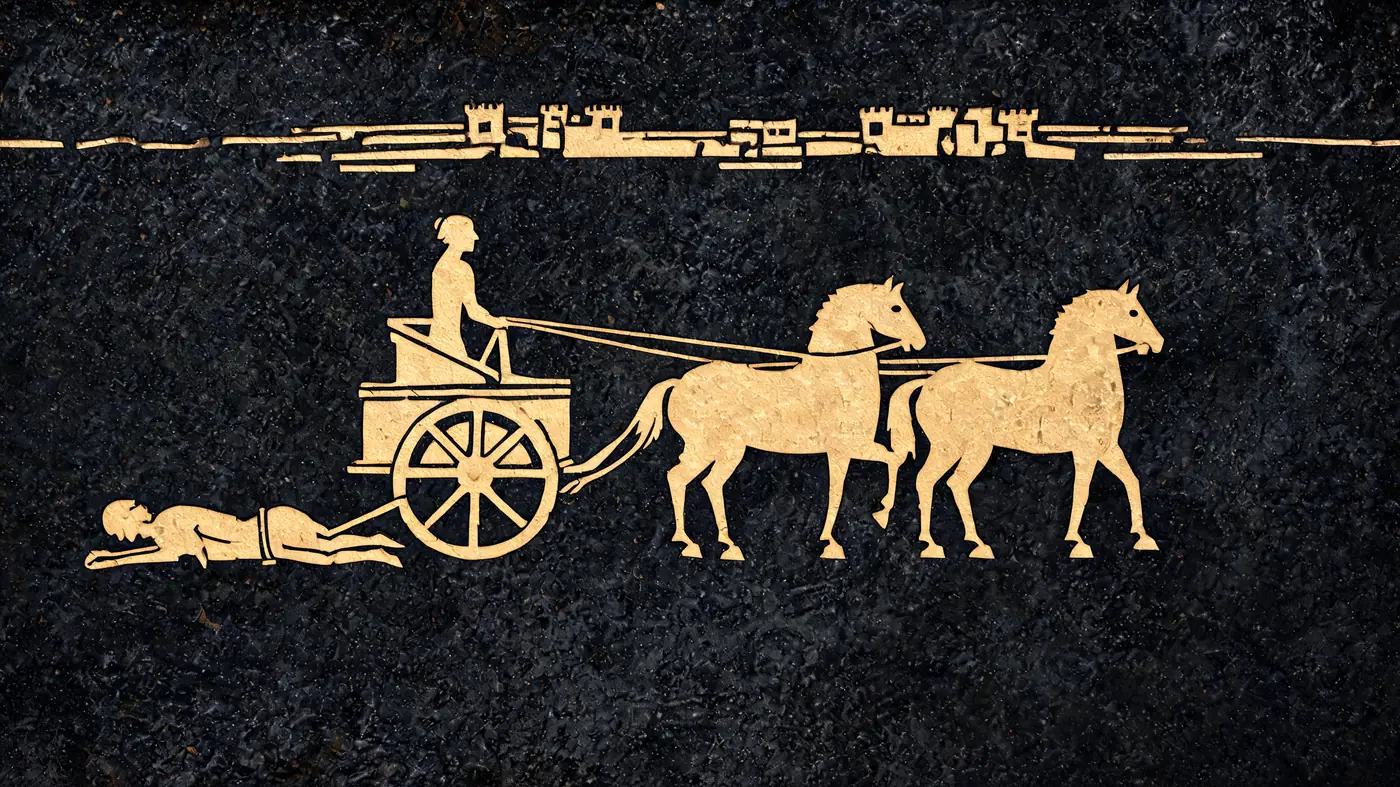
He kills Hector in single combat outside the walls of Troy, then ties the body to his chariot and drags it in the dust before the eyes of the dead man’s family, day after day. It is the single most brutal image in the poem — and Homer does not let Achilles off for it. The Iliad ends not with a Greek victory, but with Hector’s father, King Priam, sneaking into the Greek camp at night to kneel before the man who killed his son and beg for the body back. Achilles, still grieving Patroclus, looks at an old man’s grief and recognizes his own. He returns Hector’s body. The poem closes with a funeral, not a triumph.
THE HEEL THAT HOMER NEVER MENTIONED
Achilles does not die in the Iliad — the poem ends before Troy falls. His death belongs to later epics and later poets: struck by an arrow from Paris, guided, in most versions, by the god Apollo, to the one unprotected point on his body. Whether that point was ever literally a heel dipped in the Styx or simply “wherever the story needed him to be vulnerable,” the image outlived the details. It gave the language a word for the single flaw that undoes an otherwise unstoppable strength — a phrase people still reach for, in contexts that have nothing to do with Troy, without always knowing whose story they borrowed it from.
WHAT ACHILLES MEANS
Achilles is not a hero in the modern sense of the word. He is closer to a warning wearing a hero’s armor: what happens when the fastest, strongest, most gifted person in the room decides the rules do not apply to his grief. His wrath kills his own allies before it kills a single Trojan. His revenge on Hector is, by the poem’s own telling, a violation of everything an ancient Greek understood about honoring the dead — and it takes an enemy king kneeling in front of him to remind him of it.
And yet he chose this. Offered a long, comfortable, unremembered life, he chose a short one that would be spoken of for three thousand years. He got exactly what he asked for. Whether that is a triumph or the oldest tragedy in Western literature depends on which line of the Iliad you’re standing closest to when you ask.
THE NEOLITHIC CONNECTION
Achilles is the reason the war our Greek Legends collection keeps returning to was ever winnable. The fleet that Iphigenia’s sacrifice finally set moving toward Troy needed a soldier the oracles said the city could not survive. He is that soldier — the one the whole war was arguably fought around. His fury finds its target in Hector, Troy’s own greatest defender.
And when Troy finally fell, it was other men who had to find their way home from it — the decade-long return carried in Enduring Will and The Long Return. Achilles never made that journey. He chose the short, remembered life over the long, quiet one — and the war he shaped outlived him by ten more years before it was even finished being fought over.
His own piece is He Chose the Short Life.: Achilles on the back in a crested helm, spear flung wide, shield on his arm and a torn red cloak behind him, drawn in white against the dark with one gold streak for the spear. On the chest, the helm alone.
— Neolithic Store
[…] standing between Troy and the fleet that Iphigenia’s sacrifice set in motion, and the man Achilles’ wrath was ultimately spent […]