AH PUCH — THE LORD OF MITNAL, WHERE THE DESCENT ENDS
Ah Puch, the Maya god of death, ruled Mitnal — the deepest level of the underworld. His owl messenger, his bells, and why the Maya crowned decay itself as a lord.
Every house of Xibalba had a master. The bats had Camazotz. The trials had their lords — cold, fire, blades, darkness. But beneath all of them, at the bottom of everything, the Maya placed one figure that even the underworld answered to.
His name is Ah Puch. Lord of Mitnal, the deepest level of the world below. The god not of dying — but of death itself.
Most death gods are executioners. Ah Puch is something quieter and far more patient. He does not chase. He does not hunt. He waits — because everything, eventually, comes down to him.
THE FACE IN THE CODICES
Open the surviving Maya codices — the handful of bark-paper books the Spanish fires missed — and he is impossible to miss. Scholars, not knowing his full name at first, simply catalogued him as God A. The first of the list. Death filed before everything else.
The Maya drew him honestly, and their honesty is brutal. A skeletal figure, but not a clean skeleton — his body carries the marks of a corpse in progress, the bloat and the black spots of decomposition, because the Maya refused to pretend death was instant. He wears the regalia of a lord: ceremonial collars, ornaments, and — his most chilling signature — bells. Copper and shell bells fastened in his hair, at his wrists, at his ankles. In the silence of Mitnal, you would hear Ah Puch before you ever saw him.
The Yucatec Maya knew him by other names too — Yum Kimil, “Lord of Death,” or simply Kisin, “the flatulent one,” the smell of decay made into a name. They did not flatter him. They also never pretended he wasn’t a king.
MITNAL — THE FLOOR OF THE UNIVERSE
The Maya underworld was not one place. In the K’iche’ tradition of the Popol Vuh it is Xibalba, the place of fear — a kingdom of trials and death lords sitting directly beneath the living world. The Yucatec Maya, further north, spoke of Mitnal: the lowest of the underworld’s nine levels, the place where the descent finally stops.
That is Ah Puch’s kingdom. Not the trial houses, not the ballcourt, not the roads where lords played their tricks — the floor. The other lords of the underworld governed specific ordeals. Ah Puch governed the thing every ordeal eventually leads to: the end that does not negotiate.
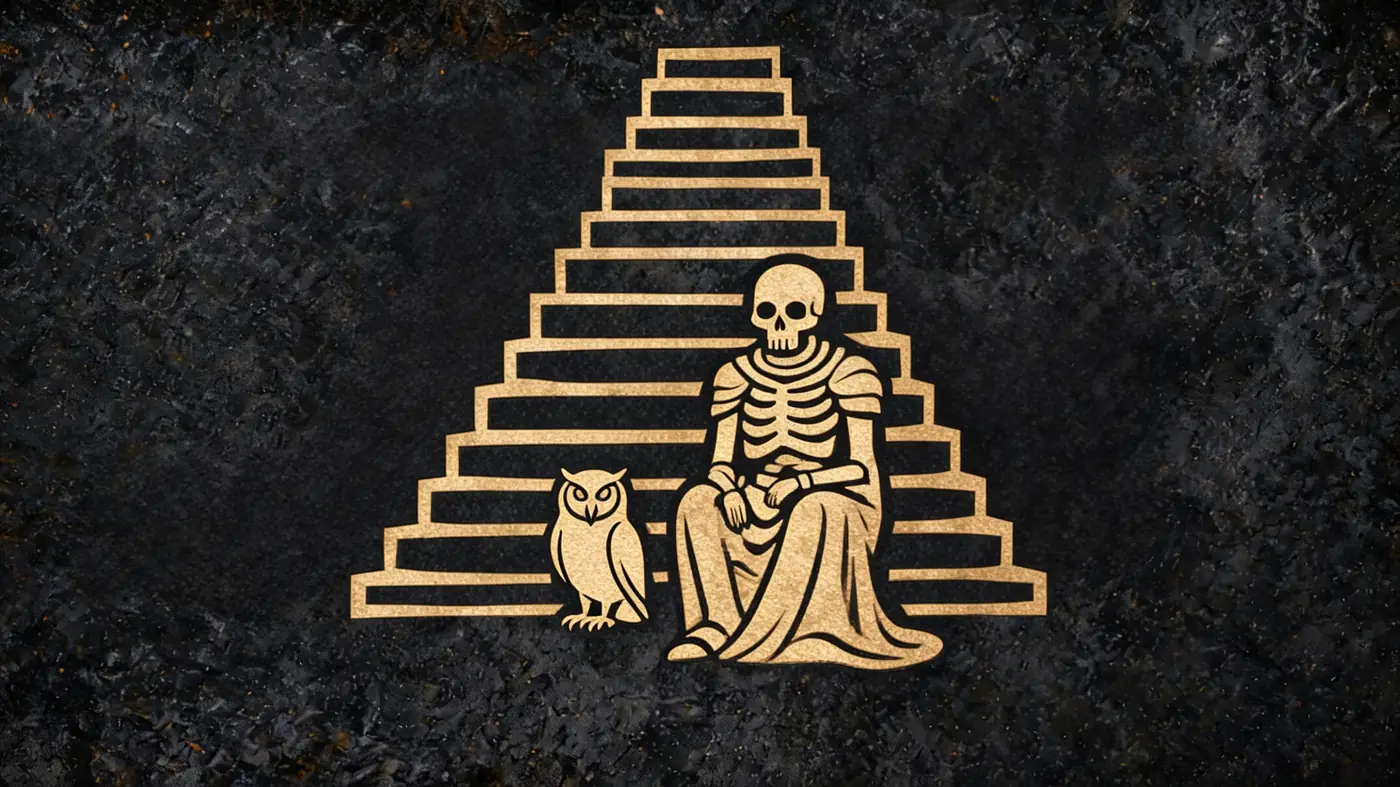
In a cosmology built as thirteen heavens above and nine underworlds below, Mitnal is the last rung of the ladder. The Maya built their pyramids upward in defiance of it — but they never doubted where the ladder ended.
THE OWL THAT DOES NOT HUNT
Ah Puch did not travel alone. His messenger was the owl — the muan bird of the underworld, the same messenger the lords of Xibalba sent to summon the Hero Twins’ father down to his death.
Across the Maya world, and across Mesoamerica long after, the owl’s night call was read as a summons: Ah Puch had taken notice of a house. The belief outlived the temples and the codices and survives in a proverb still spoken in Mexico and Central America today — cuando el tecolote canta, el indio muere. When the owl cries, someone dies.
Notice what the owl does not do. It does not attack. It does not pursue. It perches, it watches, and it waits — the perfect emissary for a god whose power has never once needed to hurry.
DEATH AS A PROCESS, NOT A MOMENT
Here is what separates Ah Puch from nearly every other death god in world mythology.
The Greek Hades rules a destination. The Norse Hel keeps a hall. Ah Puch embodies a process — decay, decomposition, the slow return of the body to the earth that grew it. That is why the Maya drew him mid-rot rather than as polished bone. In a civilization built on maize, decomposition was not only horror; it was agriculture. The kernel goes into the dark, breaks down, and something green comes back. Every Maya farmer enacted that cycle every planting season, and the Popol Vuh built its greatest story on it — the Hero Twins’ father, buried in the underworld, becoming the maize that feeds the world.
Ah Puch rules the dark half of that cycle. He is not its enemy. He is its engine.
NOT THE VILLAIN
It would be easy to cast Ah Puch as the monster of Maya mythology. The Maya themselves never did.
They gave him a title, a kingdom, and the carved ceremonial markings of a lord — the same regalia they gave their kings and their gods. They feared him the way you fear gravity: not as malice, but as law. The lords of Xibalba could be tricked, outplayed, and humiliated — the Hero Twins proved it. But nowhere in the mythology does anyone outwit decay itself. The trials have loopholes. The floor does not.
He is not the villain of the story. He is the inevitability every story eventually arrives at — and the Maya, clear-eyed as ever, decided the honest response was not denial. It was respect.
THE NEOLITHIC CONNECTION
Ah Puch rules the deepest chapter of The Underworld Series — our ongoing exploration of Maya mythology within the Mayan Legacy collection, one design at a time.
The Ah Puch — Lord of Mitnal tee does not soften him. The owl grips the carved cranium of its master, wings spread, waiting the way it has always waited. The geometric carvings across the skull are the markings of a lord, drawn from the ceremonial detail the Maya gave their kings. The fire in the empty sockets is not Hollywood horror — it is the heat of the passage every soul makes through Mitnal. The series he rules runs deeper still: the Hand of Xibalba, Camazotz — Wings of Xibalba, and Xbalanque — The Jaguar, the one who went down and came back.
The owl is patient.
So is the lord it serves.
Available now at neolithicstore.com.
Forged from ancient bloodline. Worn by the modern warrior.
Neolithic Store is a premium mythology-inspired streetwear brand rooted in the stories that shaped human civilization. Every design begins with research, every piece carries a story, and every stitch is made for those who wear their beliefs on their skin.
[…] Norse tradition has Hel, the queen who keeps the dead. The Maya go down through Xibalba, where Ah Puch waits at the bottom. In Egypt the heart is weighed in the judgment of Anubis. Each one asks what a […]