EYE OF HORUS — THE EYE THAT WAS TORN APART AND MADE WHOLE
Five thousand years after it was first drawn, the Eye of Horus is still watching.
It looks out from museum cases and tattoo sleeves, from pendants and temple walls, from the sterns of fishing boats in the Mediterranean where sailors still paint it without quite remembering why. It is one of the oldest symbols human beings have never stopped wearing.
Most people know it means protection.
Almost nobody knows that it means something far stranger — that the most famous eye in history is famous precisely because it was torn to pieces.
THE WAR THAT COST HORUS HIS EYE
The story begins with a murder.
Osiris, the good king of Egypt, was killed by his brother Set — god of storms, deserts, and chaos. Set sealed him in a coffin, cut his body into pieces, and scattered them across the land. Isis, wife of Osiris, gathered the pieces and, through great magic, conceived a son: Horus, the falcon god.
Horus was born for one purpose. To take back what Set had stolen.
The war between Horus and Set lasted, by some accounts, eighty years. It was fought in courtrooms before the assembled gods and on battlefields across Egypt — a war of trials, tricks, transformations, and open violence between order and chaos for the throne of the world.
And in the most brutal of those battles, Set did to the son what he had done to the father.
He tore out Horus’s left eye — and ripped it to pieces.
In some tellings the eye was torn into six parts. In others it was shattered and flung across Egypt the way Osiris’s body had been. The symmetry is deliberate. Set’s signature move is fragmentation. He takes what is whole and scatters it, because a thing in pieces has no power.
The Egyptians disagreed.
WEDJAT — THE ONE MADE WHOLE
What happened next is the entire meaning of the symbol.
Thoth — god of wisdom, writing, and the moon — gathered the scattered pieces of the eye. Piece by piece, with knowledge and magic, he reassembled it. He healed it. He filled in what was missing and made it complete again.
The Egyptians called the restored eye the wedjat.
The word means the whole one. The sound one. The one made healthy again.
Read that carefully, because it changes what the symbol is. The Eye of Horus is not the eye of a god who was never hurt. It is the eye of a god who was maimed in battle — and made whole afterwards. The Egyptians did not choose an unbroken thing as their greatest emblem of protection. They chose a healed one.
Indeed, in Egyptian thought the wedjat became the model for every act of healing and every act of repair. To make something whole — a body, a temple, an offering, the land of Egypt itself — was to “fill the eye.” Restoration was not a metaphor borrowed from the myth. The myth was the original act that all restoration repeated.
THE EYE THAT RAISED THE DEAD
Horus did not keep his healed eye.
He gave it away.
In one of the most quietly devastating moments in Egyptian mythology, Horus travelled to the underworld and offered the restored eye — the most precious thing he possessed, the thing that had cost him a war — to his dead father. Osiris consumed it, and the power of the whole and healed eye awakened him into his existence beyond death, as lord of the afterlife.
The son’s sacrifice brought the father back.
This is why, for the rest of Egyptian history, every offering laid on every altar could be called “the Eye of Horus.” Bread, beer, incense, oil — the offering lists of the temples name them all as the eye. To give anything, in Egypt, was to re-enact the moment Horus gave what he had bled for to someone he loved.
THE MATHEMATICS HIDDEN IN THE EYE
Then there is the strangest layer of all.
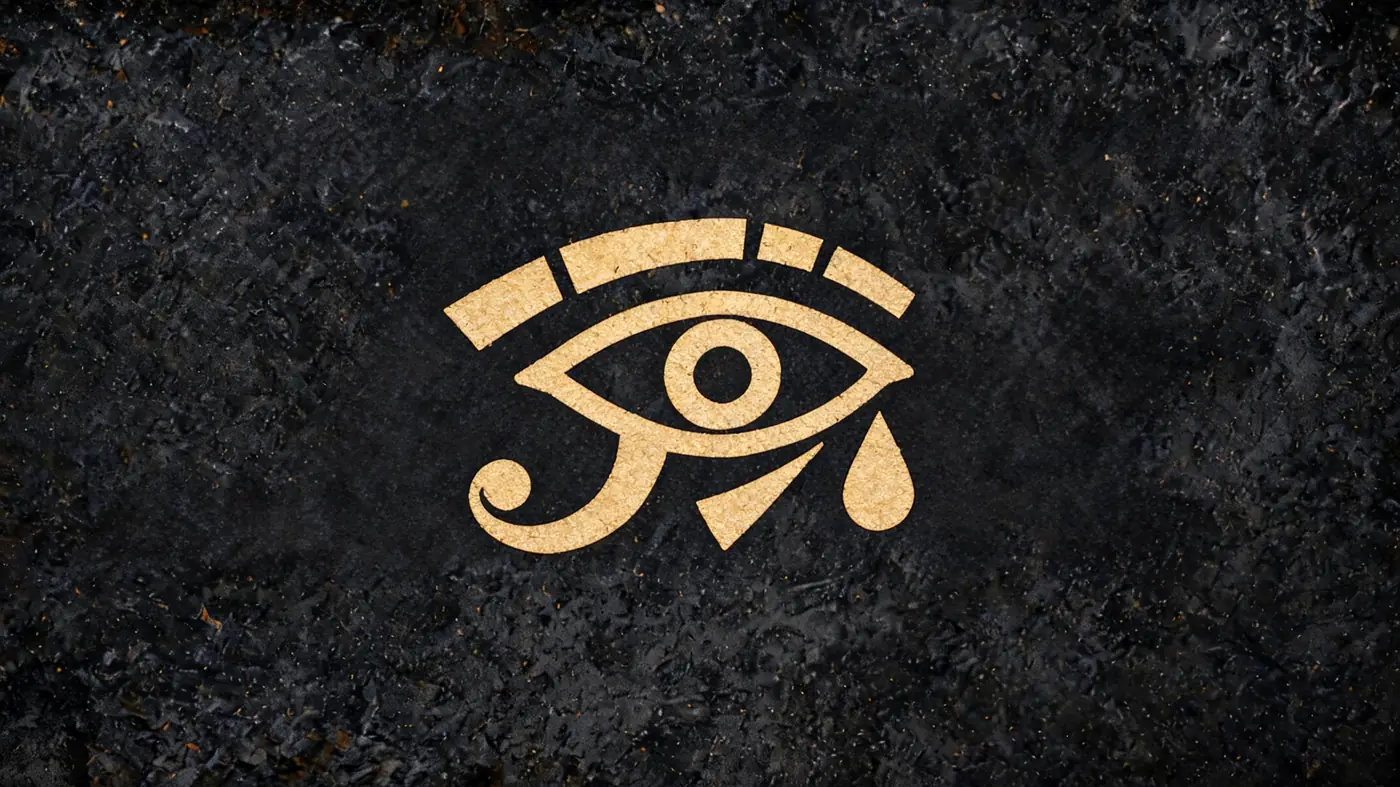
The Eye of Horus is drawn in six strokes: the eyebrow, the pupil, the two halves of the white, the curling spiral below, and the straight teardrop line. A long scholarly tradition holds that Egyptian scribes used these six parts as fractions for measuring grain — the eyebrow 1/8, the pupil 1/4, the halves 1/2 and 1/16, the spiral 1/32, the teardrop 1/64.
Add the six fractions together and you get 63/64.
Not one. Almost one. One sixty-fourth short of whole.
The missing piece, the tradition says, was supplied by Thoth himself — filled in by magic, because no matter how carefully the pieces of a broken thing are gathered, the final fraction of wholeness is never material. Later symbolic readings went further and assigned each part to a sense: smell, sight, thought, hearing, taste, touch — the eye as a diagram of everything through which a human being perceives the world.
Modern Egyptologists debate how much of this the scribes truly intended. But the idea has endured for a reason. A symbol of healing that is mathematically incomplete — and completed only by something beyond mathematics — is exactly the kind of thing Egypt would design.
EYE OF HORUS VS EYE OF RA — KNOW THE DIFFERENCE
Egypt had two great eyes, and they are not the same.
The Eye of Horus is the left eye, and it belongs to the moon. Its monthly wounding and healing is written in the sky — the moon waning as the eye is torn apart, waxing as Thoth restores it, whole again at every full moon. It is the eye of protection, healing, and restoration.
The Eye of Ra is the right eye, and it belongs to the sun. It is not gentle. The Eye of Ra is the sun god’s wrath made independent — a goddess of fire sent out to burn the enemies of order. It protects by destroying.
Two eyes. One heals what chaos breaks. The other incinerates chaos before it can break anything. Egypt saw no contradiction in needing both.
HOW EGYPT WORE THE EYE
The wedjat was the most popular amulet in ancient Egypt — by the numbers, possibly the most-worn symbol of the ancient world.
It was moulded in faience and carved in carnelian, lapis lazuli, and gold. The living wore it against injury and the evil eye. The dead wore it more: wedjat amulets were laid directly on mummies, often over the embalming incision — placed, quite literally, over a wound, so that what was opened would be made whole in the next world. Tutankhamun was buried with the eye upon him.
Sailors painted the eyes on the prows of boats so the vessel could see its way through danger — a practice that outlived Egypt itself and still survives around the Mediterranean. Physicians wrote it: some historians trace the pharmacist’s Rx sign back through the wedjat, the mark of Thoth’s healing at the head of every prescription. The claim is debated. The instinct behind it is not — for three thousand years, if an Egyptian wanted to say healed, protected, complete, they drew this eye.
WHAT THE EYE ACTUALLY MEANS
Strip away five millennia of use and the Eye of Horus says one thing.
Broken is not the end of the story.
The eye was torn out and torn apart by chaos itself — and it was gathered, healed, and made so whole that its very name became the Egyptian word for wholeness. It was then given away, and the gift was powerful enough to wake the dead. It protects not because it was never wounded, but because it knows exactly what wounding is and came back from it.
That is why it never stopped being worn. Every civilization produces symbols of power. Very few produce a symbol of recovery — and none produced one that lasted like this.
THE NEOLITHIC CONNECTION
At Neolithic Store, the Eye of Horus is not decoration. It is the founding argument of our Egypt Mythos collection — that a symbol which carried meaning for five thousand years does not need reinventing. It needs to be carried further.
The Eye of Horus oversized tee renders the wedjat with the falcon’s wing over it and the wound still running red — for the person who wants the oldest mark of protection worn the modern way. The Watching Eye pendant puts it where the Egyptians themselves put it: at the body, close, the way an amulet was always meant to be worn.
The eye was torn apart.
It watches still.
Available now at neolithicstore.com.
Forged from ancient bloodline. Worn by the modern warrior.
Neolithic Store is a premium mythology-inspired streetwear brand rooted in the stories that shaped human civilization. Every design begins with research, every piece carries a story, and every stitch is made for those who wear their beliefs on their skin.