KARNA — THE SON OF THE SUN WHO REFUSED TO FIRE TWICE

Every warrior in the Mahabharata is fighting for something. Karna is fighting against everything he was never given.
He is the firstborn of the Pandavas, and he dies on the other side of the war, a king without a birthright. He is also the warrior who, with an arrow in his hand and his enemy at his mercy, refused to fire twice.
THE SON NO ONE CLAIMED
Karna is the son of Kunti and the sun god Surya. Kunti bore him before her marriage, and in fear of the world’s judgement she set the infant in a basket on the river. A charioteer named Adhiratha and his wife Radha found the child and raised him. That is why Karna is also called Radheya, the son of Radha.
He was born with a golden armour fused to his skin, the kavacha, and golden earrings, the kundala. He grew up as a charioteer’s son in a world that ranked people by birth, and he became the finest archer of his age. When he stood in the arena beside Arjuna, he was refused a duel because of his parentage. Duryodhana made him king of Anga on the spot. Karna was loyal to him from that day, to the end.
THE GIFT HE GAVE AWAY
The god Indra, who wanted his son Arjuna to win, came to Karna disguised as a Brahmin and asked for his armour and earrings. Karna knew who was asking. He cut the armour from his own body and gave it away, because a man who has been asked for charity does not refuse. Indra gave him a single weapon in return, the Vasavi Shakti, which could be used once.
This is the Karna the epic remembers: a man who could be generous to a fault and who gave up his protection because he had been asked.
THE ARROW OF THE SERPENT
On the seventeenth day of the war at Kurukshetra, Karna took up the weapon called the Nagastra, the serpent arrow. A serpent named Ashwasena, a son of Takshaka, had entered the arrow. He wanted revenge on Arjuna, who had burned the Khandava forest and killed his mother.
Karna drew the bow and aimed at Arjuna’s head. His charioteer that day, Shalya, told him to aim lower, at the chest. Karna refused: he had aimed at that mark and would not change it. At the last moment, Krishna, who was driving Arjuna’s chariot, pressed it down into the earth with his foot. The arrow missed Arjuna’s head and struck the crown, knocking it to the ground.
The serpent came back to Karna and asked to be fired a second time. Karna said no. He had shot the arrow once, and he would not use the same weapon twice in the same war, even to win it. The serpent left him and was killed.
THE WHEEL
Later that day, the earth took Karna’s chariot. Its wheel sank into the ground and would not come free. The epic gives several reasons: a Brahmin’s curse for a cow Karna had killed by accident, and his teacher Parashurama’s curse, that he would forget his most powerful weapon when he needed it most. In some tellings the Earth herself is part of it.
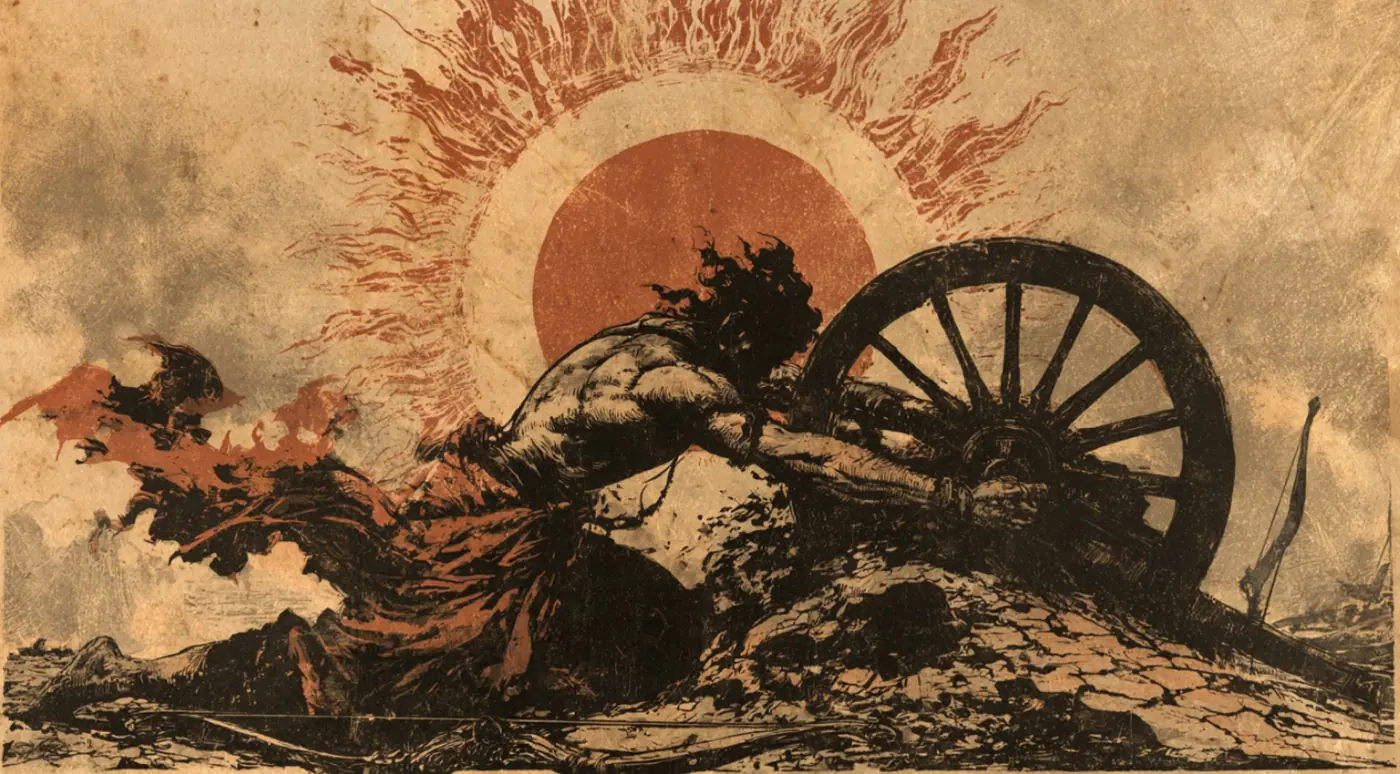
Karna climbed down and tried to lift the wheel with his hands. He asked Arjuna to wait, appealing to the rule that an unarmed man must not be attacked. Krishna answered him: where had that rule been when Draupadi was dragged into the assembly, and when Abhimanyu was surrounded and killed? Karna was silent. Arjuna fired, and Karna died with his hands on the wheel.
WHAT THE DESIGN CARRIES
The back is the Nagastra moment: Karna in profile and at full draw, a muscular figure in cream and antique gold on black, with the ornate bow held at arm’s length and a gold cobra coiled around the arrow on the string. His face is set and his eyes are on the target.
The front is the wheel. A chariot wheel, carved and gilded, half-sunk into cracked earth, with flame-like sun rays fanning out behind it and thin red cracks running through the ground below. The sun is his father, and the earth is what took him.
WHY HE STILL MATTERS
Karna loses the war and wins the argument about it. Every reader of the Mahabharata eventually finds that the man they admire most is the one on the wrong side. He kept every promise he made, even the ones that cost him the war: he spared four of Kunti’s sons because he had promised her, and he would not shoot twice because he had decided he would not.
THE NEOLITHIC CONNECTION
Karna belongs to our Vedic Legends collection, beside another archer who fires only once: Rudra, in Three Cities. One Arrow. The god who ends an age is told in Kalki and The Horse Comes First, and the bird who fell defending a woman in Jatayu. More stories are in our Hindu mythology guide.
— Neolithic Store