LOKI — THE GOD WITH NO TRUE FACE

Every mythology has a liar. The Norse made theirs a god, gave him a seat at the table of the Æsir, and let him eat beside the men he would eventually bury.
Loki is not the enemy at the gate. He is the one already inside — blood-brother to Odin, useful, clever, entertaining, and the direct cause of the end of the world.
The strangest thing about him is not what he did. It is that nobody can say what he looked like when he did it.
THE GIANT AT THE GODS’ TABLE
Loki was not born Æsir. His father was Fárbauti, a giant — one of the jötnar, the race the gods spent their entire existence fighting. His mother was Laufey. By blood he belonged to the other side.
He lived among the gods anyway, because Odin had sworn brotherhood with him. In the Lokasenna, when the hall turns on him, Loki reminds Odin of exactly that: they mixed blood, and Odin swore never to drink unless Loki drank too. The All-Father, who traded an eye for foresight, bound himself to the one creature in the nine worlds who could not be predicted.
The arrangement worked the way such arrangements always work. Loki created the disaster. Loki solved the disaster. The gods kept him because the solving was worth the creating — right up until the day it wasn’t.
THE SHAPES HE WORE
Most gods have one body. Loki has a list.
He became a mare to lure away the stallion Svaðilfari, and stayed a mare long enough to give birth to Sleipnir — the eight-legged horse Odin would ride for the rest of the age. He became a salmon to hide in the waters of Fránangr. He became a fly to crawl into a forge and ruin the dwarfs’ work, and a fly again to sting Freyja in her sleep and take the necklace from her throat. He borrowed her falcon cloak to cross into Jötunheim. He fought Heimdall as a seal. And when the whole world was weeping to bring Baldr back from the dead, he became an old giantess called Þökk, sat down in a cave, and refused to cry.
A man when it suited him. A woman when a woman could do what a man could not. An animal, an insect, a fish, a stranger.
There is no passage anywhere in the Norse corpus that tells you what Loki actually looks like when he is not pretending. The sources describe what he wore, never what he was.
FATHER OF MONSTERS, MOTHER OF A HORSE
With the giantess Angrboða he fathered three children, and each one became a thing the gods could not undo.
Fenrir, the wolf they had to bind because they could not beat him. Jörmungandr, the serpent thrown into the sea, who grew until he circled the world and bit his own tail. And Hel, given the realm of the dead to rule, half living woman and half corpse — a daughter who is two things at once, exactly like her father.
And then Sleipnir, whom Loki did not father but bore. The same god is the father of the wolf that eats Odin and the mother of the horse Odin rides. Norse mythology never asks you to reconcile this. It simply reports it.
THE DEATH THAT ENDED THE JOKE
Baldr, the bright one, dreamed of his own death. His mother Frigg went through the entire world and took an oath from every living and unliving thing — fire, water, iron, stone, sickness, beasts, poison — that none would harm her son.
She skipped the mistletoe. It was too young to swear.
The gods made a game of Baldr’s invulnerability, throwing weapons at him and laughing as everything refused to bite. Loki found out what Frigg had missed. He put a shaft of mistletoe into the hands of Höðr, Baldr’s blind brother, and guided the aim.
Hel agreed to release Baldr on one condition: that every single thing in creation weep for him. Everything did. Gods, giants, animals, stones, trees, metals — all of it wept.
Except one giantess in a cave, who said she had no use for Baldr and would let Hel keep what she held.
Everyone knew who she was. That was the end of the tolerance.
THE BINDING AND THE BOWL
He ran. He built a house with four doors so he could see in every direction, and by day he became a salmon and hid in the waterfall. The gods came with a net — woven to the design Loki himself had invented and thrown in the fire, reconstructed from the ash.
Thor caught him by the tail as he leapt. The sources say that is why the salmon is narrow at the back to this day.
What followed is the cruellest sentence in Norse myth. They took his sons. Váli was turned into a wolf and tore his brother Narfi apart, and with Narfi’s entrails the gods bound Loki across three stones. Skaði fixed a serpent above his face so its venom would fall into his eyes.
And there the story turns, unexpectedly, to his wife.
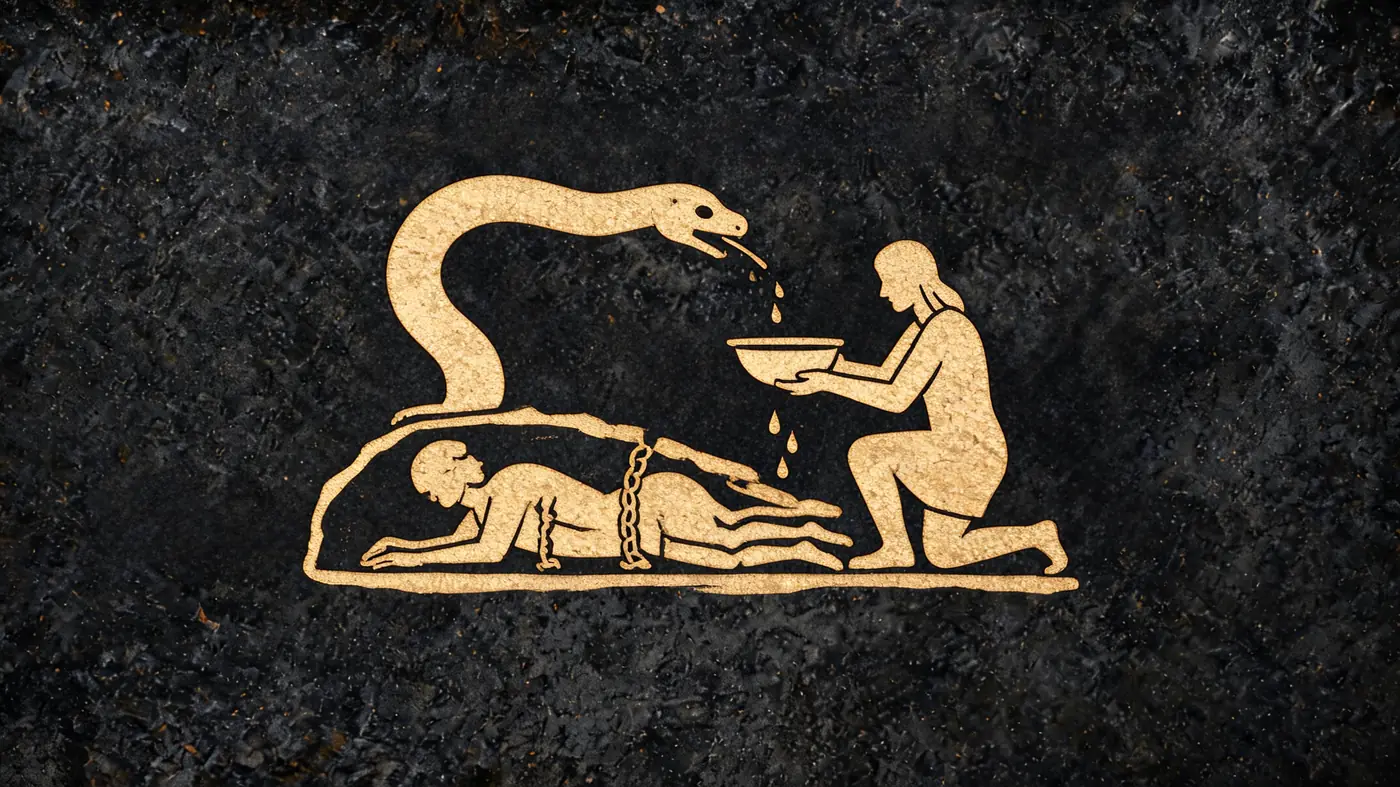
Sigyn stayed. She sits beside him holding a bowl above his face to catch the venom before it lands. When the bowl fills she has to turn away and empty it, and in those seconds the poison strikes him and he convulses so violently that the whole earth shakes. The Norse explained earthquakes this way: a wife emptying a bowl.
She has been doing it since before the world had people in it. She will do it until Ragnarök, when the bindings break, Loki takes the helm of Naglfar — the ship built from the untrimmed nails of the dead — and sails against the gods who held him down. He and Heimdall find each other in that last battle. Neither survives it.
WHY HE HAS NO FACE
Every other god in the Norse world can be identified by a thing. Thor has the hammer. Odin has the missing eye and the ravens. Heimdall has the horn. Týr has the hand the wolf took.
Loki has nothing fixed, because there is nothing fixed to have. His emblem would have to be the act of changing itself.
That is the problem every artist runs into with him, and it is not a problem to be solved. It is the character. The only honest way to show Loki is to show him in the middle of stopping being one thing and not yet being the next — because the moment you think you have him held still is precisely the moment he isn’t there.
THE NEOLITHIC CONNECTION
At Neolithic Store, Loki is the one face we show you in the Norse Saga collection — and showing it is the trick.
The Face That Isn’t carries a face split down its length at the chest, one half flesh and one half a slab of oxblood, the mark of something wearing a shape. The back carries what the split is hiding: a face set into a tower of stacked stone, breaking apart where it stands. Above it, venom falls toward two hands holding the bowl — Sigyn’s hands, still holding, centuries in.
Ink, bone and oxblood on Bone White. Nothing about it resolves, because he never did.
The one time you think you have caught Loki looking back — he is already becoming something else.
Available now at neolithicstore.com.
Forged from ancient bloodline. Worn by the modern warrior.
Neolithic Store is a premium mythology-inspired streetwear brand rooted in the stories that shaped human civilization. Every design begins with research, every piece carries a story, and every stitch is made for those who wear their beliefs on their skin.