THE MEDUSA SIGIL — THE FACE THAT GUARDED THE ANCIENT WORLD
Before Medusa was a myth, her face was the ancient world's most trusted mark of protection. The story of the gorgoneion — the sigil on shields, temples, and the aegis of Athena.
Long before Medusa had a story, she had a face.
It stared out from the shields of hoplites and the chests of goddesses, from temple pediments and city gates, from coins, ovens, doorways, and the armour of the man who conquered the known world. The Greeks put it everywhere they were vulnerable — and they did it for close to a thousand years.
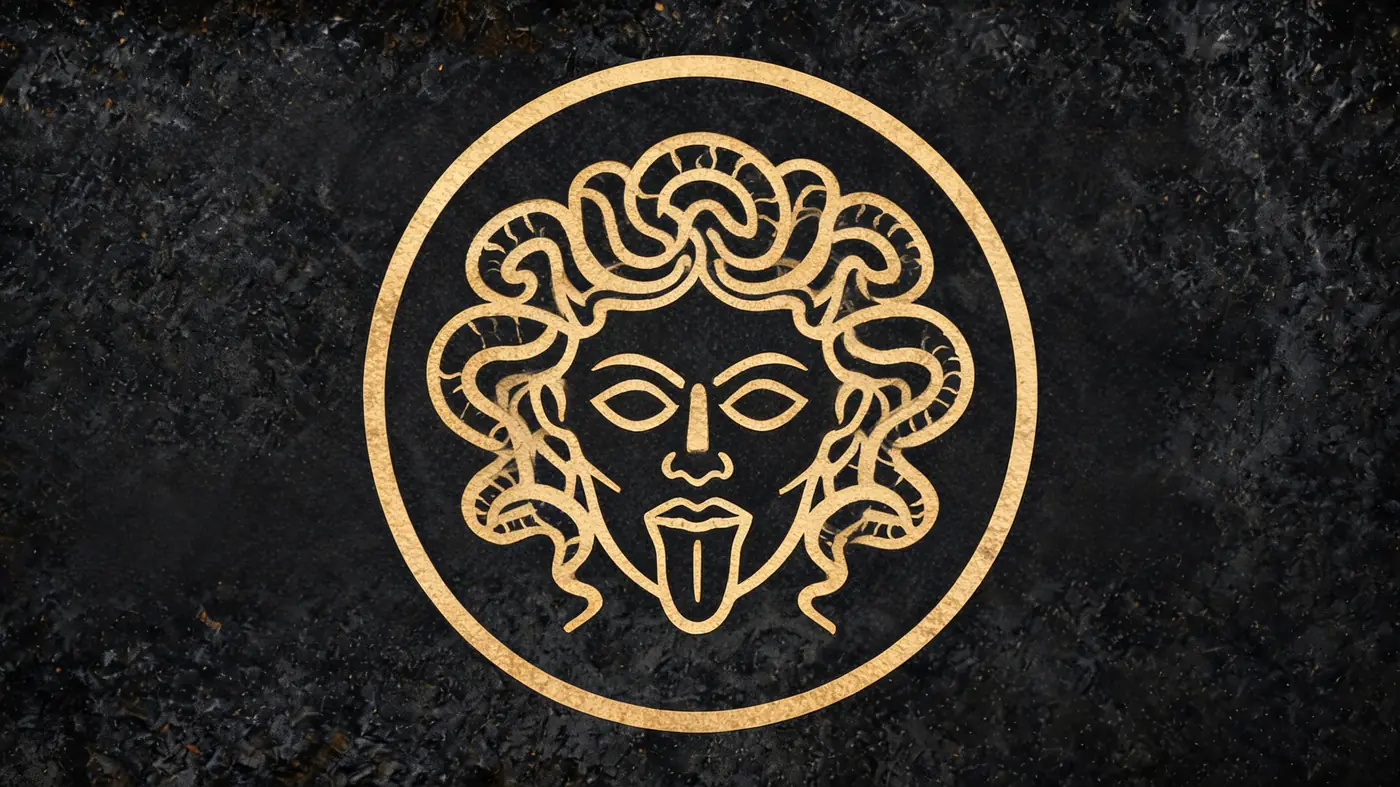
They had a name for this emblem: the gorgoneion. The Gorgon’s face, worn as a sigil.
Most people today know Medusa as a monster from the Perseus myth. Almost nobody knows that to the ancient world she was something closer to the opposite — the single most trusted mark of protection a Greek could carry.
A SYMBOL OLDER THAN ITS OWN MYTH
Here is the strange truth archaeologists keep running into: the face came first.
Gorgon faces appear in Greek art as early as the eighth century BC — wide staring eyes, bared teeth, tongue thrust out — before the story of the priestess, the curse, and the hero’s mirror-bright shield had settled into the shape we know. The image was not invented to illustrate the myth. The myth grew up around an image the Greeks already believed in.
And what they believed is written in the word they used for it. The gorgoneion was apotropaic — from the Greek for to turn away. A face so absolute in its ferocity that harm itself would flinch and go elsewhere.
Homer knew it. In the Iliad, the Gorgon’s head glares from the shield of Agamemnon, king of the Greeks, and from the aegis of Athena herself. When Odysseus stands at the edge of the underworld in the Odyssey, what finally makes him retreat is the fear that Persephone will send up the Gorgon’s head. In the oldest poetry the Greeks possessed, this face is already the boundary line — the point past which nothing dares to go.
THE FACE ON THE GODDESS’S CHEST
Then the myth arrived, and it gave the face a history.
Medusa — the only mortal among the three Gorgon sisters — was slain by Perseus, who took her head and learned what every Greek already knew: the gaze kept its power after death. He used it as a weapon, turning his enemies to stone, and when his quest was done he did not keep it.
He gave it to Athena.
And Athena — goddess of wisdom, strategy, and disciplined war — set the Gorgon’s face at the centre of her aegis, over her own heart. Think about what that means. The most rational deity in the Greek pantheon looked at the severed head of a so-called monster and judged it the finest protection in existence. From that moment, in every statue and every painted vase, wherever Athena stands guard, Medusa guards her.
The myth even split her power in two. Blood taken from Medusa’s left side was lethal poison; blood from her right side could heal — by some accounts, raise the dead. The healer-god Asclepius worked with both. Destruction and protection, venom and medicine, in one body. The Greeks did not think this was a contradiction. They thought it was the definition of power.
EVERYWHERE THE ANCIENT WORLD FELT VULNERABLE
What Athena wore, Greece copied.
Hoplites painted the gorgoneion on their shields so the enemy met Medusa before they met the spear. The oldest great temple pediment in Greece — the Temple of Artemis on Corfu, carved around 580 BC — puts a colossal running Gorgon at its very centre, guarding the house of a goddess. Cities stamped the face on their coins. Households fixed it above doorways and on the doors of ovens and kilns, where fire could ruin a family’s livelihood. Potters set it on their wares, city walls carried it on their gates, and Roman mosaic floors placed it at the threshold, staring up at whoever entered.
Alexander the Great wore the gorgoneion on his breastplate — the famous Alexander Mosaic from Pompeii shows it at the centre of his chest as he charges the Persian king. The emblem of a Macedonian conqueror, five centuries after Homer, was still the same face.
No other figure in Greek art was reproduced this way, in this many places, for this long. Gods had temples. Heroes had statues. Medusa had everything else — every edge, every entrance, every surface where the ordinary world felt exposed.
WHY A “MONSTER’S” FACE PROTECTS
The logic of the sigil is ruthless and beautiful.
Evil is turned away not by innocence, but by a force more formidable than itself. The Greeks did not guard their temples with images of gentleness. They guarded them with the one face that fear itself could not look at. The gorgoneion works because Medusa has already survived the worst — condemned, hunted, beheaded — and still her gaze holds. Nothing that approaches a door she guards can threaten her with anything she has not already endured.
That is the quiet reversal at the heart of the symbol. The figure the myth calls a victim is the figure the civilization trusted as its guardian. Her power was never granted by the gods — it was taken from her story, and it answered to no one.
The modern world has not stopped understanding this. Her face fronts a global fashion house. She has become an emblem for survivors who refuse to be defined by what was done to them. Three thousand years on, people still reach for Medusa when they want to say: I am not to be approached carelessly.
If you want her full story — the priestess, the curse, Perseus, and the long history of her reinvention — we have told it here: Medusa: The Gorgon Who Turned Fear Into Power. This is the story of her sigil — the face that outlived the myth.
THE NEOLITHIC CONNECTION
At Neolithic Store, the gorgoneion sits at the heart of our Greek Legends collection for the same reason it sat at the heart of Athena’s aegis — because no civilization ever designed a stronger mark of untouchable power.
The Medusa Sigil oversized tee renders her the way the ancients rendered her emblem — as a sigil, not a scene. A single gold mark on deep black, drawn from the Greco-Roman tradition where symbolism spoke louder than words: deliberate in every line, never loud, never excessive. It is the gorgoneion carried the modern way — controlled power, worn on the chest, exactly where Athena wore hers. And the Gorgon’s Gaze pendant puts her where the Greeks put their amulets: at the body, close, a guardian that travels with you.
For a thousand years, her face marked the line that harm could not cross.
It still does.
Available now at neolithicstore.com.
Forged from ancient bloodline. Worn by the modern warrior.
Neolithic Store is a premium mythology-inspired streetwear brand rooted in the stories that shaped human civilization. Every design begins with research, every piece carries a story, and every stitch is made for those who wear their beliefs on their skin.