Medusa — The Monster They Made

Everyone knows the ending. The severed head. The stone gaze. The hero holding his trophy in the air. But the story of Medusa didn’t begin with monstrosity — it began with beauty, devotion, and a punishment that was never deserved.
That’s the part they don’t put on the vases.
The Priestess
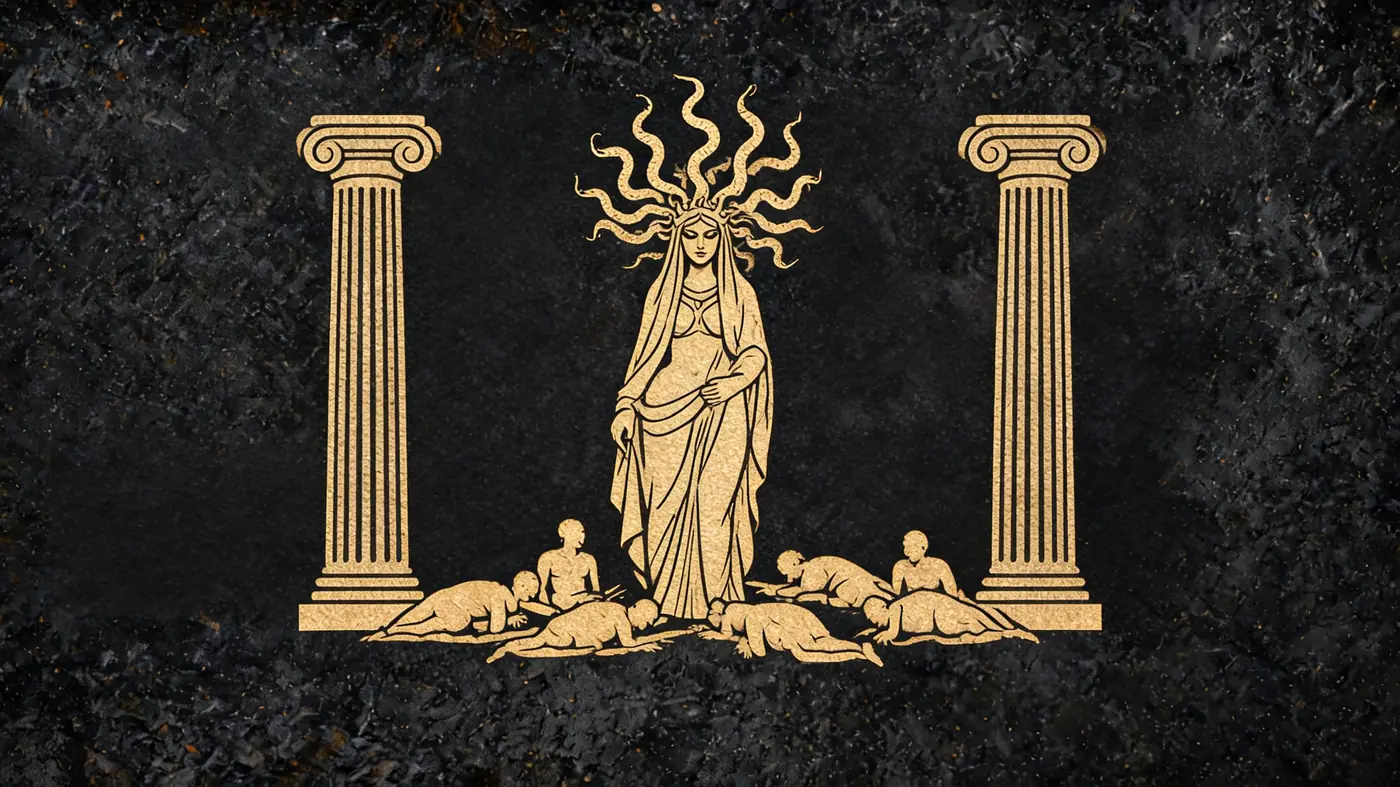
Before the serpents, before the fangs, Medusa was a mortal woman. A priestess of Athena — the goddess of wisdom and war. Ancient sources describe her as strikingly beautiful, with hair that moved like living silk. She served in Athena’s temple, bound by vows of purity, devoted to a goddess she believed would protect her.
She was wrong.
Poseidon, god of the sea, saw Medusa and wanted her. What happened next varies across the ancient tellings, but the core remains the same — Poseidon violated her in Athena’s own temple. The sacred ground was desecrated. And when it was over, it wasn’t the god who was punished.
It was the woman.
The Curse
Athena — the goddess Medusa had served, the goddess whose temple had been defiled — turned her wrath not on Poseidon, but on the priestess. Medusa’s legendary hair became a nest of living serpents. Her face became something so terrible that anyone who looked upon it turned to stone. Her sisters, Stheno and Euryale, were transformed alongside her. The three Gorgons were cast out to the edges of the known world, exiled to a place where no living thing would dare to follow.
Medusa didn’t choose to become a monster. The gods made that choice for her. And then they called her dangerous for surviving it.
The Hunt
Eventually, the gods sent someone to finish what they started.
Perseus — half-mortal son of Zeus — was given the task of bringing back Medusa’s head. Not out of heroism, but as a political favour, a deadly errand dressed up as a quest. The gods armed him generously: Athena gave him a polished shield to use as a mirror, Hermes lent him winged sandals, Hades provided a helm of invisibility, and the nymphs offered a magical satchel to carry the severed head.
An entire divine arsenal. For one woman. Exiled and alone.
Perseus found Medusa sleeping. He approached using Athena’s shield as a mirror, never meeting her gaze directly, and cut off her head with a single stroke. From her neck sprang Pegasus, the winged horse, and Chrysaor, a giant wielding a golden blade — children of Poseidon she had carried since the violation.
Even in death, she was giving life to things that weren’t hers to keep.
The Weapon After Death
Medusa’s story didn’t end with the sword. Her severed head retained its power — anyone who looked upon it still turned to stone. Perseus used it as a weapon, petrifying his enemies, before gifting it to Athena. The goddess mounted it on her aegis, her sacred shield.
Think about that for a moment. The goddess who punished Medusa for being a victim then wore her face as armour. The very power Athena condemned became the power Athena carried into battle.
Medusa’s image became the ultimate symbol of divine protection — the apotropaic gaze, meant to ward off evil. Her face was carved into temple walls, stamped onto shields, and worn as amulets across the ancient Mediterranean world. The thing they called a curse became the thing they couldn’t stop using.
Beyond the Myth
The ancient Greeks placed Medusa’s face everywhere — not because they feared her, but because her image carried force. The Gorgoneion, as it was known, appeared on coins, armour, doorways, and rooftops. It was a boundary marker between the sacred and the profane, the safe and the dangerous. To wear Medusa was to say: I am not to be touched.
Centuries later, that meaning hasn’t faded. Medusa has been reclaimed — not as a monster, but as a symbol of transformation through suffering, of rage made beautiful, of power that refuses to be silenced even after death.
She is the patron saint of everyone who was punished for someone else’s crime and came out the other side with something sharper than forgiveness.
Why She Endures
Medusa’s real power was never the stone gaze. It was the story itself — a story about what happens when systems designed to protect you become the systems that destroy you. About how the world will call you a monster long before it calls the ones who made you that way by their real names.
She didn’t ask for the serpents. But she wore them like a crown.
THE NEOLITHIC CONNECTION
The face Greece carved to turn danger back lives in our Greek Legends collection.
The Medusa Sigil tee carries the serpents she never asked for — worn, as she wore them, like a crown.
The ancient world understood something we keep forgetting — that the most powerful symbols aren’t born from comfort. They’re forged in the space between what was taken and what refused to die.
— Neolithic Store