SOBEK — THE CROCODILE THEY COULD HAVE FEARED, BUT CROWNED
Every civilization worships what feeds it.
Egypt did something stranger. Egypt worshipped the thing in the water that ate people.
The Nile crocodile is one of the deadliest animals that has ever lived alongside human beings — five metres of armored patience, invisible beneath the brown water of the river every Egyptian depended on for survival. It took farmers at the banks, fishermen from their boats, children from the shallows. The Egyptians had every reason to make it a demon.
Instead, they built it temples.
His name was Sobek.
THE RIVER THAT FED AND DEVOURED
To understand Sobek, you have to understand what the Nile was.
Egypt is a desert. Everything that made it a civilization — the grain, the cattle, the cities, the pyramids — existed because once a year the river rose, flooded the land, and left behind black silt so fertile the Egyptians named their whole country after it: Kemet, the Black Land.
The river was life itself. And the river was full of crocodiles.
The same water that fed the fields concealed the jaws. There was no having one without the other — no flood without the flood’s teeth. Most cultures would have split this into two stories: a good river spirit and an evil river monster.
Egypt refused to split it.
Sobek is the whole river in one body — the fertility and the ferocity, the flood that feeds and the jaws that end. The Egyptians did not pretend the danger away. They gave it a name, a face, and a throne, and they called it holy.
WHO SOBEK IS
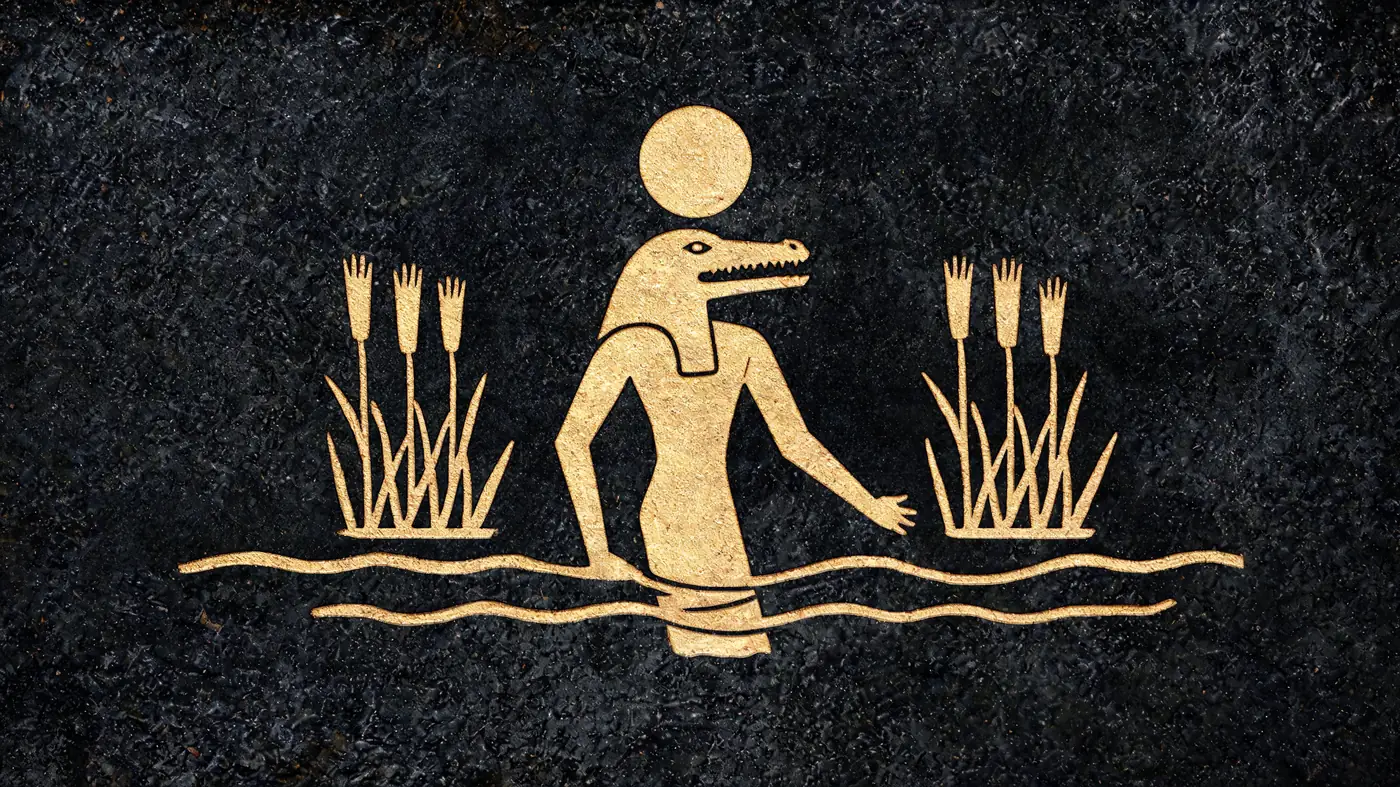
Sobek appears in Egyptian art in two forms: as the crocodile itself, and as a man with a crocodile’s head, crowned with the sun disk and tall plumes — a beast wearing the regalia of a king.
He is one of Egypt’s oldest gods. He appears already in the Pyramid Texts — the oldest religious writings on earth — where the dead king rises “as Sobek, strong of face,” taking on the crocodile’s power to cross the waters of the afterlife. His titles tell you exactly how Egypt saw him: Lord of the Waters. Lord of Faiyum. The Rager. Pointed of Teeth.
He was a god of the Nile’s strength — of the flood, of fertility, of the army’s fury, of the pharaoh’s raw power. Where other gods embodied wisdom, order, or magic, Sobek embodied something older and simpler.
Force. Unapologetic, unreasoning, indispensable force.
THE GOD WHO ROSE FROM THE FIRST WATERS
In Egyptian cosmology, before there was a world there was water — Nun, the dark, limitless primordial ocean. Creation was the first ground rising out of that water.
Sobek belongs to that oldest layer of the cosmos. Some traditions made him a son of Neith, the ancient creator goddess who was old before the other gods were young. Others went further: in the temple hymns of Faiyum, Sobek himself rises from the primal waters as a creator, and the Nile is said to flow from his very sweat — the river not merely his home but his body’s own gift.
In later ages he merged with the sun god as Sobek-Ra: the crocodile who carries the sun, primordial water and daylight fire in a single god. A creature of the dark river bottom, crowned with the brightest thing in the sky.
And for all his ferocity, Sobek guards. In the myths of the divine family he appears as a protector — in some tellings it is Sobek who retrieves the four sons of Horus from the waters, gathering them in a net at Ra’s command. The crocodile that takes is also the crocodile that carries. Egypt never saw a contradiction in that.
TEMPLES WITH LIVING GODS
Most gods received statues. Sobek received the real thing.
At Shedet in the Faiyum oasis — a city the Greeks simply called Crocodilopolis — the temple kept a living crocodile as the god’s earthly presence. The priests adorned it with gold and jewels on its ears and forelegs, fed it honey cakes, meat, and wine, and when it died, they embalmed it like a pharaoh and raised the next in its place. Greek travellers, Herodotus among them, came and stared: a civilization hand-feeding the animal every other nation on the river speared on sight.
At Kom Ombo in the south, Sobek shared a double temple with Horus — two sanctuaries, side by side, perfectly mirrored: the falcon of the sky and the crocodile of the deep, order and raw power worshipped under one roof. Hundreds of mummified crocodiles have been found there, some with mummified hatchlings, and whole crocodile cemeteries lie buried across the Faiyum.
Think about what that means. The Egyptians did not worship a safe, symbolic crocodile. They looked at the actual animal — the one that killed their neighbors — and said: this too is divine. This especially is divine.
THE PHARAOHS WHO TOOK HIS NAME
Kings do not name themselves after weak gods.
In the Twelfth Dynasty, Amenemhat III — one of the great builder-pharaohs of the Middle Kingdom — raised Sobek’s cult to royal heights in the Faiyum. After him came a dynasty of kings named Sobekhotep: “Sobek is satisfied.”
And between them ruled someone remarkable: Sobekneferu — “the beauty of Sobek” — the first woman we can prove ruled Egypt as pharaoh, nearly three hundred years before Hatshepsut. When a woman took the throne of the mightiest kingdom on earth for the first time in recorded history, the god whose name she carried was the crocodile.
Pharaohs borrowed Sobek’s ferocity the way they borrowed Horus’s legitimacy. Horus made a king rightful. Sobek made a king dangerous. A throne needs both.
WHAT SOBEK ACTUALLY MEANS
Strip away the temples and the gilded crocodiles, and Sobek is Egypt’s answer to a question every human being eventually faces: what do you do with power you cannot defeat?
You can pretend it isn’t there. You can call it evil and tell stories where it loses. Or you can do what Egypt did — look it in the eye, give it its due, and make its strength your own.
Sobek was never asked to be gentle. He guarded the waters and the throne precisely because he was the most dangerous thing in the river. The Egyptians understood that protection does not come from the harmless. It comes from the powerful, standing on your side.
The river does not explain itself.
Neither did he.
THE NEOLITHIC CONNECTION
At Neolithic Store, Sobek is the piece in our Egypt Mythos collection for those who understand that calm water hides the strongest current.
The Sobek — Lord of the Nile tee carries the crocodile god on black — fertility and destruction in the same body, the flood that feeds and the jaws that end. It is not a design that asks for attention. Like the god it carries, it waits, and it is noticed anyway.
Egypt could have called the crocodile a monster.
They called it a god. We put it on black.
Available now at neolithicstore.com.
Forged from ancient bloodline. Worn by the modern warrior.
Neolithic Store is a premium mythology-inspired streetwear brand rooted in the stories that shaped human civilization. Every design begins with research, every piece carries a story, and every stitch is made for those who wear their beliefs on their skin.