KAAL — TIME, THE FORCE THAT OUTWAITS THE GODS
Every god in the Hindu cosmos can be moved. Offer the right devotion, keep the right fast, say the right name enough times, and even the fiercest of them will turn toward you. All except one.
Kaal. Time. The force that does not answer prayers because there is nothing you own that it needs.
TIME WITH A NAME
In Sanskrit, kaal means both time and death — because the two are the same thing seen from opposite ends. To name time is to name the thing that will eventually take everything time has given.
Kaal is not a measure on a wall. It is the force that watches creation rise, holds it steady while it stands, and dissolves it when its term is spent — never early, never late, never in a hurry.
The word carries more than one weight. Kāla is time. It is also the dark, the black, and the appointed hour — the moment fixed for an ending. Old commentators traced it to a root that means to drive and to count: the thing that counts out every life and drives it on to its last number.
TIME AS A HORSE
The oldest portrait of Kaal is not a god on a throne. It is a horse.
In the Atharva Veda, two hymns are given to Time alone. Kaal is a horse with seven reins and a thousand eyes. He never ages. He is full of seed. The seers who think deeply mount him, and every world turns as his wheel.
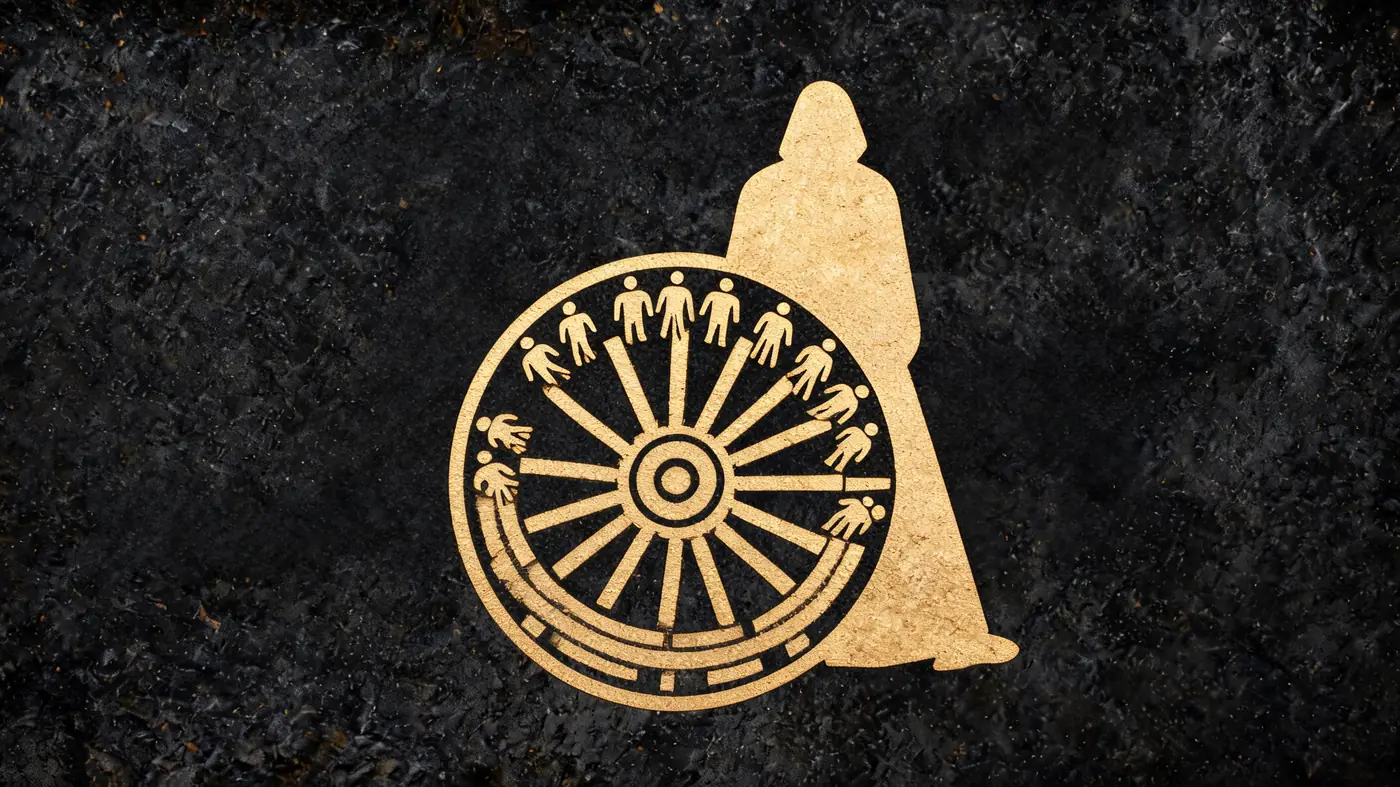
The hymn goes on. Time carries seven wheels. Seven are his hubs. Immortality is his axle. The heavens and the earth were made in Time. Whatever is, is held in Time.
Nothing here is a threat. The hymn does not fear him and does not plead with him. It describes a force the way you would describe weather or a river: vast, patient, and carrying everything forward whether you ride or not.
A thousand eyes. A horse that does not tire. A wheel that every world is part of.
Remember the horse. It comes back at the end of the age.
MAHAKALA — THE GREAT TIME
Shiva carries the title Mahakala: the great time, the one who stands beyond time and therefore beyond its reach. At Ujjain, the Mahakaleshwar temple keeps a form of Shiva as the lord of time itself — the aspect against which even the other gods measure their own age.
To be beyond Kaal is the one power no boon can grant. It is why Mahakala sits at the top of the list.
Ujjain was never an ordinary city. In classical Indian astronomy it was the place the prime meridian was drawn through — the line from which the day was counted. The city where time was reckoned is the city where Time has its seat.
Mahakaleshwar is one of the twelve Jyotirlingas, the self-born lingas of light. The old story says a demon came against the city, and the earth opened under the temple, and Shiva rose out of it as Mahakala and ended the demon with a sound. He stayed because the city asked him to.
Every dawn the lingam is anointed with ash. Ash is what a fire leaves when it is finished. The ritual is a statement the whole day long: everything burns, and what remains is still holy.
KALAGNI RUDRA — THE FIRE AT THE END
When a cycle of creation closes, the Puranas say a fire rises from beneath the worlds and burns them down to ash. They call it the fire of Time. Its name is Kalagni.
The Upanishads attach it to Rudra, the old storm god who grew into Shiva. The Kalagni Rudra Upanishad is the text that tells you to mark the brow with three horizontal lines of ash. The three lines you see on every ascetic’s forehead begin as a mark of Time’s fire, worn by those who have made their peace with it.
Rudra is the howler who fires the arrow. Kalagni is the fire that arrow lights. Same force, two faces. (Read: Rudra — The Roarer Before the First Storm.)
“I AM TIME” — KRISHNA’S VERDICT
On the field at Kurukshetra, Arjuna asks to see what stands behind his friend. Krishna shows him a form too large for any eye: mouths, lights, worlds going into the open jaws like rivers into the sea.
Arjuna asks who he is. The answer in the Bhagavad Gita is one line: I am Time, grown vast, the destroyer of the worlds, come here to gather them in.
Then Krishna says the armies are already dead. Arjuna’s arrows only carry out a verdict that Time had passed before the war began.
This is the line the whole idea turns on. Kaal is not a villain in the story. Kaal is the one who decided, and who was never in doubt.
A verse repeated through the Mahabharata says the same thing without the vision: Time cooks all beings. Time withdraws creatures. Time stays awake while they sleep. Time is hard to cross.
YAMA AND THE BOY WHO REFUSED — TIME’S COURT
Yama is the god of death, the first mortal to die and the judge who rules the dead. He carries a rod, and the rod has a name: Kaladanda, the staff of Time. One of Yama’s own titles is Kala.
Where Kaal is the force, Yama is the court. He reads the sentence. He does not write it.
The old story is about the boy Markandeya, who was born with sixteen years to live. On the last day he held the Shiva-lingam, and when Yama’s noose fell over both of them, Shiva rose from the stone and stopped the god of death. In that form he is called Kalantaka: the ender of the one who ends. It is the only time in the tradition that Time’s court is overruled, and the one who overrules it is Mahakala.
KALI AND KALARATRI — TIME WITH A MOUTH
Kali is the feminine of kala: the dark one, the one who is Time. Where the other forms stand above Time or judge by it, Kali swallows it. She is the force that devours the age whole and is not frightened by what she has eaten.
The Navadurga carries a darker sister of the same name, Kalaratri, “the night of death,” worshipped on the seventh night of Navratri. She is black as the dark between the stars, and the mercy she offers is not comfort. It is the end of fear, because a person who has looked at their own ending is no longer afraid of anything smaller.
(Read: Chamunda — The Goddess Named by What She Killed.)
THE WHEEL OF THE AGES — VISHNU’S COUNT
The Puranas give Time a number.
One great cycle, a mahayuga, is 4,320,000 human years, split in four ages of falling length: the Satya yuga of 1,728,000 years, the Treta of 1,296,000, the Dvapara of 864,000, and the Kali yuga of 432,000. The ratio is four, three, two, one.
The same fall is drawn as an animal. Dharma is a bull that stands on four legs: austerity, purity, mercy, truth. Each age one leg breaks. In the Kali yuga, the Bhagavata Purana says, it stands on one.
We are in the age of the last leg.
Vishnu holds the Sudarshana wheel, the cycle of the ages turned into a weapon, and the cycle ends the same way every time: with Kalki, the tenth avatar, riding the white horse out of the dark with the sword that ends the age. The horse of Time and the horse of the last avatar are the same horse. (Read: Kalki — The Final Avatar Who Ends the Age.)
SHANI, PRAJAPATI AND THE SMALLER CLOCKS
Time is also given to smaller keepers.
Shani, the slow planet, takes nearly thirty years to turn once around the sky. He is Time as consequence: not the end, but the long ripening of what you did. Hindu astrology gives him the heaviest hand because he never hurries and never forgets.
In the Brahmanas the Year itself, Samvatsara, is named as Prajapati, the creator. The year is the creator, and the year is also what burns him down each time it turns. Creation and ending ride the same wheel.
WHAT EVEN GODS CANNOT OUTRUN
Demons defy fate. Kings build against it in stone. Sages earn boons that stretch their lives across ages. And Kaal outlasts all of them without once moving quickly.
The empire falls. The mountain wears to sand. The boon runs out on the exact day it was written to. Time does not compete with any of them. It simply remains after they are gone.
KALABHAIRAVA — TIME’S GUARDIAN
Time also has a keeper, and the tradition gave him a face no one mistakes for gentle. Kalabhairava is Shiva as the fierce guardian of time: dark, bare, garlanded with skulls, a staff in his hand. The name joins kala, time and death, to bhairava, the terrifying one.
In the Puranic telling, Bhairava rose from Shiva’s anger when Brahma boasted, and he took the creator’s fifth head. The skull clung to his hand until he walked into Kashi, where it fell away. He stayed, and he is still honoured there as its kotwal, the city’s guardian, whose leave a pilgrim asks before staying.
A dog walks beside him, and the tradition treats it as his companion and mount, not an omen. It is the one animal that stays at the edge of the cremation ground, watching the dead go by. Mahakala is Time as the force beyond reach. Kalabhairava is Time at the gate: the one who stands at the threshold, with the dog, and keeps the hour.
THE CONSTANT AT THE CENTER
Picture काल at the centre of a cycle that is forever breaking and reforming around it. The cracks are not damage. They are the record — every age that believed it was permanent, leaving its mark on the way out.
It does not seek attention. It does not need to. Everything comes to it eventually.
Kaal is not the enemy. Kaal is the verdict.
QUESTIONS PEOPLE ASK ABOUT KAAL
Who is the god of time in Hinduism?
There is no single throne. Time is a force first, personified as Kala in the Atharva Veda, then carried by Mahakala (Shiva), Kalagni Rudra, Yama and Kali. Krishna says in the Gita that he is Time.
Is Kaal the same as Mahakala?
Kaal is Time itself. Mahakala is Shiva as the lord who stands beyond Time. Mahakala is the face of Shiva that Time cannot touch.
Is Kaal the same as Kali?
Related, not the same. Kali is the feminine of kala: the dark one, Time with a mouth. Kaal is the larger force the word names.
Is Kaal good or evil?
Neither. Kaal does not punish. It completes. The texts treat it as a verdict, not an enemy.
What does the horse mean in the Atharva Veda?
The horse stands for Time’s tireless forward motion. The wheels are the worlds. Its thousand eyes are the sense that nothing happens unseen.
THE NEOLITHIC CONNECTION
In the Vedic Legends collection, this is He Keeps the Hour.
The back carries Kalabhairava standing in the dark with his dog, skulls strung at his chest, the dog’s eyes lit. The chest carries the wheel of time, broken and scattered in embers, still turning. Antique detail on black, worn rather than explained.
Time does not rush. It has a guardian.
Available now at neolithicstore.com.
Forged from ancient bloodline. Worn by the modern warrior.
Neolithic Store is a premium mythology-inspired streetwear brand rooted in the stories that shaped human civilization. Every design begins with research, every piece carries a story, and every stitch is made for those who wear their beliefs on their skin.
[…] In the Vedic cosmos, time is not a measure. It is a force with a name: Kaal. Shiva keeps it as Kalabhairava, the fierce guardian of time and of Kashi, who walks with a dog at his side. The back carries Kalabhairava standing in the dark with his dog and a garland of skulls. The chest carries the wheel of time, broken and still turning.See the design · Read the story […]