
CHAMUNDA — THE GODDESS NAMED BY WHAT SHE KILLED

Most mythologies keep their war goddesses presentable. They give them armour, a lion, a straight back, a face you could put on a coin. Hindu mythology has those too. And then it has Chamunda — who arrives out of another goddess’s forehead already snarling, kills two demons, cuts their heads off, and is rewarded with their names for the rest of eternity.
She is not a separate invention. She is what the Goddess turns into when the negotiating is over. One moment there is Ambika, calm and radiant, refusing a demon king’s marriage proposal. The next, her brow creases with anger, and something steps out of that crease with a sword already in its hand.
That something is Chamunda. This is where her story starts — not with a birth, but with a loss of temper.
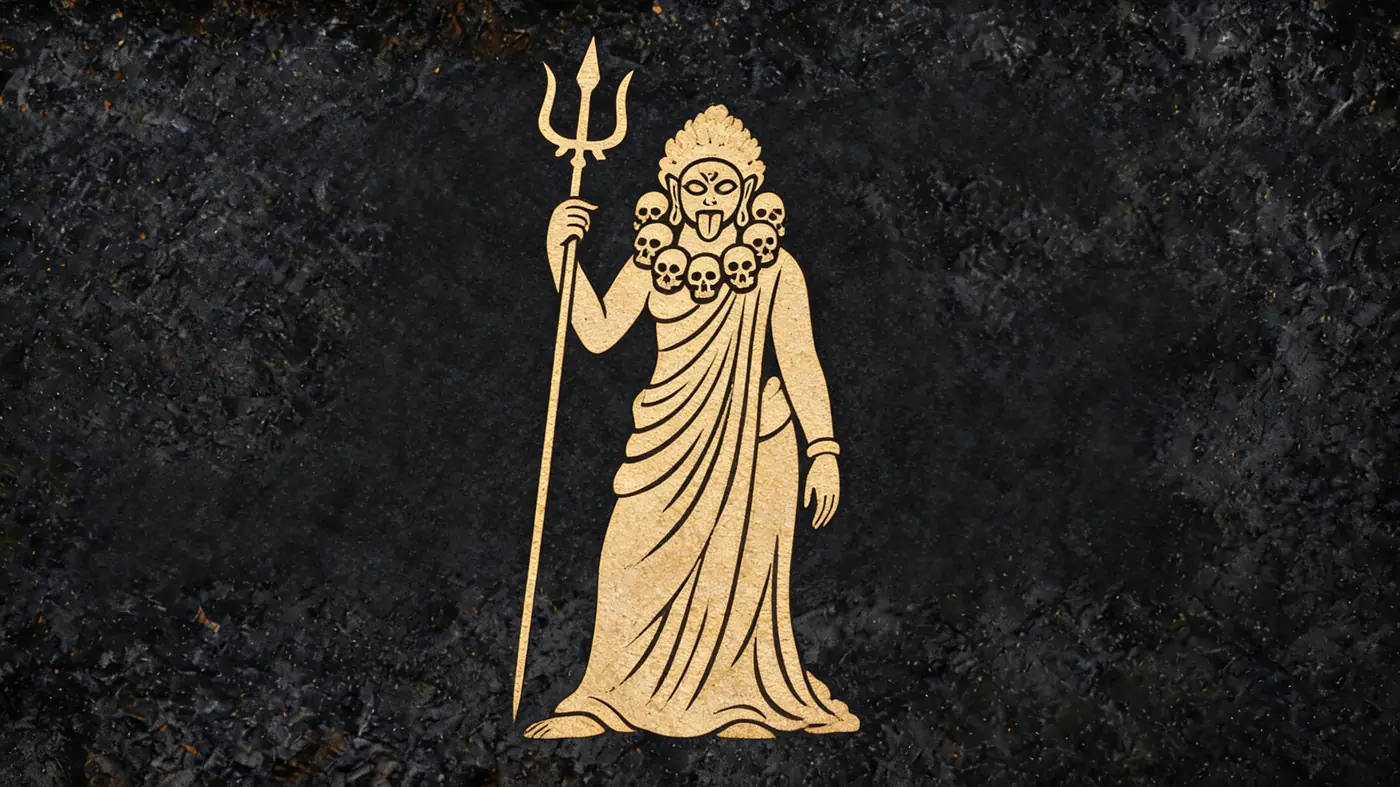
THE BROW THAT OPENED
The episode belongs to the Devi Mahatmyam — the “Glory of the Goddess,” seven hundred verses embedded in the Markandeya Purana and recited across India during Navaratri. The demon brothers Shumbha and Nishumbha have conquered the heavens and driven the gods into exile. From the collected anger of those gods, a goddess takes form: Ambika, also called Kaushiki, radiant and impossibly beautiful.
Shumbha wants her. He sends messengers, then armies. When persuasion fails, he dispatches two of his best commanders — Chanda and Munda — to seize her by force and drag her to his court.
They ride out and find her waiting on a lion. And here the text does something startling. It does not describe Ambika fighting. It describes her getting angry — and from the furrowed skin of her forehead springs Kali: black as a rain cloud, gaunt to the bone, wrapped in a tiger skin, a garland of skulls swinging at her chest, a skull-topped staff in her fist and a noose and sword in her hands. Her eyes are sunk and red. Her mouth gapes. Her tongue lolls. She fills the sky with a roar.
This figure — born from the brow, not from any god’s weapon — is the one who will be renamed Chamunda before the chapter ends.
CHANDA AND MUNDA
What follows is short and one-sided. She wades into the demon ranks and eats them — crushing chariots, horses, elephants and riders in her jaws, flinging handfuls of the army into her mouth. Chanda looses a storm of arrows; Munda hurls discuses thick enough to blot the sun. She laughs and swallows them.
Then she takes Chanda by the hair, pins him, and cuts off his head with her sword. Munda rushes her in fury, and she does the same to him. She picks up the two severed heads, carries them to Ambika — sometimes called Chandika here — and holds them out, still laughing.
It is a gift. A grotesque, triumphant, entirely sincere gift: the heads of the two men sent to abduct the Goddess, delivered by the Goddess’s own rage.
THE NAME THAT IS A KILL COUNT
Ambika’s response is the line the whole design hangs on. She tells the black goddess: because you came to me bearing Chanda and Munda, you will be famous in the world, from this day, as Chamunda.
The name is a compound of the two corpses. Cha from Chanda. Munda from Munda — a word that already means “severed head” or “shaved skull” in Sanskrit, which only sharpens the pun. Her name is not a description of her nature or her lineage or her home. It is the record of one afternoon’s work, made permanent.
Other gods are named for what they rule — lord of fire, lord of the dead, lord of beginnings. Chamunda is named for who she ended. Every time the name is spoken in a temple, two demons are decapitated again.
THE MOUTH THAT DRANK RAKTABIJA
Her most important act comes one chapter later, against a demon named Raktabija — “blood-seed.” He has a boon: every drop of his blood that touches the ground becomes a fully grown copy of him. The Goddess and her Matrikas wound him again and again, and each wound fills the battlefield with a thousand new Raktabijas. The fight is being lost by winning it.
Chandika turns to Chamunda and gives a blunt instruction: open your mouth wide. Drink the blood before it lands. Eat the copies as they rise.
So Chamunda stretches her jaw across the field and drinks. Every strike the Goddess lands, Chamunda catches the spray on her tongue; every blood-born duplicate, she swallows. Drained dry, the original Raktabija finally falls. It is not an elegant victory. It is a goddess turning her own appetite into a weapon — and it is why, in temple lists of the seven or eight Mother Goddesses, the Matrikas, Chamunda is the one who is also Kali, the one who consumes.
WHAT SHE LOOKS LIKE
Sculptors and the iconographic texts agree on Chamunda, and none of it is flattering. She is emaciated — ribs showing, belly sunk in, veins standing out like cord. Three eyes. Fangs pushing past her lips. Hair loose and upright, sometimes flaming. She wears a garland of severed heads or skulls, the mundamala, and often little else.
Her hands hold a trident, a drum, a sword, a skull-cup for drinking. She is shown seated on a corpse, or on an owl, in a cremation ground scattered with bones and jackals and hovering ghosts, sometimes beneath a dead tree. Where other goddesses are given lotuses and thrones, Chamunda is given a burning ground and told to make herself at home.
The ugliness is the point. She is the form the divine takes at the exact place life ends — and the tradition refuses to make that place pretty.
THE HILL ABOVE MYSURU
And then, in Karnataka, the same goddess is a crowned queen.
On Chamundi Hill, overlooking the city of Mysuru, she is worshipped as Chamundeshwari — the tutelary deity of the Wadiyar kings who ruled Mysore for six centuries. Here her defining kill is not Chanda and Munda but Mahishasura, the buffalo-headed demon who held the region in terror. She destroyed him on that hill. The city at its foot, Mahishuru — “Mahisha’s town” — carries his name the way the goddess carries her victims’, and it wore down over centuries into Mysuru, Mysore.
Every autumn the Mysore Dasara — the state festival of Karnataka — celebrates that victory, with the goddess paraded in gold through the streets. A giant statue of the demon Mahishasura stands on the hill near her temple, club in hand, glaring down at the traffic. The fierce Matrika of the cremation ground and the golden state goddess of a royal house are the same figure. Both are true. Neither cancels the other.
WHY SHE STILL MATTERS
Chamunda is the part of the Goddess that most traditions would rather keep in a side shrine — the anger, the hunger, the willingness to do the ugly work herself instead of sending a champion. Hindu mythology does the opposite. It puts her at the front of the fight, gives her the decisive kill against Raktabija, seats her among the Mothers, and lets a royal dynasty build its legitimacy on her.
The lesson underneath is old and unsentimental: there are threats that politeness cannot answer, and someone has to be able to become the thing that answers them. Chamunda is what the Goddess keeps in reserve for exactly that. She is not a lapse in the divine order. She is a function of it.
She was named for her worst day of violence, and the name was meant as an honour. She has answered to it, in stone and gold and firelight, for two thousand years.
THE NEOLITHIC CONNECTION
Chamunda sits in our Vedic Legends collection, among the figures Hindu mythology remembers for what they were willing to do rather than how they looked doing it.
She Took Their Names — Chamundi Edition puts the trophy on the chest: Chanda and Munda as two horned, fanged skulls strung from a single cord, worked in old gold, a thread of blood still falling from between them. The back carries her face — wild-haired, ash-dark, a small gold crown above the brow, and the wrath-eye open in a red seam down the centre of her forehead, the same brow she stepped out of.
Front and back are one sentence. She killed two, and was given their names to keep.
Born From The Brow — Chamundi Edition carries only her face, worn gold on black — crowned, downcast, the wrath-eye open down the brow — and leaves the back bare.
Available now at neolithicstore.com.
Forged from ancient bloodline. Worn by the modern warrior.
Neolithic Store is a premium mythology-inspired streetwear brand rooted in the stories that shaped human civilization. Every design begins with research, every piece carries a story, and every stitch is made for those who wear their beliefs on their skin.