HEL — THE QUEEN WHO IS TWO
Every mythology needs someone to hold what death actually is, not the glorious version. The Norse gave that job to a woman who is, herself, exactly half of one thing and half of another.
Hel is not a monster hiding at the edge of the map. She sits at the bottom of the nine worlds, in a hall of her own, doing a job none of the shining gods wanted: keeping the dead who died without a story worth singing.
She was given that job before she could have earned or refused it. That is where her story actually starts.
THE DAUGHTER GIVEN A KINGDOM
Hel is Loki’s daughter, born to the giantess Angrboða alongside two brothers the gods feared even more openly: Fenrir the wolf, and Jörmungandr the serpent that would grow long enough to circle the entire world. Odin, warned that Loki’s children would bring ruin, had all three brought before him.
The wolf he bound. The serpent he threw into the sea. Hel he cast down into Niflheim, the world of mist and cold, and then did something stranger than banishing her — he gave her power over it. Authority over nine worlds’ worth of the dead, and a house to keep them in. Not a punishment exactly. Not a gift exactly either.
She did not choose the underworld. The underworld was handed to her, the way a crown is handed to whoever is standing there when no one else wants it.
HALF THE COLOR OF THE LIVING
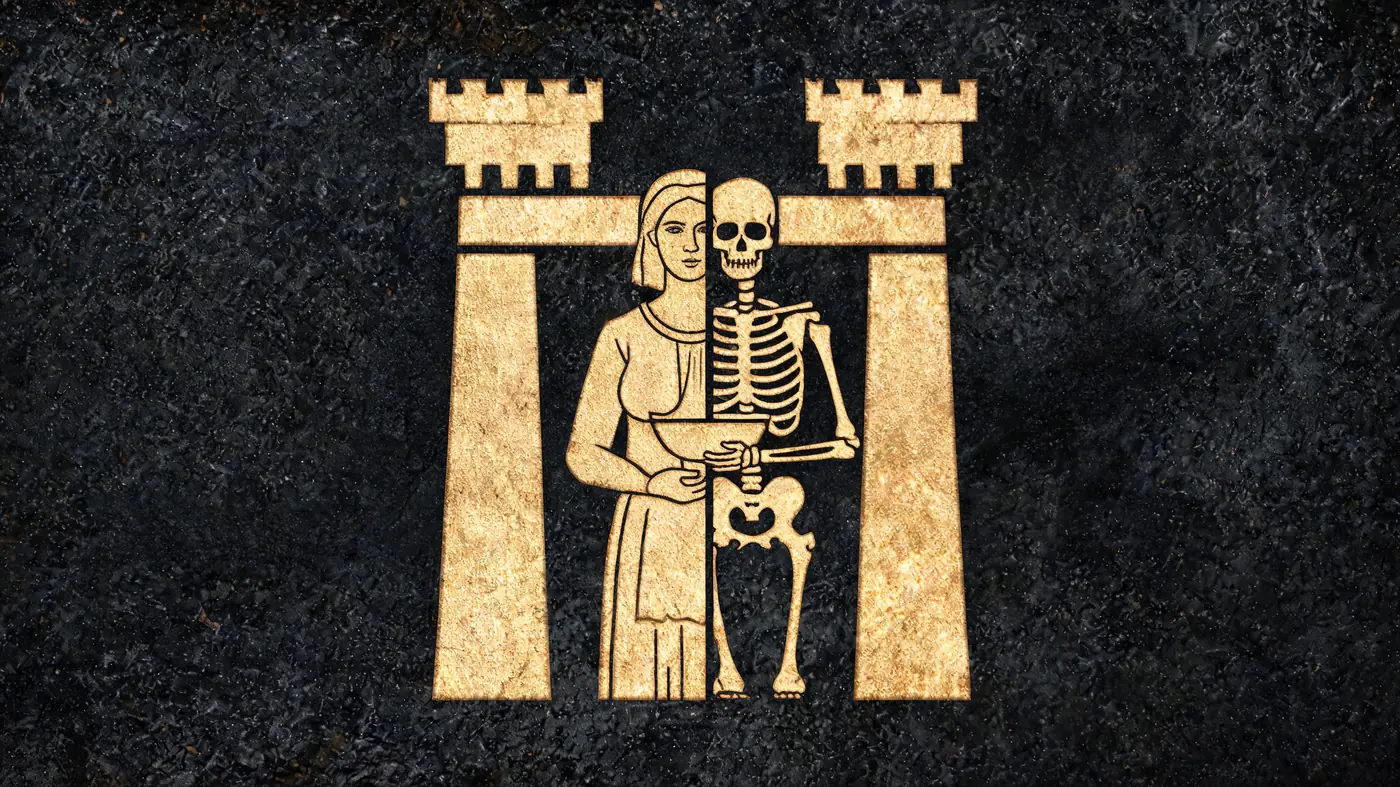
Snorri Sturluson, writing the fullest account of her that survives, describes her body directly: half of her flesh-colored, as any living woman’s would be. The other half is not. Dark, hollow, already the color of something that stopped.
No explanation is offered for why, and none is needed. She is not sick. She is not cursed. She is simply built from both conditions at once, permanently, the way her father was never fully god and never fully giant, never fully honest and never fully lying.
The sources call her expression grim and downcast. Not cruel — just unable to fake the half of her that isn’t there.
NOT FOR THE BRAVE, BUT FOR THE REST
Warriors who die in battle do not go to Hel. Half of them go to Odin’s Valhalla, half to Freyja’s field, Fólkvangr — the death that gets remembered, sung about, prepared for.
Hel keeps everyone else. The ones who died of sickness. The ones who died of age, or an accident, or nothing worth telling a story about — what the Norse called a “straw death,” dying in bed instead of on a field. Most people, in other words. The dead that no hall of glory was built for.
Her own hall has a name — Éljúðnir, “drenched with sleet.” Her dish is called Hunger. Her knife is called Famine. Her bed is Sick-bed, and the curtain around it is Gleaming Bale. Every object in her house is named for the thing that put someone there. It is not a torture chamber. It is just honest about what most death actually is.
THE BOWL SHE WOULDN’T FILL
When Baldr, best-loved of the gods, died and came down to her hall, the Æsir sent a rider all the way to Hel’s threshold to beg for him back.
Hel set one condition, and it was not cruel — it was exactly fair. If every single thing in creation would weep for Baldr, she would let him go. Gods wept. Giants wept. Stones, trees, metal, every animal — everything wept.
Except one giantess sitting alone in a cave, who said she had no use for Baldr, living or dead, and that Hel should keep what she held. That giantess was Loki, in disguise, refusing to cry for the son of the gods who had exiled his own family.
Hel kept her word. One voice short, and Baldr stayed. She never bent the rule to be merciful, and she never bent it to be cruel either. She just kept the count exact — the same way she keeps everything.
WHO RIDES OUT AT THE END
At Ragnarök, when every old debt comes due at once, Hel’s dead do not stay quiet in their hall. Naglfar, the ship built from the untrimmed nails of the dead, breaks loose and sails against the gods, and it is Hel’s realm that fills its ranks.
The woman who spent an age keeping the dishonored dead patiently, fairly, without complaint, is also the one who marches them out when the world finally ends. She was never gentle and never vicious. She was just owed, and at Ragnarök, the debt gets collected.
THE NEOLITHIC CONNECTION
At Neolithic Store, Hel is carried in the Norse Saga collection as the design that admits what most mythology apparel doesn’t — that the underworld is not a villain’s lair, it is just where most of us end up.
One Face. Two Fates. carries a threshold mark at the chest — two crossed lines, the shape of a boundary you cross once and do not cross back. The back carries what the front only hints at: her face, split exactly down the center, one half holding the light and one half already gone, a single mark of blood-red running through the divide.
Nothing about her resolves, because she was never built to. She is not the ending. She is what comes after the ending, patient, exact, and always half here.
Available now at neolithicstore.com.
Forged from ancient bloodline. Worn by the modern warrior.
Neolithic Store is a premium mythology-inspired streetwear brand rooted in the stories that shaped human civilization. Every design begins with research, every piece carries a story, and every stitch is made for those who wear their beliefs on their skin.
[…] mythologies walk the same road. Norse tradition has Hel, the queen who keeps the dead. The Maya go down through Xibalba, where Ah Puch waits at the bottom. […]
[…] Hel is Loki’s daughter, and nothing about her resolves into one thing. One side of her face keeps the colour of the living. The other side does not. She waits at the bottom of the nine worlds, in a hall for those who died the wrong way, not in battle and not remembered, and she keeps them, the way a ledger keeps a debt. The threshold mark rests over the heart. The back holds a queen who was always two people.See the design · Read the story […]