THE NORNS — WEAVERS OF FATE IN NORSE MYTHOLOGY
Norse myth gives its gods war, wit, and thunder. It gives fate to three women who never raise their voice, never draw a weapon, and never lose an argument, because there has never been an argument. There is only what they decide.
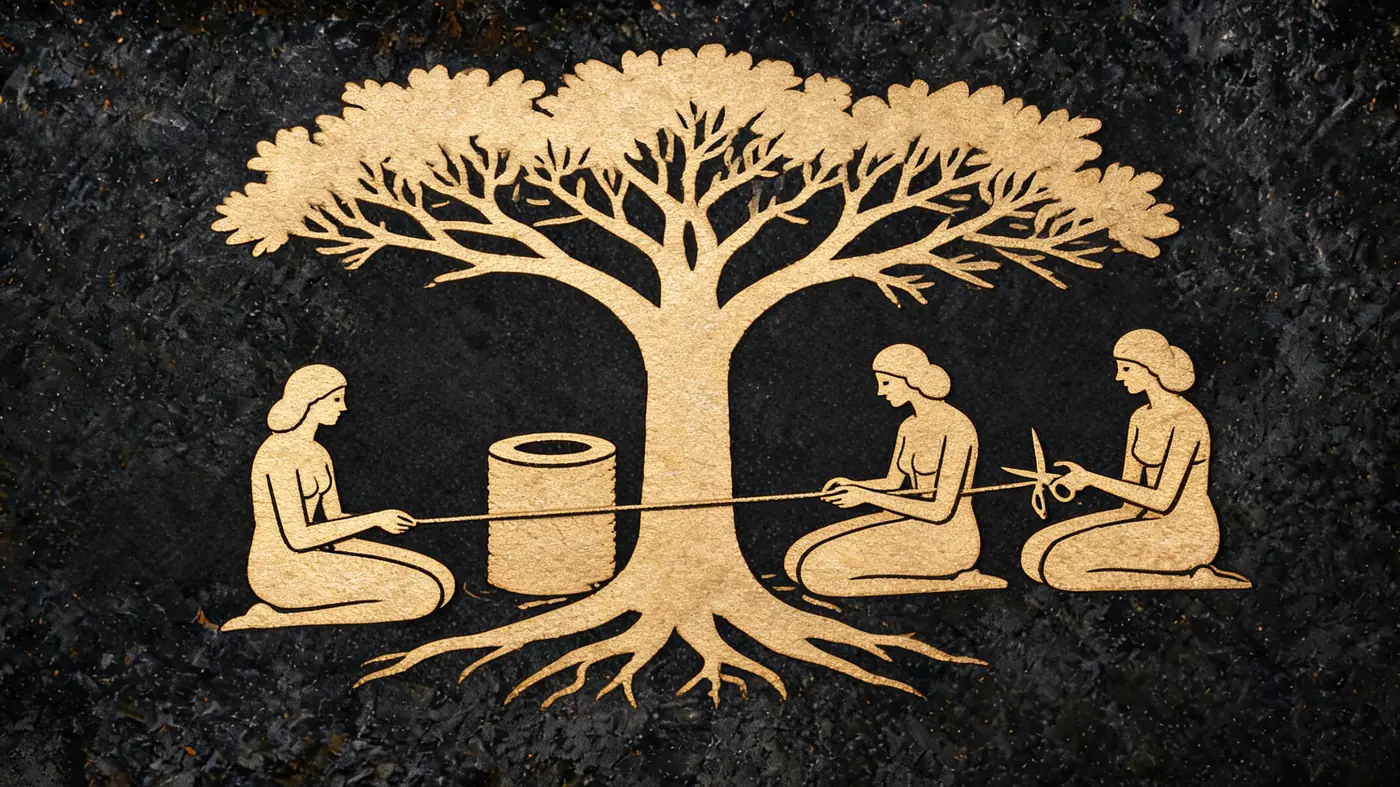
The Norns sit at the base of Yggdrasil, the tree that holds up all nine worlds, drawing water from a well and pouring it back over roots that would otherwise rot. That alone would make them essential. What makes them absolute is the other half of the job: they spin, measure, and cut the thread that becomes every life lived under the tree.
Gods included. There is no myth in which a god successfully argues with a Norn, because there is no myth in which anyone has ever tried twice.
THE WELL BENEATH THE WORLD TREE
Yggdrasil is not healthy. The old sources say a serpent gnaws at one root, a stag and three harts strip its bark, and rot works at it from underneath, always. It survives because three sisters keep pouring the water of Urðarbrunnr — the Well of Urd — back over it every single day, along with white clay that seals what the rot opens.
This is maintenance, not glamour. No poem lingers on the Norns riding into battle or performing feats. They sit at the well, they draw the water, they pour it, and the tree that the entire cosmos depends on keeps standing because they never once stop.
That patience is the same quality that makes them terrifying elsewhere. A being that will show up every day for the life of the world to do an unglamorous job is not a being that forgets, forgives, or negotiates a deadline.
THREE NAMES, THREE TENSES
The Norns are usually named as three: Urd, Verdandi, and Skuld. Their names are not decoration — they are grammar. Urd comes from a root meaning “that which has become,” the past, already fixed and unchangeable. Verdandi means “that which is becoming,” the present, still in motion. Skuld means “that which shall be” — and it shares its root with the Old Norse word for debt.
Put together, the three sisters are not three separate goddesses so much as one process seen from three angles: what happened, what is happening, and what is owed and has not yet come due. A life is not judged by the Norns after the fact. It is measured out, tense by tense, while it is still being lived.
That is also why Skuld is the one who appears again later, alone, riding with the Valkyries toward battlefields where debts are about to be collected. She is fate in its most active form — not memory, not the present moment, but the bill arriving.
THE THREAD EVEN ODIN CANNOT OUTRUN
Odin spends the entire mythology trying to know more than he is allowed to. He trades an eye for a look into Mímir’s well. He hangs himself from Yggdrasil for nine nights to learn the runes. He rides to the edge of the world to interrogate a dead völva about how everything ends.
None of it buys him a different ending. The völva he wakes tells him, in detail, the order in which his own death and the deaths of his children will arrive at Ragnarök — Fenrir swallowing him whole — and Odin does not argue with her, does not bargain, does not attempt to rewrite it. He listens, because the length was set by the Norns long before he went looking, and knowing the number does not change what is owed.
The Norns themselves are said to carve their decisions into the bark of Yggdrasil in runes, and to cast wooden lots that determine the fate of the newly born. Once cast, once carved, the record does not get revised. This is the specific horror the Norse gave their fate-keepers: not cruelty, just permanence.
NOT ONLY THREE
Beyond the three at the well, the sources describe lesser norns arriving at every birth to decide how long that particular life will run — some kind, some harsh, and a person’s luck in life was explained, in part, by which norn had attended their cradle. Fate in Norse belief was not one grand decree from on high. It was retail, applied individually, one birth at a time, by attendants who were themselves under the authority of the three.
This is why the Norns are described so rarely as villains. A villain wants something for themselves. The Norns want nothing — they administer. The tree needs water, the newborn needs a length, the ledger needs a number, and they are simply the ones who have always done it and will keep doing it until the tree falls.
WHAT WAS ALREADY WRITTEN AT RAGNARÖK
When Ragnarök finally arrives — the wolf loose, the serpent surfacing, the ship of the dead sailing on nails that were never trimmed — nothing about it is a surprise to the tree’s oldest tenants. Every death in that battle was thread the Norns had already measured, in some cases centuries before the armies met.
The end of the world, in Norse myth, is not a rupture in fate. It is fate’s most crowded appointment — the day every debt Skuld has been holding finally comes due at once. The three sisters do not fight in that battle. They do not need to. They already won it the moment they cut the first thread.
THE NEOLITHIC CONNECTION
At Neolithic Store, the Norns are carried in the Norse Saga collection as the design that admits fate is not drama — it is bookkeeping, kept by three hands that never once put the ledger down.
The Length Was Never Yours. carries one of the three alone at the chest: hooded, faceless, a cut of oxblood falling behind it. The back carries the three themselves: faceless, robed, thread pulled taut between their hands over a tangle of roots marked in the same runes that keep the debt, under a torn mass of oxblood, the price of the length.
Nothing about the thread bends for the wearer, and nothing about it needs to. It was already measured.
Available now at neolithicstore.com.
Forged from ancient bloodline. Worn by the modern warrior.
Neolithic Store is a premium mythology-inspired streetwear brand rooted in the stories that shaped human civilization. Every design begins with research, every piece carries a story, and every stitch is made for those who wear their beliefs on their skin.
[…] Three sisters sit at a well beneath the roots of Yggdrasil. Urd holds what has already happened. Verdandi holds what is happening now. Skuld holds what is owed and not yet paid. What they spin, measure and cut becomes the shape of every life in the nine worlds, gods included, and no cut has ever been recorded as undone. The chest carries the moon already rooted. The back carries the three themselves.See the design · Read the story […]