VÍÐARR — THE SILENT GOD WHO AVENGES ODIN AT RAGNARÖK
The gods of the Norse world are loud. Odin speaks in riddles, Thor in thunder and Loki in lies. One of them says almost nothing, and he is the one who survives the end.
His name is Víðarr. The old sources call him the silent god.
THE SON OF A GIANTESS
Víðarr is a son of Odin, but not of Frigg. His mother is the giantess Gríðr, and the Prose Edda of Snorri Sturluson says he is almost as strong as Thor and that the gods trust him in every danger. That is nearly all the sources tell us about his life. No tales of his travels survive, no quarrels and no jokes. He is a figure kept in reserve, and everything we know about him points at one day.
The Grímnismál tells us where he lives: Landviði, a country thick with brushwood and tall grass. It is wild, overgrown ground, and it suits a god who waits.
THE THICK SHOE
Snorri gives him one object: a thick shoe. It is made, he says, from all the scraps of leather that people have ever cut from the toes and heels of their own shoes. So whoever wants to help the gods, Snorri writes, should throw those scraps away.
It is a strange kind of weapon, and a very old kind of idea. Nothing about it is forged. It is made of the small things that ordinary people discard, and in the end it is what the gods depend on.
RAGNARÖK AND THE WOLF
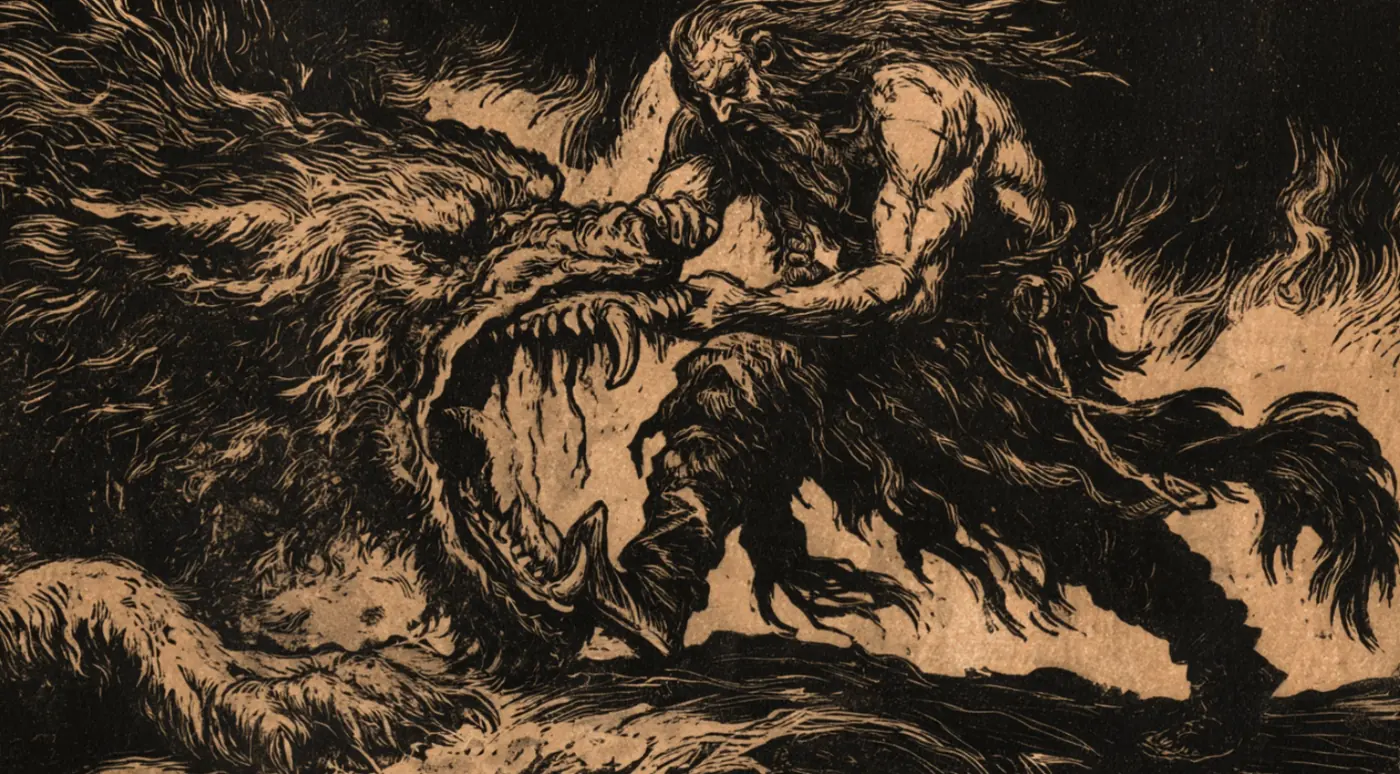
At Ragnarök, the wolf Fenrir breaks his chains and swallows Odin whole. The father of the gods is gone. It is Víðarr who steps forward.
The sources do not agree on how he does it. In Snorri’s account he plants the thick shoe on the wolf’s lower jaw, takes the upper jaw in his hand and tears the mouth apart until the wolf is dead. In the Völuspá he drives his sword into the wolf’s heart. In both, Odin is avenged, and the thing that killed him is destroyed by his silent son.
WHY SILENT
The sources never say why he is called the silent god, and that is part of what makes him strong. Every other god in the stories spends their power in words, bargains, boasts and threats. Víðarr keeps his for one moment. A god who has said nothing for the whole of the story has nothing to take back when the time to act comes.
WHAT COMES AFTER
Víðarr is one of the few gods who live through Ragnarök. Along with his brother Váli, he walks out onto the field called Iðavöllr, where the new world begins. The sun’s daughter is in the sky, the earth is green again, and the gods who are left sit together and remember.
The silent god who never speaks in any story is the one who is still there at the end of them all.
WHAT THE DESIGN CARRIES
The front is small and quiet: a single cracked disc of pale gold on the chest, with one dark oxblood slash torn across it. It reads like a moon broken open, or a wound in the sky.
The back is the figure behind it. Seen from below, a bearded warrior throws his head back against a huge cracked gold disc, his bare shoulders and chest cut in gold and black ink, and a torn oxblood-red cloak falls from one shoulder, held at the throat by a round brooch. On the pale rocks below him, small and dark, stands a tiny silhouette. We drew him looking up, as if at the end of the world.
WHY HE MATTERS
Most heroes in Norse myth are known for what they do before the end. Víðarr is known for what he does at it. He is not the strongest or the loudest, and he gets no speech. He answers for his father with one act and then outlasts the war.
THE NEOLITHIC CONNECTION
Víðarr belongs to our Norse Saga collection. The wolf he kills is told in Fenrir and carried on the Fenrir – The Unchained Wolf tee. The god whose death he answers is told in One Sees. One Remembers., and the thunder-god who also dies in that war is carried in He Carries the Storm. The whole war is told in Ragnarök, and the horn that begins it in Gjallarhorn.
— Neolithic Store