
ORPHEUS AND EURYDICE — THE LOOK THAT ENDED THE SONG
Most Greek heroes go into the dark with a sword. Orpheus goes with a lyre, and it gets him further than any sword ever did.
He is the greatest musician the Greeks ever imagined — a singer whose voice bent animals, stones and rivers toward him. He walks into the land of the dead, where no living man is meant to walk, and the dead listen. He earns the one thing no mortal has ever been given: a second chance at a life already over.
He loses it on the last step. The story of Orpheus and Eurydice is the oldest Greek account of what grief does to a man who almost wins.
THE SINGER
Orpheus was born in Thrace, the wild northern edge of the Greek world. His mother was Calliope, the Muse of epic poetry. His father was either Oeagrus, a Thracian king, or Apollo himself — the Greeks told it both ways. Apollo gave him a lyre, and the Muses taught him to play it.
What followed was a different kind of power. When Orpheus sang, wild beasts lay down beside him. Trees leaned in to listen. Rivers slowed. Even the stones, in the old accounts, shifted to follow him.
He sailed with Jason on the Argo, and there the song did real work. When the ship passed the island of the Sirens, whose voices drowned sailors in longing, Orpheus played louder and truer than they sang, and the crew sailed on unharmed. Everywhere he went, his music turned a dangerous place into a quiet one.
THE BRIDE
Eurydice was a nymph, one of the spirits who lived in the groves and streams of Thrace. Orpheus loved her and she loved him, and they were married.
The omens at the wedding were wrong. Ovid tells it plainly: the torch carried by Hymen, the god of marriage, would not burn clean. It smoked and stung the eyes of everyone near it. No one there could have named the danger. They only noticed that the fire would not catch.
Soon afterwards Eurydice walked into a meadow with her sister nymphs. In Virgil’s version, a beekeeper named Aristaeus saw her and chased her. She ran through the tall grass to escape him and did not see the viper in it. It bit her ankle. She died before she reached her husband.
THE DESCENT
Orpheus did not bury her and go on. He went to the entrance of the underworld instead, at Cape Taenarum, where the Greeks believed a cave led down to the land of the dead.
He walked past everything that guards the place. Charon, the ferryman, took him across the river Styx, which no living man had crossed. Cerberus, the three-headed hound, stopped barking and lay down. Orpheus sang as he went, and the underworld stopped to listen.
The old poets list what went quiet. Ixion’s wheel stopped turning. Tantalus stopped straining for the water that always slipped away. Sisyphus sat down on his stone. The Furies, who do not weep, wept. Then Orpheus stood before Hades and Persephone, the king and queen of the dead, and sang for his wife.
He asked for nothing grand. Death, he told them, comes for everyone in the end. He only asked that Eurydice’s time be given back to her now, while the two of them could still share it.
THE ONE RULE
Persephone was moved, and Hades agreed. Eurydice would follow Orpheus up out of the dark and live again. There was a single condition: Orpheus must walk ahead of her, and he must not look back until they had both reached the light.
So the climb began. Orpheus went first, up the long path out of the underworld, and Eurydice followed him. The path was silent. He could not hear her steps. He could not see her. All he had was the promise of two gods who rule the dead.
THE LAST STEP
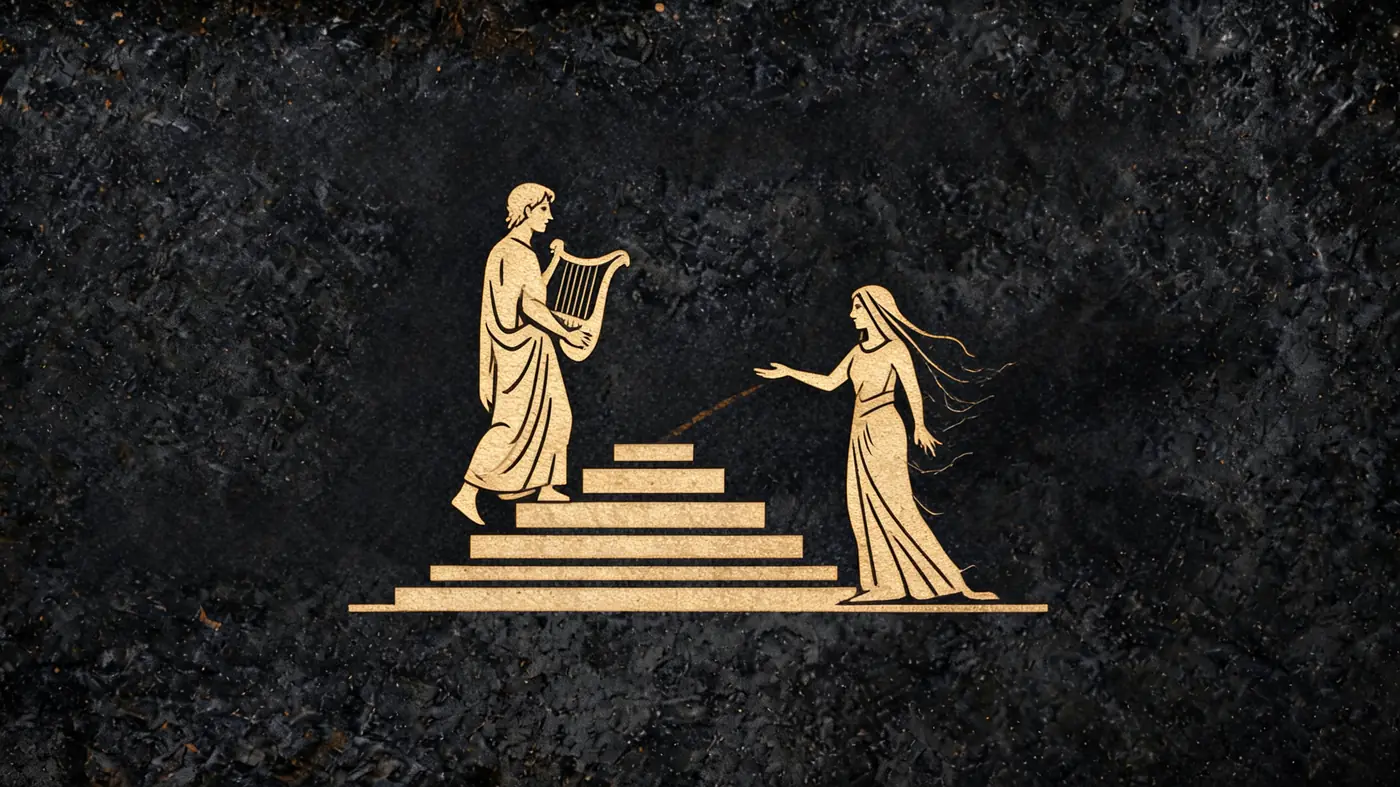
They were nearly out. In Ovid’s telling, Orpheus was at the very edge of daylight when the fear finally broke him. He could not hear her, and he could not know she was there. He wondered whether the gods had tricked him, whether the path behind him was empty. Afraid of losing her and longing to see her, he turned his head.
She was there. For an instant he saw her face. Then she began to slip backwards into the dark. She did not blame him. She said only a last faint farewell, and he reached for her and closed his hands on air.
He had turned one step from the world above. The rule broke, and Eurydice died a second time.
THE SECOND DEATH
Orpheus tried to go down again. This time Charon refused him, and there was no crossing twice. The poets say he sat for days at the edge of the river without eating, singing his grief to nobody who could answer.
Then he gave up on the living world. He wandered Thrace alone, played only for himself, and turned away the women who came to him. He had lost the one person he wanted, and he would not replace her.
His end came from the followers of Dionysus. The Maenads, women caught in the god’s frenzy, found him singing alone in the wilderness. They threw stones and branches at him, and his music charmed them so completely that the weapons fell harmlessly at his feet. Then their shouting drowned out the lyre, and with the song gone there was nothing left to protect him. They tore him apart.
His head and his lyre floated down the river Hebrus to the sea. They washed ashore on the island of Lesbos, and Orpheus was still singing, even then.
WHAT CAME AFTER
The Muses gathered what was left of him and buried it at the foot of Mount Olympus. Zeus placed his lyre among the stars, where it still hangs as the constellation Lyra.
Orpheus’s shade went down to the underworld one last time. There, at last, he found Eurydice. In Ovid’s ending they walk together in the fields of the dead, sometimes she in front and sometimes he, and now he may look at her whenever he likes.
The myth gave the Greeks a whole tradition. Followers called Orphics believed that Orpheus had brought back secret teachings from the land of the dead, and they copied out poems and rites that promised the soul a path through it. The story was not only a love story to them. It was a map of what lies beyond.
WHAT ORPHEUS MEANS
Orpheus is not a fighter. He wins where fighting fails, and he loses in the one place skill cannot help him. The descent costs him nothing but the gift of his voice. The climb costs him everything, because it asks something harder than music: to walk without proof, to trust what he cannot see, and to not look back.
Every reader feels the same thing at the turn. You know he will look. You want him not to. And when he does, you understand him, because the silence behind him was unbearable. That is the force of the myth. The catastrophe is not a flaw in Orpheus. It is the cost of loving someone you can no longer hear.
Three thousand years later, the question is still open: what would you have done on that last step?
THE NEOLITHIC CONNECTION
Orpheus takes the road that every bloodline in our collections knows: the descent. Greek Legends carries it again in Odysseus’s journey to the house of Hades, where the living speak to the dead and come back changed.
The last scene of the myth is now a tee. The Silence Behind Him puts Orpheus and Eurydice on the back as one figure in the fields of the dead, with the lyre on the chest.
Other mythologies walk the same road. Norse tradition has Hel, the queen who keeps the dead. The Maya go down through Xibalba, where Ah Puch waits at the bottom. In Egypt the heart is weighed in the judgment of Anubis. Each one asks what a person owes the dead. Only Orpheus tried to take someone back.
— Neolithic Store
[…] living got past him. Aeneas crossed with a golden bough as his pass. Heracles crossed by force. And Orpheus crossed because he sang, and the ferryman could not refuse a song like […]