Anubis and the Weighing of the Heart — Egypt’s Judgment of the Dead

Most mythologies let you in through a gate. Egypt made you stand on a scale first.
Before a soul could reach any version of paradise, it had to pass a single test with no appeal and no retake: the heart of the dead was set on a balance and weighed against a feather. Not a metaphorical weighing. A physical one, performed in front of witnesses, with a verdict read aloud.
The god who ran that scale was Anubis — and the thing waiting under it, if the beam tipped the wrong way, was not a punishment. It was an ending.
THE HEART ON THE SCALE
The Egyptians called it the Hall of Two Truths — the Hall of Ma’at. It is described most fully in the Book of the Dead, the collection of spells copied onto papyrus and tomb walls to carry a person through everything that happened after they died.
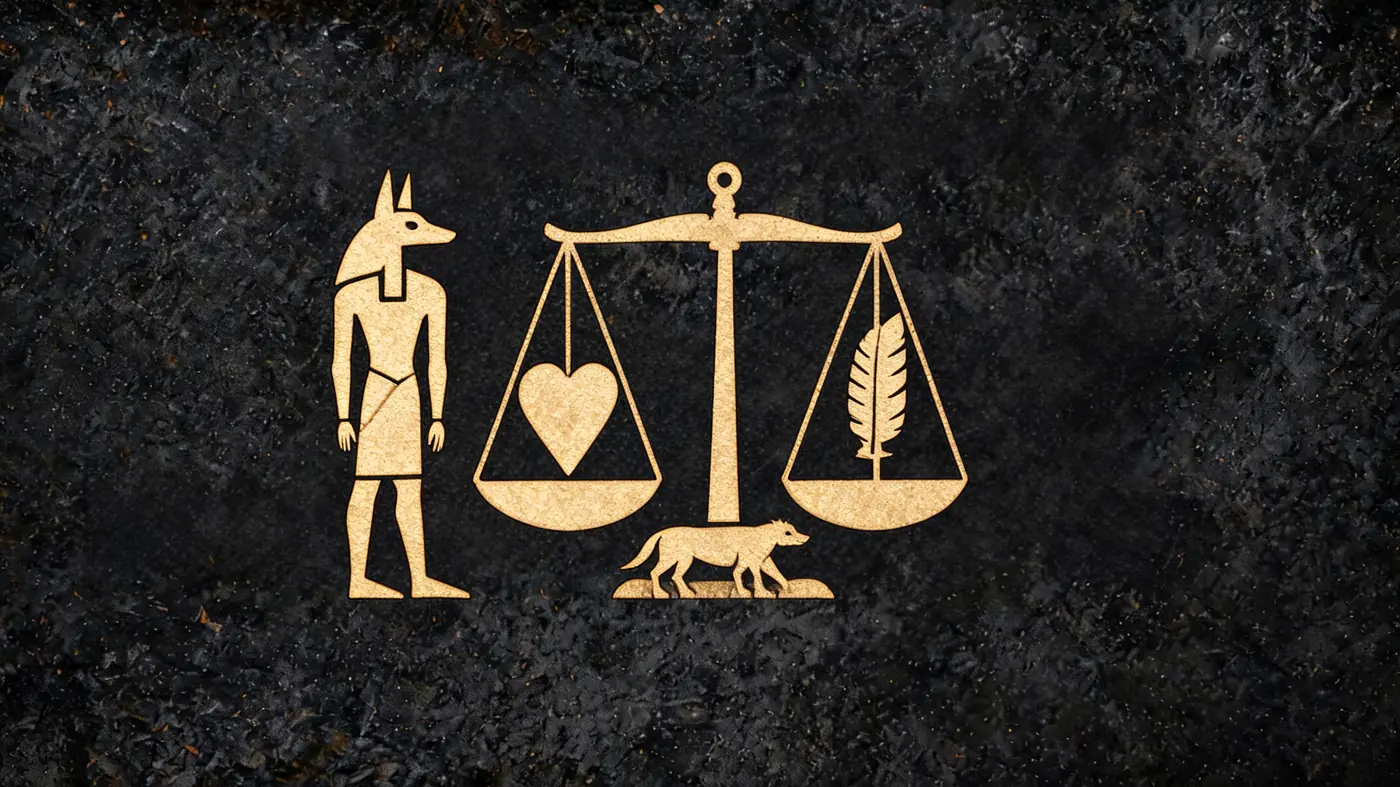
The dead arrived and were led to a great balance. On one pan went the heart. On the other went a single ostrich feather, the emblem of Ma’at — the goddess who stood for truth, justice, and the order that held the cosmos together. The question the scale asked was simple: is this heart heavier than truth?
A heart that balanced the feather, or sat lighter than it, belonged to someone who had lived within Ma’at. That soul was declared “true of voice” and allowed to continue toward the Field of Reeds, an idealised Egypt where the barley grew tall and the river never failed.
A heart that sank the pan was weighed down by cruelty, deceit, and disorder — a life lived against Ma’at. There was no sentence, no term of punishment to serve. There was only what stood beside the scale, waiting.
WHY THE HEART, AND NOT THE HEAD
To understand why the scene carries the weight it does, you have to know what the Egyptians thought the heart was.
The heart — ib — was the centre of the person. It held thought, intention, memory, and conscience. It was where decisions were made and where the record of those decisions was kept. The brain, by contrast, was considered near-useless; during embalming it was broken up and drawn out through the nose and thrown away.
The heart stayed. It was left inside the body, or wrapped and returned to the chest, precisely because it would be needed at the trial. It was the witness. It carried the evidence of how a life had actually been lived, and it could not be told to stay quiet.
That is also why so many mummies were buried with a heart scarab — a carved beetle, placed over the heart, inscribed with a spell that speaks directly to it: do not stand up against me as a witness, do not tip the scale before the keeper of the balance. A last, quiet request to one’s own conscience not to give everything away.
ANUBIS AT THE BEAM
Anubis is the oldest death-god in the Egyptian record. Before Osiris rose to rule the underworld, it was the jackal-headed Anubis who owned the business of dying — the embalming, the wrapping, the guarding of the grave, the guiding of the soul down the first dark roads. His title was Opener of the Ways.
By the time the Book of the Dead was standardised, Osiris presided over the hall as its enthroned judge, but the hands-on work at the scale still belonged to Anubis. In the vignettes painted on papyrus, it is Anubis who kneels at the base of the balance, adjusting the plumb line, making sure the reading is honest. He is not there to condemn. He is there to make the measurement exact.
Beside him stands Thoth, ibis-headed, holding a scribe’s palette, ready to write down the result. Whatever the scale says, Thoth records, and the record stands. Between the one who weighs and the one who writes, the verdict is both taken and kept.
THE FORTY-TWO DENIALS
The weighing was not silent. As the heart was placed on the pan, the dead person spoke.
Spell 125 of the Book of the Dead contains what is usually called the Negative Confession — a long series of denials addressed to a court of forty-two divine judges, one for each region of Egypt. The dead names each judge in turn and clears themselves of a specific wrong: I have not stolen. I have not killed. I have not lied on the scales. I have not caused anyone to weep. I have not held back the water when it should have flowed.
It is not a plea for forgiveness. It is a statement of account — a person standing before the powers of the cosmos and listing, precisely, the lines they did not cross. The scale was there to check the statement against the heart. Both had to agree.
AMMIT, AND THE SECOND DEATH
Crouched under the balance, in almost every surviving image of the scene, is Ammit.
Her name means “Devourer of the Dead,” and she is assembled from the three animals Egyptians feared most: the head of a crocodile, the forequarters of a lion, the hindquarters of a hippopotamus. She does not chase anyone. She waits by the scale, and when a heart proves heavier than the feather, it is given to her and she eats it.
What that meant, in Egyptian terms, was total. To lose the heart was to lose the self. There was no afterlife to be exiled from, no punishment to endure and outlast — the soul was unmade, wiped from every world at once. The Egyptians had a phrase for it: the second death. The first death took the body. The second one took the fact that you had ever existed.
Everything the culture built around dying — the embalming, the spells, the scarabs, the offerings left at the tomb — was engineering against that second death. The scale was the point where all of it was tested at once.
THE ANKH ON THE OTHER SIDE
The reward on the far side of the scale had a symbol too.
The ankh — a looped cross, carried by nearly every Egyptian god in the tomb paintings — was the sign for life, and specifically for life that continues past the body. Gods are shown holding it to the lips of the dead, breathing existence back into them. It is the visual opposite of Ammit: where she is the end of the self, the ankh is the self that does not end.
But it was never automatic. In the art, the ankh is always being given — extended by a god, earned by a passed judgment, placed in the hand of someone who has already stood at the balance and been found light. It is not a promise made to everyone. It is what the scale releases to you if the heart holds.
THE NEOLITHIC CONNECTION
At Neolithic Store, this judgment is carried in the Egypt Mythos collection as the design that puts the whole trial on one garment — the test, and what waits on either side of it.
Lighter Than the Feather carries the weighing on the back: Anubis upright between two slabs of oxblood, the scales held out beside him. The front holds his head in profile, ink on a block of oxblood — the one who keeps the count, lifted out of the courtroom and worn on its own.
The title is the pass condition, stated plainly. A heart no heavier than a feather. Everything Egypt built was aimed at being able to say that one sentence and have the scale agree.
Available now at neolithicstore.com.
Forged from ancient bloodline. Worn by the modern warrior.
Neolithic Store is a premium mythology-inspired streetwear brand rooted in the stories that shaped human civilization. Every design begins with research, every piece carries a story, and every stitch is made for those who wear their beliefs on their skin.
[…] Maya go down through Xibalba, where Ah Puch waits at the bottom. In Egypt the heart is weighed in the judgment of Anubis. Each one asks what a person owes the dead. Only Orpheus tried to take someone […]
[…] held to be the shape of the world, the same order whose feather is weighed against the heart in the judgment of Anubis. Apep was not the god of anything. He ruled no region and no season. He was what would happen if […]
[…] Egypt did not ask whether you lived well. It asked whether your heart was light. In the Hall of Two Truths, Anubis sets the heart of the dead against the feather of Ma’at. Balance it and the road goes on. Tip it and Ammit is already waiting. The heart was kept in the body through every stage of embalming because it, not the brain, was thought to hold the record of a life.See the design · Read the story […]