Fenrir — The Wolf That Devoured the Gods

There are wolves in every mythology. Guardians, tricksters, shadow figures that lurk at the edge of firelight. But none of them carry the weight of Fenrir — the monstrous wolf of Norse legend whose very existence made the gods tremble.
Fenrir wasn’t born from darkness. He was born from Loki, the trickster god, and the giantess Angrboða. From the moment he drew breath, the Aesir — the ruling gods of Asgard — saw what he would become. The prophecies were clear: this wolf would bring about Ragnarök, the twilight of the gods, the end of everything they had built.
So they did what gods do when they’re afraid. They tried to control it.
The Chains That Could Not Hold
The gods raised Fenrir in Asgard, keeping him close, watching him grow. Only Tyr, the god of war and justice, had the courage to feed him. But as Fenrir grew larger — his shadow stretching across the halls of the divine — the gods knew that watching wasn’t enough.
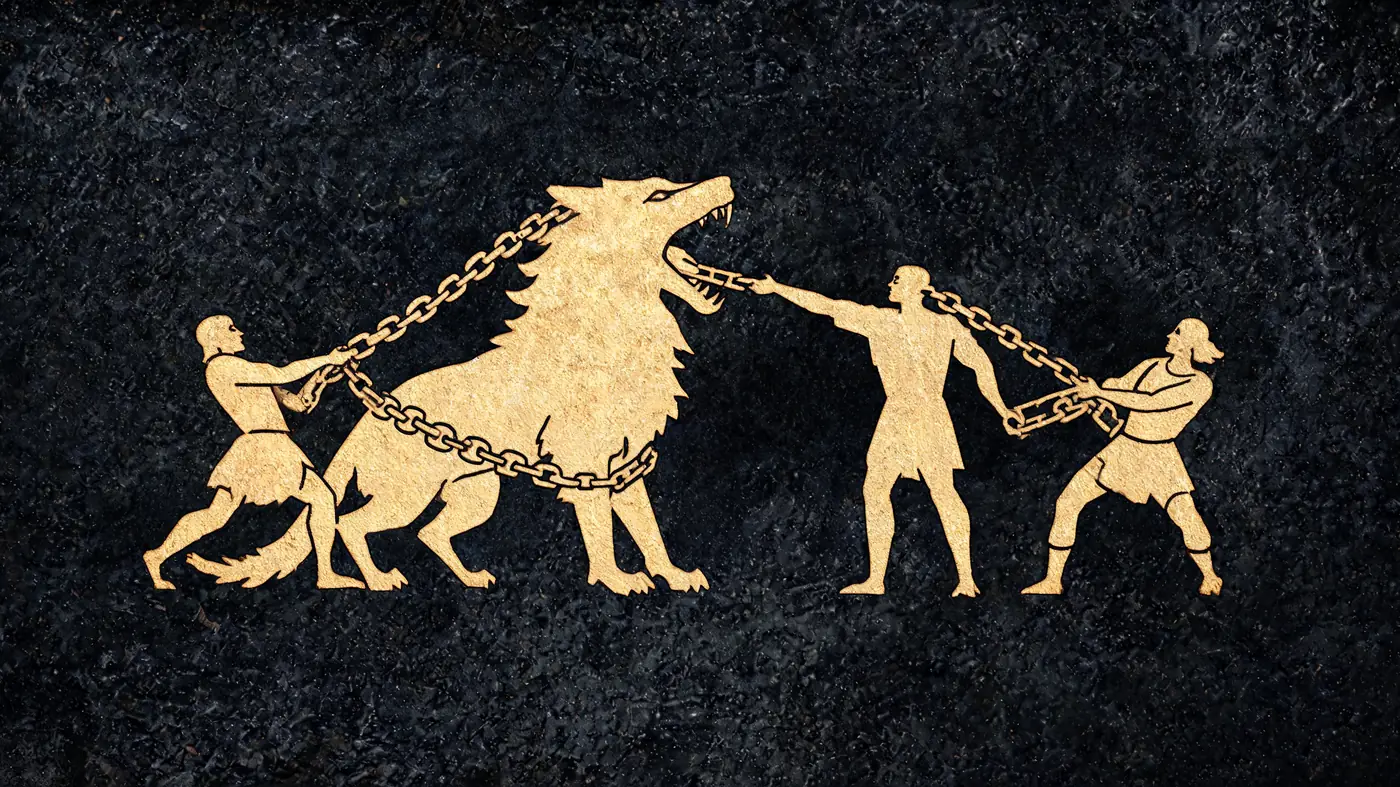
They forged Leyding, a massive chain, and challenged Fenrir to test his strength against it. The wolf shattered it effortlessly. They forged Dromi, twice as strong. Fenrir broke that too, his legend growing with every link that fell.
Desperate, the gods turned to the dwarves — the master craftsmen of the nine realms. What the dwarves created was Gleipnir, a binding that looked like a silk ribbon but was forged from impossible things: the sound of a cat’s footsteps, the beard of a woman, the roots of a mountain, the sinews of a bear, the breath of a fish, and the spittle of a bird. Things that don’t exist — and that’s precisely why it could never be broken.
The Price of Binding
Fenrir was no fool. When the gods presented Gleipnir as another test of strength, the wolf sensed the trap. He agreed to be bound on one condition: a god must place their hand in his mouth as a pledge of good faith.
Only Tyr stepped forward.
When Fenrir strained against Gleipnir and realized the ribbon would not break, he bit down. Tyr lost his hand — the price of binding something that was never meant to be caged. It remains one of the most powerful images in all of Norse mythology: the god of justice sacrificing his sword hand for a lie told by the heavens.
Fenrir was dragged to a desolate place, a sword thrust between his jaws to hold them open, his howls echoing across the realms. There he would remain, growing, seething, waiting — until the end of everything.
Ragnarök — The Chain Breaks
At Ragnarök, Fenrir breaks free. His jaws stretch from earth to sky. He swallows Odin, the Allfather, the king of gods — consuming the most powerful being in the Norse cosmos. It takes Odin’s son Víðarr, stepping into the wolf’s mouth and tearing it apart, to finally end Fenrir’s hunger.
But by then, the old world is already burning.
Why Fenrir Still Matters
Fenrir isn’t a villain. He’s a mirror.
He represents the thing every civilization, every empire, every person tries to suppress — the force they know will eventually undo them. The gods didn’t create Fenrir’s rage. They created the chains, and the chains created the rage.
There’s a reason Fenrir endures in art, in ink, in the iconography of rebellion and strength. He embodies the idea that what you try to suppress will eventually consume you. That power isn’t something you cage — it’s something you become.
In the ancient world, wolves weren’t symbols of evil. They were symbols of the untamed, the sovereign, the unapologetic. Fenrir is the ultimate expression of that archetype — a creature so powerful that even the gods couldn’t look away.
THE NEOLITHIC CONNECTION
Fenrir belongs to our Norse Saga collection — the wolf the gods bound because they could not beat him.
Fenrir — The Unchained Wolf carries the moment the chain gives. What you cage, you feed.
The old myths didn’t tell stories about comfort. They told stories about power, sacrifice, and the things that refuse to stay buried. That’s the thread we carry forward.
— Neolithic Store
[…] The gods raised the wolf, watched him grow, and grew afraid. Two chains broke like dry wood. The dwarves then made Gleipnir, a ribbon woven from things that do not exist, and Fenrir would accept it only if a god placed a hand in his jaws. Only Týr stepped forward. The ribbon held, and the wolf bit down. The chest carries the mark of the god who paid. The back shows the wolf tearing loose.See the design · Read the story […]