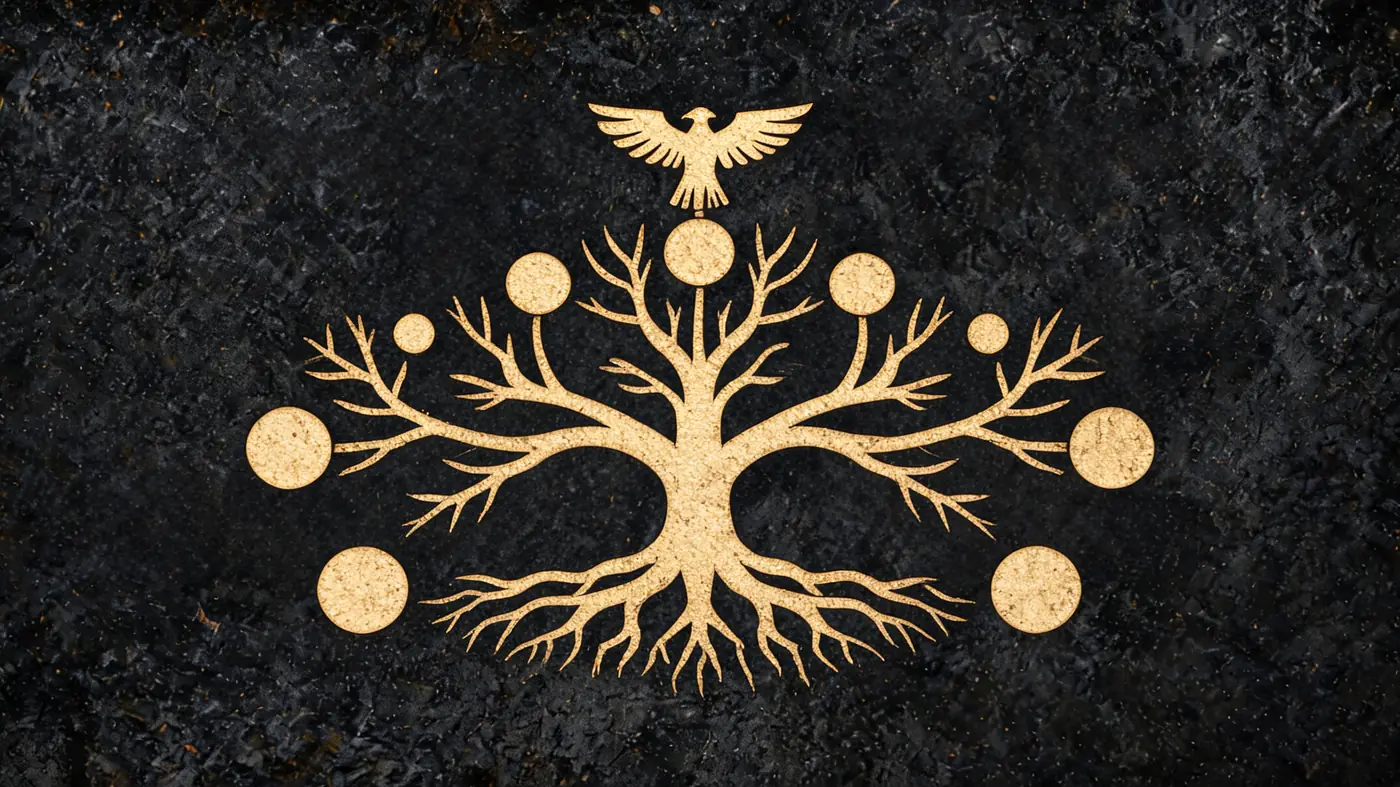
Yggdrasil — The Tree That Holds Everything

Every civilization has a centre. A point where all lines converge, where the sacred meets the real, where meaning is anchored before it spirals outward. Rome had its forum. Egypt had the Nile. The Norse had something older and stranger — a tree so vast that its roots drank from the wells of fate and its branches held the sky in place.
They called it Yggdrasil. The World Tree. The spine of existence itself.
The Architecture of Everything
Yggdrasil is an ash tree — immense, evergreen, and impossible. Its canopy stretches above the highest heavens, its trunk runs through the middle world of men, and its three roots plunge into the deepest layers of the cosmos. It doesn’t grow in the Norse universe. It is the Norse universe. Without Yggdrasil, the nine realms have no structure, no connection, no reason to exist in relation to one another.
The nine worlds are threaded through its branches and roots like rooms in a vertical cathedral. Asgard, realm of the gods, sits at the crown. Midgard, the world of humans, rests along the trunk, encircled by the great serpent Jörmungandr. Below, in the cold depths, lies Niflheim — the realm of the dead, ruled by Hel. Between them: Jötunheim, land of the giants. Alfheim, world of the elves. Svartálfheim, domain of the dwarves. Vanaheim, home of the Vanir gods. Muspelheim, the realm of fire. Each world distinct, each world dependent on the same living axis.
Yggdrasil doesn’t just connect these realms. It sustains them. When the tree shudders, all of reality shudders with it.
The Three Roots
Every great structure needs a foundation, and Yggdrasil’s roots are as mythic as its branches. Three massive roots extend from the base of the tree, each reaching a different well — each well holding a different kind of knowledge.
The first root reaches into Urðarbrunnr, the Well of Fate. Here sit the three Norns — Urð, Verðandi, and Skuld — who carve the destinies of gods and mortals into the wood of the tree itself. Past, present, and future are not abstract concepts in Norse cosmology. They are women, sitting at the base of a tree, writing history into bark. The Norns draw water from the well each day and pour it over Yggdrasil’s roots to keep it from rotting. Even the World Tree needs tending.
The second root descends to Mímisbrunnr, the Well of Wisdom, guarded by the ancient being Mímir. This is where Odin came when knowledge alone wasn’t enough — when he needed understanding. The price of a single drink from that well was an eye. Odin paid it without hesitation, plucking out his own eye and dropping it into the water. The Allfather walked away half-blind and twice as dangerous.
The third root extends into Hvergelmir, the Roaring Kettle, a churning spring in the frozen depths of Niflheim. This is the source of eleven ancient rivers, the primordial waters from which life first stirred. And coiled among these roots is Níðhöggr — the dragon that gnaws endlessly at the tree’s foundation, slowly devouring the very thing that holds the cosmos together.
The Creatures Within
Yggdrasil is not a quiet place. It is an ecosystem — a vertical world teeming with beings that exist in constant tension.
At the top of the tree sits an unnamed eagle, wise and watchful, its gaze sweeping across the realms. Between its eyes perches a hawk called Veðrfölnir. At the bottom, Níðhöggr chews at the roots with ancient patience. And running between them — up and down the trunk in an endless relay — is Ratatoskr, a squirrel who carries insults between the eagle and the dragon, feeding their hatred, keeping the tension alive.
It’s a strange and brilliant image. The structure of the universe held together not by harmony, but by conflict. The eagle and the dragon despise each other, and the squirrel makes sure neither one forgets it. Yggdrasil doesn’t survive because everything is at peace. It survives because every force within it — creation and destruction, wisdom and decay — is locked in a balance that never quite tips.
Four stags — Dáinn, Dvalinn, Duneyrr, and Duraþrór — roam the branches, feeding on the tree’s foliage. Yggdrasil gives endlessly, and everything takes from it. The tree is both the source and the sacrifice.
Odin’s Gallows
Yggdrasil’s name itself carries a dark meaning. “Ygg” is one of Odin’s names, meaning “the terrible one.” “Drasill” means “horse” — but in Old Norse kenning, a gallows was called “the horse of the hanged.” Yggdrasil is, literally, Odin’s gallows.
The name points to one of the most harrowing episodes in Norse myth. Odin, in his relentless hunger for knowledge, hanged himself from Yggdrasil’s branches. He pierced his own side with a spear and hung there for nine days and nine nights — no food, no water, staring into the void below. On the ninth night, the runes revealed themselves to him. The secret alphabet of reality, the symbols that could bend fate, heal wounds, raise the dead, and bind enemies.
Odin didn’t find the runes in a library. He bled for them on the trunk of the World Tree. Knowledge, in the Norse worldview, was never free. It was always purchased with sacrifice — and the greater the knowledge, the greater the cost.
The Tree at the End
When Ragnarök comes — the final battle, the twilight of the gods — Yggdrasil trembles. The worlds it holds together begin to fracture. Fire sweeps through the branches. The seas rise. The sky splits.
But Yggdrasil does not fall.
In the wreckage of the old world, two humans — Líf and Lífþrasir — survive by sheltering within the World Tree. They emerge into a world washed clean, green and silent, and from them, humanity begins again. The tree that held the old cosmos together becomes the seed of the new one.
Yggdrasil is not a symbol of permanence. It is a symbol of continuity — the idea that even when everything burns, the structure endures. The roots hold. The cycle begins again.
Why It Still Resonates
Most mythologies place their gods at the centre of everything. The Norse placed a tree.
Not a throne, not a weapon, not a palace — a living thing that grows, suffers, gives, and endures. Yggdrasil is the quiet argument that connection matters more than power. That the thing holding everything together isn’t the strongest force in the room — it’s the most rooted.
In a world that builds monuments to dominance, the Norse built their cosmology around something that grows in silence, feeds everything that takes from it, and stands long after the gods themselves have fallen.
That’s not weakness. That’s the deepest kind of strength there is.
THE NEOLITHIC CONNECTION
Yggdrasil anchors our Norse Saga collection the way it anchors the nine worlds.
Yggdrasil — World Tree carries the roots, the wells and the branches. Norse Níðhöggr carries what gnaws at them from below. The tree holds anyway — that is the whole point of it.
The ancients didn’t worship power for its own sake. They understood that the things which endure aren’t the things that conquer — they’re the things that hold.
— Neolithic Store
[…] Yggdrasil, the great ash, is not a tree that grows in the Norse cosmos. It is the Norse cosmos. Its branches hold up the sky; its trunk passes through the world of men; its three vast roots reach into the wells of fate, wisdom, and the frozen dark. Gods hold their councils beneath it. The fates of all living things are carved at its base. If the tree stands, everything stands. […]