
IPHIGENIA — THE DAUGHTER WHO BECAME THE PRICE OF WAR

Before the first Greek ship could cut through the waters toward Troy, before Achilles drew his sword or Odysseus spun his cunning, there was a moment of terrible stillness. A thousand ships sat motionless in the harbour at Aulis, their sails slack, their crews restless. The wind had died — not by chance, but by divine command. And the price to restore it was not gold, not cattle, not the blood of warriors. It was a girl.
Her name was Iphigenia. And her story is one of the most haunting in all of Greek mythology — a tale that sits at the crossroads of duty and love, of divine cruelty and human courage. It is a story that launched a war, destroyed a family, and has echoed across millennia of art, literature, and philosophy.
Her name means “strong-born.” The irony of that name would unfold on a sacrificial altar at the edge of the Aegean Sea.
THE HOUSE OF ATREUS
Iphigenia was born into one of the most powerful — and most cursed — families in the ancient world. She was the eldest daughter of Agamemnon, King of Mycenae and supreme commander of the Greek forces, and Queen Clytemnestra. Her siblings included Orestes and Electra, both of whom would later become central figures in their own cycles of tragedy and revenge.
The House of Atreus was no ordinary royal line. This was a dynasty stained with ancestral sin — a family haunted by a generational curse that twisted every triumph into catastrophe. Her grandfather Atreus had committed unspeakable acts against his own brother, and the gods had long marked this bloodline for suffering. Iphigenia, innocent as she was, was born into the centre of this storm.
In some earlier traditions, she is called Iphianassa — a name that appears in Homer’s Iliad. Whether these are two names for the same figure or two distinct daughters of Agamemnon has been debated by scholars for centuries. But in every version, she is the daughter whose fate would alter the course of the war before it even began.
THE STILLNESS AT AULIS
When Helen of Sparta was taken to Troy by Paris, the Greeks assembled the greatest military expedition the ancient world had ever seen. Over a thousand ships gathered at the port of Aulis, ready to cross the Aegean and lay siege to Troy. But the fleet could not move. Artemis, goddess of the hunt and the wild, had stilled the winds.
The reason for her anger varies by tradition. In the most widely told version, Agamemnon had killed a sacred deer in a grove dedicated to Artemis. Some accounts say he boasted that his hunting skill surpassed even the goddess herself — a staggering act of hubris that no Olympian would tolerate. Whatever the precise offence, Artemis’s response was devastating: no wind would blow, and no ship would sail, until Agamemnon paid her price.
The seer Calchas delivered the oracle. To appease the goddess and free the fleet, Agamemnon had to sacrifice his eldest daughter.
Think about the weight of that demand. A father. A king. A military commander. Told that the entire war effort — the honour of Greece, the retrieval of Helen, the ambitions of heroes yet unnamed — hinged on his willingness to kill his own child.
THE FALSE WEDDING
Agamemnon resisted at first. But the pressure of kings, commanders, and the restless Greek army eventually broke him. Under pressure from Menelaus, Odysseus, and the assembled warlords, he devised a cruel deception.
He sent word to Clytemnestra that their daughter was to be married to Achilles, the greatest warrior of the age. What mother would not rejoice? What daughter would not travel eagerly to meet such a groom? Clytemnestra and Iphigenia journeyed to Aulis with joy in their hearts — only to discover that the altar waiting for Iphigenia was not a wedding altar, but a sacrificial one.
In Euripides’s Iphigenia at Aulis, the revelation unfolds in agonising stages. Agamemnon, immediately regretting his decision, tried to send a second letter warning his family away — but Menelaus intercepted it. When Clytemnestra arrived and mentioned the marriage to Achilles, the hero had no idea what she was talking about. The truth crept out slowly, then all at once. Achilles, furious that his name had been used in this deception, vowed to protect Iphigenia. But the army was turning violent in its impatience.
The gears of war do not stop for a father’s tears.
THE SACRIFICE — OR WAS IT?
What happens next is where the myth fractures into its most compelling variations.
In some versions, Iphigenia goes willingly. She transforms from a terrified young woman into a figure of startling resolve, choosing to give her life so that the Greek army may fulfil its destiny. She asks her mother not to mourn and walks to the altar of her own volition. In these tellings, Iphigenia becomes a symbol of selfless courage — a mortal who accepts her fate with a dignity that shames the gods who demanded it.
In other versions, she begs for her life. She pleads with her father, asking what Helen’s honour is worth compared to his own daughter’s blood. These versions are darker, more unflinching in their portrayal of power crushing innocence.
But the most widely told version offers a twist: at the very moment the knife falls, Artemis intervenes. The goddess spirits Iphigenia away, replacing her body on the altar with a deer. The witnesses see only the animal’s blood. To them, the sacrifice is complete. The winds return. The fleet sails for Troy.
But Iphigenia is not dead. She has been taken by Artemis to the wild shores of Tauris, on the Black Sea, where she will begin an entirely new chapter of her story.
PRIESTESS IN A FOREIGN LAND
In Tauris, Iphigenia became a priestess of Artemis. The girl who had been brought to an altar as a sacrifice now stood behind one as its keeper. The irony is layered and deliberate — Greek myth rarely wastes a parallel.
Years passed. The Trojan War was fought and won. Troy fell. Agamemnon returned home in triumph — only to be murdered by Clytemnestra and her lover Aegisthus, partly in vengeance for Iphigenia’s sacrifice. The cycle of violence within the House of Atreus continued unbroken.
Then came Orestes, Iphigenia’s brother, tormented by the Furies after killing his own mother to avenge his father. Seeking purification, he was directed to Tauris to retrieve a sacred wooden image of Artemis and bring it back to Athens. He travelled there with his loyal companion Pylades.
The siblings did not recognise each other at first. Iphigenia, tasked with preparing foreign captives for sacrifice, came face to face with her own brother without knowing who he was. The moment of recognition — when brother and sister finally see each other across years of separation, grief, and assumed death — is one of the most powerful scenes in Greek drama. Together, Iphigenia, Orestes, and Pylades escaped Tauris and returned to Greece, bringing the cycle of the House of Atreus one step closer to resolution.
WHAT IPHIGENIA MEANS
Iphigenia’s story is not just a myth. It is a moral earthquake.
It asks the questions that civilisations have never stopped wrestling with. How much should one person sacrifice for the ambitions of many? Can a father’s duty to his nation override his duty to his child? Is obedience to the gods virtuous — or is it cowardice dressed in piety? And perhaps most uncomfortably: who decides which lives are expendable when power demands a price?
Even the Roman poet Lucretius held up her story as evidence of religion’s capacity for cruelty. For him, the tale was not one of divine wisdom but of the horror that blind devotion can produce.
And yet the rescue version of the myth offers something else entirely: the possibility that the divine is not only punishing but also merciful. Artemis demanded a sacrifice but also provided a way out. Iphigenia was tested, transformed, and ultimately saved. She moved from victim to priestess, from helplessness to authority, from silence to recognition.
IPHIGENIA IN ART AND CULTURE
Few mythological figures have inspired as many retellings. Euripides wrote two entire plays centred on her — Iphigenia at Aulis and Iphigenia in Tauris. Aeschylus wove her sacrifice into his masterwork Agamemnon. Racine, Goethe, and Gluck returned to her story across centuries, in opera, theatre, and verse.
Ancient mosaics and red-figure pottery depict the moment of sacrifice, the substitution of the deer, and the reunion with Orestes. Renaissance and Neoclassical painters rendered her story in oils — the German artist Anselm Feuerbach returned to her image repeatedly, drawn to the quiet gravity of a woman who endured what no one should.
Her legacy endures because her dilemma is timeless: the individual caught between forces vastly larger than herself, finding within that impossible position a courage that transcends the circumstances that created it.
In every version of her story, Iphigenia embodies resilience forged in the most extreme circumstances. She is the unwilling sacrifice who becomes something greater than the war that consumed her family. That transformation — from bloodline to strength, from ancient wound to enduring power — is at the very heart of what mythology teaches us.
The ancients understood that strength is not always born from victory. Sometimes it is forged at the altar, in the silence between the knife and the wind, in the moment a girl decides that her fate belongs to no one but herself.
THE NEOLITHIC CONNECTION
Iphigenia is the first cost of the war our Greek Legends collection keeps returning to. The fleet that finally sailed from Aulis is the same fleet that spent ten years trying to find its way home.
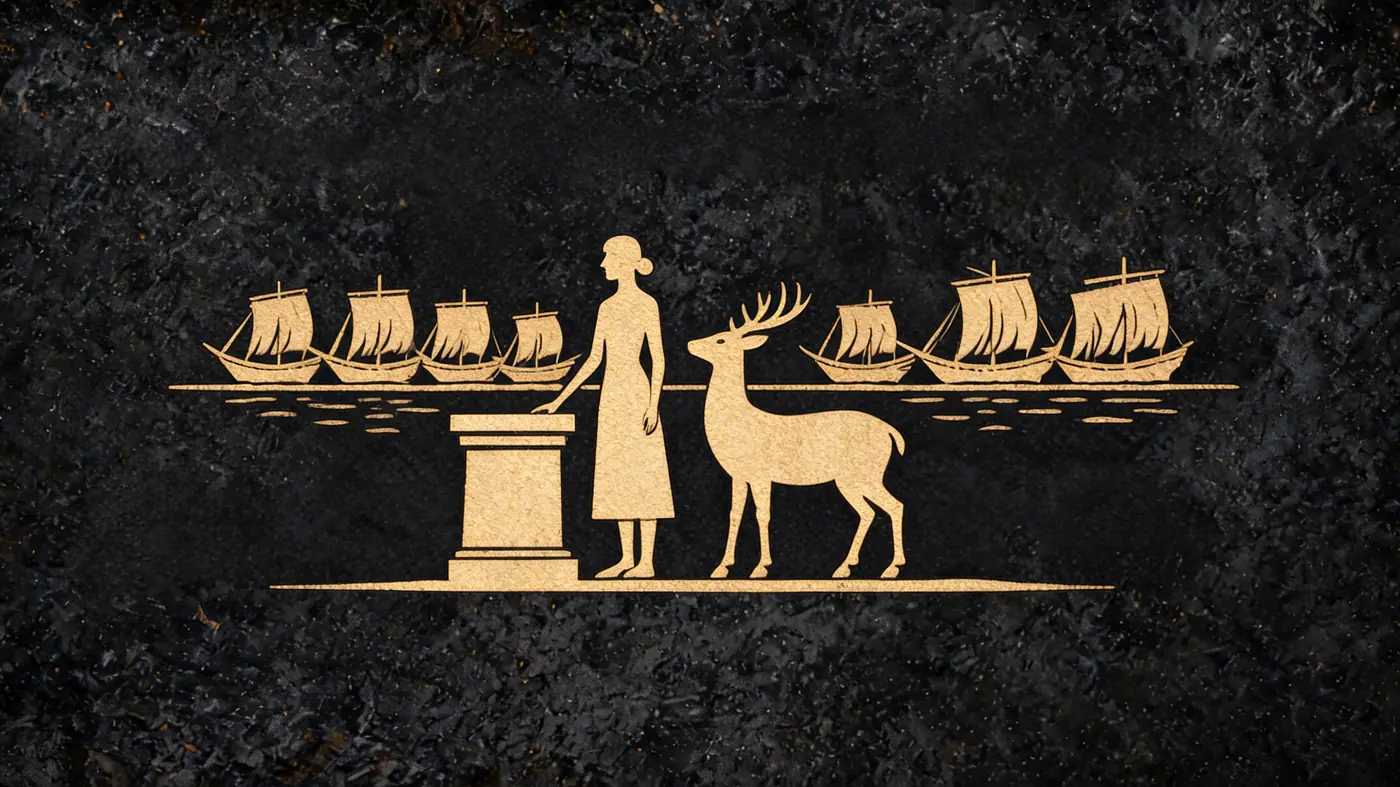
Iphigenia herself is carried in The Price of Wind, a gold sail over still water, a girl at the altar, the hind beside her. The wind is not in the picture. It is what she was asked to pay for.
That long return is carried in Enduring Will and The Long Return. The war began with a daughter at an altar. It ended with men who could not get back.
— Neolithic Store