MEDUSA: THE GORGON WHO TURNED FEAR INTO POWER

There is a moment in every myth when the story stops belonging to the gods and begins belonging to everyone who has ever been punished for someone else’s transgression. The tale of Medusa is that moment crystallized — a narrative so ancient it predates the Greek civilization that claimed it, so potent it still stops us in our tracks three thousand years later. She is the face that launched a thousand shields, the figure carved into temple pediments and warrior breastplates, the name whispered when mortals needed protection against the very darkness they feared. To call her a monster is to miss the point entirely. To call her a victim is to strip her of the terrible power she earned in suffering. Medusa is something far more dangerous than either — she is the embodiment of transformation through injustice, the proof that even the cruelest curse can become a weapon in the hands of the one it was meant to destroy.
THE MAIDEN BEFORE THE MONSTER
Before there were serpents coiled where golden hair once fell, before her gaze could petrify flesh into cold stone, Medusa was a mortal woman of extraordinary beauty. She was born to Phorcys and Ceto, primordial deities of the sea — ancient beings whose bloodline produced some of the most fearsome creatures in the Greek mythological tradition. Her sisters, Stheno and Euryale, were immortal Gorgons from birth. Medusa alone was mortal. Already, even at her origin, the myth marks her as different — the vulnerable one among monsters, the human thread in a tapestry of divine horror.
Ancient sources diverge on the details of her early life, as myths always do when they carry the weight of something true. The Roman poet Ovid, writing in his Metamorphoses around the turn of the first millennium, gave us the version that has endured most vividly in the cultural imagination. In his telling, Medusa was not merely beautiful — she was renowned for it, and her hair was her most celebrated feature. She served as a priestess in the temple of Athena, bound by the sacred vow of chastity that such devotion demanded.
However, it was Poseidon, lord of the oceans, who shattered that devotion. The sea god violated Medusa within the sacred walls of Athena’s own temple — an act of desecration so profound that it demanded divine response. But the response, when it came, did not fall upon the god who committed the transgression. Poseidon, being an Olympian, was beyond Athena’s reach or retribution. And so the punishment fell instead upon Medusa herself. Athena, enraged by the defilement of her sanctuary, cursed the very priestess who had served her. The golden hair became a nest of writhing serpents. The face that had inspired admiration became a weapon of annihilation — anyone who looked upon it would be turned to stone, frozen forever in the last expression their living face would ever wear.
THE GAZE THAT TURNED THE WORLD TO STONE
Indeed, there is something deeply unsettling about the nature of Medusa’s curse, and it is not the serpents or the petrification. It is the loneliness. The real horror of becoming a Gorgon was not the monstrous appearance — it was the impossibility of ever again being seen. Every meeting of eyes, that most fundamental act of human connection, became lethal. To look at Medusa was to die. To be Medusa was to exist in permanent exile from every gaze, every glance, every moment of recognition that makes a person feel real.
Subsequently, she retreated to the edges of the known world with her Gorgon sisters, dwelling in the desolate regions that the ancient Greeks placed at the borders of existence — beyond the great river Oceanus, in the frontier lands toward eternal night. Earlier Greek writers like Hesiod, composing his Theogony around 700 BC, placed the Gorgons in this geographic and symbolic wilderness, creatures who belonged to the boundary between the known and the unknowable. Medusa’s exile was both literal and metaphorical — she was pushed to the margins of the world because the world could not bear to face what had been done to her.
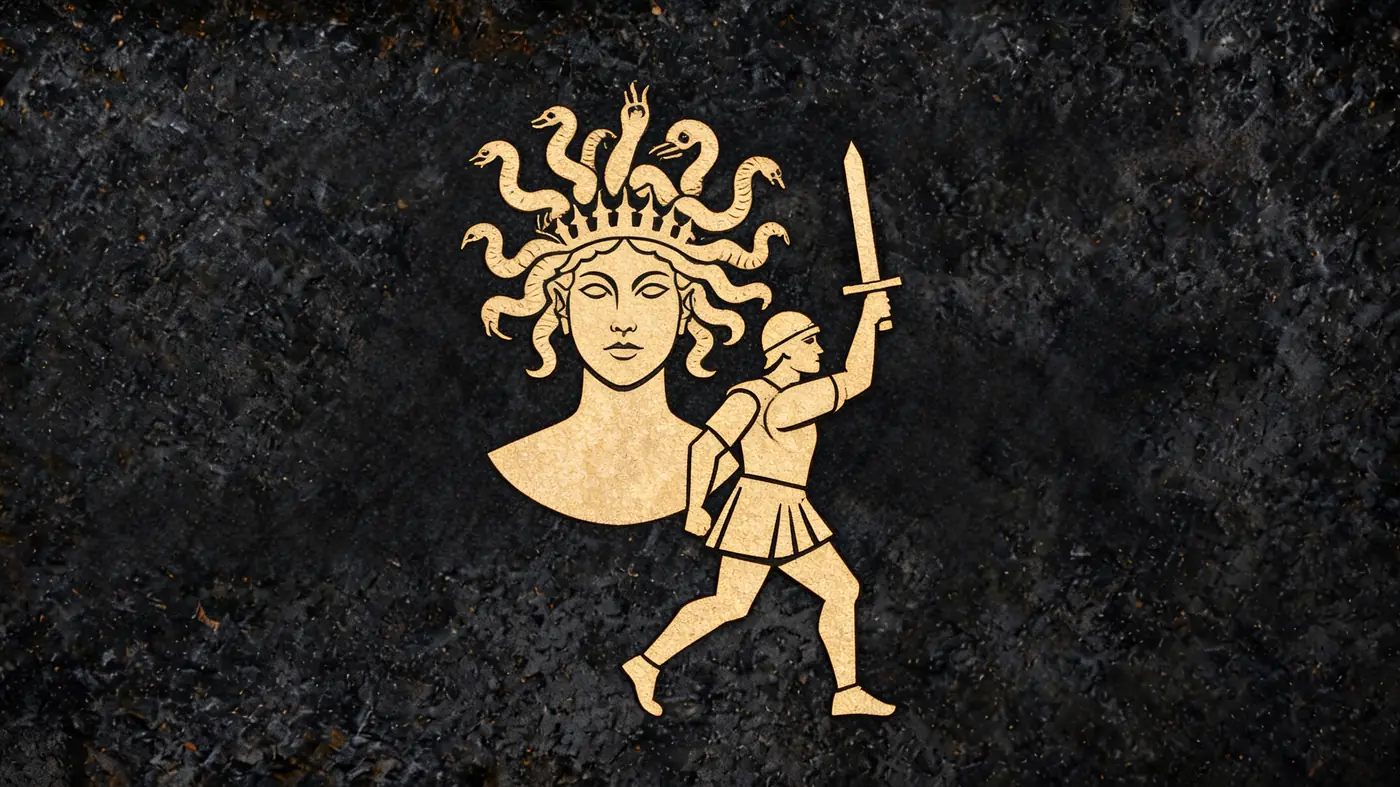
And yet, even in exile, Medusa was not safe. The hero Perseus was dispatched to claim her head — not for any crime she had committed, but as a political chess piece. King Polydectes of Seriphos desired Perseus’s mother Danaë, and sent the young hero on what was meant to be a suicide mission. Armed with divine gifts — Athena’s polished shield, Hermes’s winged sandals, Hades’s cap of invisibility, and an adamantine sickle — Perseus found the Gorgons sleeping. He approached Medusa using her reflection in the mirrored shield, never meeting her eyes directly, and severed her head with a single stroke.
Moreover, what happened next reveals the myth’s deepest layers of meaning. From Medusa’s severed neck sprang two beings — the winged horse Pegasus and the golden warrior Chrysaor. She had been pregnant by Poseidon at the time of her death, and her children could only be born through her destruction. Even in death, Medusa created. Even in the ultimate act of violence against her, life poured forth.
POWER BEYOND DEATH
The story of Medusa did not end with her beheading — in many ways, it began there. Perseus carried her head in a leather satchel called the kibisis, and the head retained every ounce of its petrifying power. As he flew over the deserts of North Africa, drops of her blood fell to the sands and spawned venomous serpents — which, according to ancient writers, is why Libya abounds with snakes to this day. Where her blood touched the waters of the Red Sea, it hardened into the red coral that grows there still.
Furthermore, Perseus wielded the head as a weapon more devastating than any sword. When Phineus and his followers attacked during the feast celebrating Perseus’s marriage to Andromeda, the hero drew Medusa’s head from its satchel and turned his enemies to stone where they stood. When he returned to Seriphos and found Polydectes forcing Danaë into marriage, he used the head once more, petrifying the king and his court in a single terrible moment. The blood of Medusa was later given to the divine healer Asclepius — blood from her right side could restore life, while blood from her left side was lethal poison. Even her remains were a paradox of creation and destruction.
Eventually, Perseus gave the head to Athena, who mounted it upon her own shield — the legendary Aegis. The face that Athena had cursed became the face that protected the goddess in battle. There is an irony here so sharp it hardly needs commentary. The woman Athena destroyed became Athena’s greatest weapon. The gaze that was meant to isolate and punish became a talisman of divine power, carved into armor and architecture across the ancient Mediterranean for centuries. The Gorgoneion — the image of Medusa’s face — appeared on coins, temple facades, shields, and amulets throughout the Greek and Roman world, always serving the same purpose: to ward off evil, to protect the bearer, to freeze enemies in their tracks.
THE GORGON BEFORE GREECE
Indeed, modern archaeology suggests that the Gorgon figure may be far older than Greek civilization itself. Research into the Neolithic cultures of southeastern Europe — stretching from the seventh to the fourth millennium BC — has uncovered abundant female imagery connected to cycles of death and regeneration. These early agricultural societies understood that decomposing matter feeds new growth, and their art reflects this understanding through fearsome female figures who embody both destruction and renewal.
When Indo-European-speaking peoples began migrating into the Balkan peninsula during the Bronze Age, they encountered indigenous communities with matrilineal social structures centered on earth deities. The newcomers brought patriarchal hierarchies and sky gods. Over centuries, these systems merged, and older female deity figures were recast — often as monsters to be conquered by male heroes. The beheading of Medusa by Perseus can be read as a mythological expression of that cultural transformation: the triumph of the new order over the ancient feminine power it could not fully suppress, only demonize and appropriate.
In fact, this reading does not diminish the myth — it deepens it. Medusa is not merely a character in a Greek story. She is an echo of something far more ancient, a figure whose roots reach into the earliest human attempts to understand the terrible, generative power of the earth itself.
WHY MEDUSA STILL TURNS HEADS
Notably, the modern reassessment of Medusa has transformed her from villain to icon. Feminist scholars have reframed her narrative as a parable of how survivors of violence are punished rather than protected — how the systems meant to shelter them instead cast them out. Her story resonates because it is, at its core, a story about the consequences of looking and being looked at, about the politics of visibility and the price of being seen.
But Medusa’s power extends beyond academic reinterpretation. In art, in fashion, in the symbolic language of contemporary culture, she represents something primal — the refusal to be diminished by suffering, the transformation of pain into power, the defiant gaze that says, “Look at me, if you dare.” Gianni Versace understood this when he chose the Gorgon’s face as the emblem of his fashion empire, drawn from the ancient ruins near his childhood home in southern Italy. Medusa, for Versace, represented a beauty so compelling that no one could look away — even at the cost of their own undoing.
Indeed, she has become a symbol of fierce individuality, of the kind of strength that does not ask for permission or approval. In a world that constantly demands that people look a certain way, behave a certain way, submit to expectations that were never designed to serve them, Medusa stands as the ultimate refusal. She does not hide. She does not apologize. She meets your gaze and lets the consequences fall where they may.
THE SERPENT CROWN ENDURES
Three millennia after the first poets set her story into verse, Medusa remains one of mythology’s most compelling figures — not despite her contradictions, but because of them. She is beautiful and terrifying, victim and weapon, mortal and eternal. Her children were born from her death. Her curse became her crown. The serpents that were meant to mark her as monstrous became the most recognizable symbol of untamed, unapologetic power in the Western mythological tradition.
Furthermore, every culture that has told her story has found in it a reflection of its own anxieties about beauty, power, gender, and the thin line between protection and punishment. The ancient Greeks carved her face into their shields because they believed her image could turn back evil. We carve her into our cultural imagination for much the same reason — because there are things in this world that can only be faced when you understand that the most terrifying force is the one that was never meant to be controlled.
Medusa does not need your sympathy. She needs your attention. And once you give it, she will never let you look away.
THE NEOLITHIC CONNECTION
Medusa runs through our Greek Legends collection — the same gorgoneion the Greeks carved onto shields to turn danger back on itself.
The Medusa Sigil tee carries that face at full scale. The Gorgon’s Gaze pendant keeps it small enough to wear against the skin. Both are worn for the reason the ancients carved her: not to frighten, but to be left alone.
The newest piece, She Looked Back., carries her half-lit face on the back — one eye fixed, a crack through the cheek, a single streak of ember — and the coiled serpents on the chest.
— Neolithic Store