POPOL VUH – THE MAYA CREATION EPIC THAT CONTAINS THE ENTIRE UNIVERSE

The Popol Vuh is the closest thing the Maya ever produced to a sacred scripture.
It is a creation myth, a cosmological document, a record of the gods, a history of kings, and an instruction manual for understanding existence — all contained within a single text that was nearly lost forever and survived only because a Kʼicheʼ Maya nobleman secretly transcribed it in the mid-1500s while Spanish priests were burning every Maya document they could find.
Indeed, that it exists at all is a miracle.
That it contains what it contains is extraordinary.
WHAT IS THE POPOL VUH
The name Popol Vuh comes from the Kʼicheʼ Maya language. Popol means council, community, or gathering. Vuh means book or paper. Together — the Council Book. The Book of the Community. The Book of the People.
It is the creation epic of the Kʼicheʼ Maya — one of the major Maya groups of the Guatemalan highlands. But its stories draw from oral traditions that stretch back thousands of years before the text was ever written down. The Popol Vuh was not written in 1550. It was transcribed in 1550. The stories it contains are ancient beyond any single date.
The full text covers three broad areas. First, the creation of the world and the early attempts to create human beings. Second, the story of the Hero Twins — Hunahpu and Xbalanque — and their journey through the Maya underworld Xibalba. Third, the history of the Kʼicheʼ Maya people themselves — their origins, their migrations, their kings, their dynasties.
It is simultaneously mythology, theology, and history. The Maya did not draw the same sharp lines between these categories that modern readers might expect.
THE CREATION — HOW THE WORLD BEGAN
The Popol Vuh opens in absolute darkness.
There is only sky and sea. No earth. No light. No sound except the quiet conversation of the Forefathers — Tepeu and Gucumatz — sitting together in the primordial void, thinking.
Indeed, they think the world into existence.
In the Maya creation tradition, the act of creation is fundamentally an act of thought and speech. The Forefathers do not build the world with their hands. They speak it. They name it. And what they name comes into being.
They speak the earth and it rises from the waters. Mountains appear. Rivers begin to flow. Forests spread across the new land. The sky separates from the earth. Dawn approaches for the first time.
Then the Forefathers create the animals.
The deer. The birds. The jaguars. The serpents. The pumas. Each called into existence by name, each given a home in the new world, each given a voice.
But the animals cannot speak back. They cannot worship their creators. They cannot say the names of the gods. And in the Maya cosmos, the purpose of creation was specifically to produce beings who could worship — who could speak the names of the gods, make offerings, and maintain the cosmic order through ritual and ceremony.
However, the animals failed this purpose. Not through any fault of their own — they simply were not made for it.
So the Forefathers tried again.
THE FAILED CREATIONS
The Popol Vuh describes three failed attempts to create human beings before the final successful creation from maize.
The Mud People
The first humans were made from mud. They could speak but their words were meaningless. They could not move properly. They dissolved in water. They had no minds, no memory, no understanding. The Forefathers destroyed them.
The Wood People
The second humans were carved from wood — the men from wood, the women from reeds. They looked like people. They could speak. They could reproduce. They populated the earth.
But they had no souls. No memory. No understanding of their creators. They went through the motions of human life without any inner life to sustain it. They did not remember the gods. They did not make offerings. They treated their animals and their tools with contempt.
As a result, the cosmos turned against them.
Their own dogs rose up and bit them. Their grinding stones attacked them. Their cooking pots revolted. A great flood came and washed most of them away. Those who survived fled into the forest and became the monkeys — which is why, according to the Popol Vuh, monkeys look so much like people.
The Maize People
The final and successful creation of human beings used maize — white and yellow corn — ground into dough and shaped into four men. From their flesh came the first true humans. From those four men came the ancestors of all the Kʼicheʼ Maya people.
Notably, maize was not chosen arbitrarily. For the Maya, maize was the most sacred substance on earth — the foundation of their diet, their economy, their civilization, and now their very bodies. Human beings were made of maize. To eat maize was to sustain the material of your own creation. To grow maize was to participate in the ongoing act of creation itself.
This is the Maya worldview in one image — the human body as a sacred agricultural product, life as an ongoing creative act, existence as a collaboration between the gods and the land.
THE HERO TWINS
The most dramatic section of the Popol Vuh tells the story of Hunahpu and Xbalanque — the Hero Twins — and their descent into Xibalba, the Maya underworld.
Notably, the twins were demigods, born under extraordinary circumstances after their father Hun-Hunahpu was killed by the lords of Xibalba and his severed head placed in a tree. A maiden named Xquic passed by, reached up to touch the skull, and became pregnant from its saliva alone. She was cast out of Xibalba for her transgression and fled to the surface world, where she gave birth to the Hero Twins.
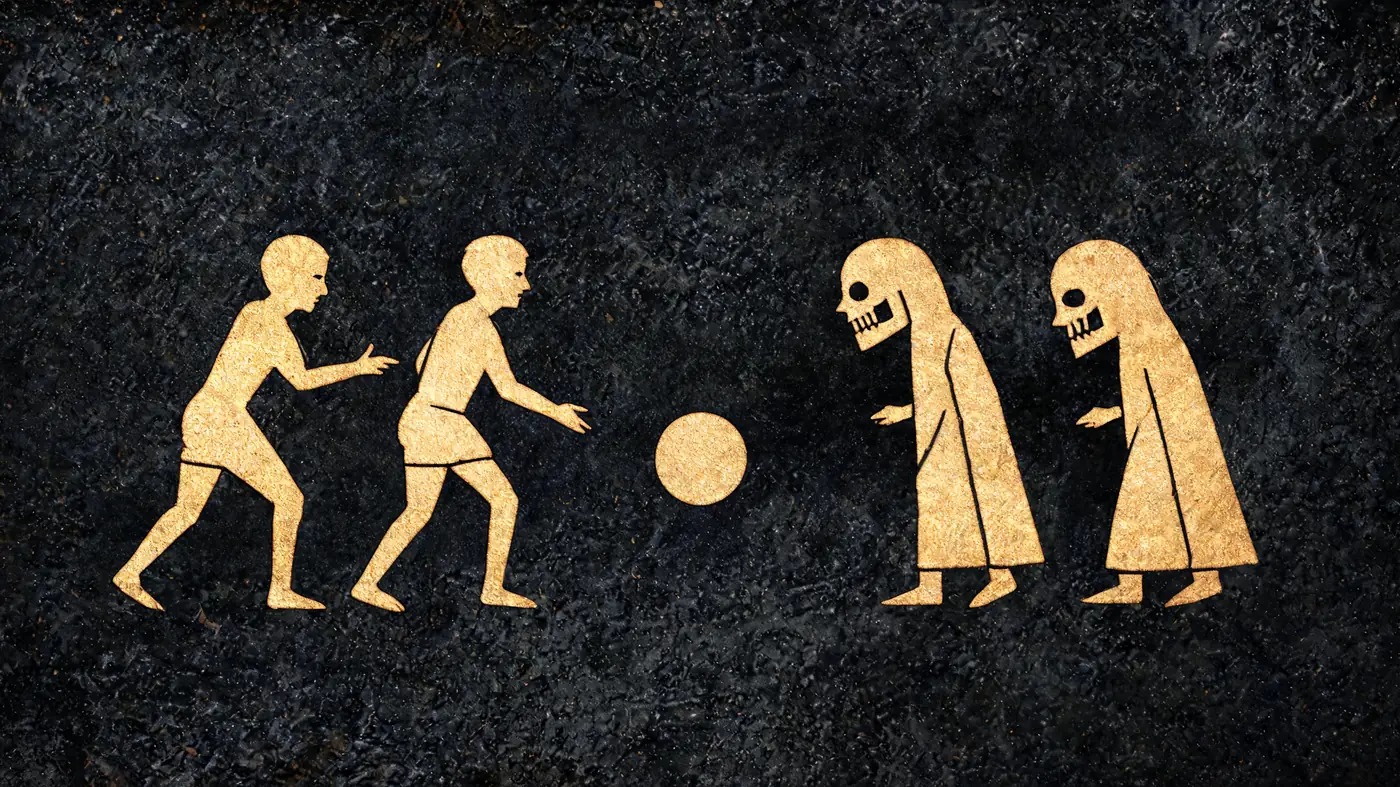
Hunahpu and Xbalanque grew up to be extraordinary — gifted ballplayers, hunters, and tricksters. Their playing of the sacred ballgame disturbed the lords of Xibalba with its noise, and the twins were summoned to the underworld to be destroyed just as their father had been.
Nevertheless, they descended.
They survived the houses of trial — Cold, Fire, Razor, Darkness, Bat — through a combination of wit, courage, and an absolute refusal to accept death as final. Camazotz, the death bat who rules the House of Bats, took Hunahpu’s head during one of these trials. Xbalanque recovered it and his brother was restored.
Ultimately the twins defeated the lords of Xibalba through an extraordinary trick — they allowed themselves to be killed, then arranged to be resurrected by disguised sorcerers. The lords of Xibalba, astonished by this power over death, demanded the same treatment. The twins obliged — and did not resurrect them.
The twelve lords of death were defeated. The underworld was humbled. And the Hero Twins ascended from Xibalba to become the sun and the moon — the two most visible celestial bodies in the Maya sky, rising every day as living proof that death can be survived.
THE POPOL VUH AND MAYA DAILY LIFE
The Popol Vuh was not a text reserved for priests and scholars. Its stories were alive in everyday Maya culture — in art, in ceremony, in agriculture, in architecture.
Moreover, the ballgame that the Hero Twins played was a real sport played across all of Mesoamerica — stone ballcourts have been found at every major Maya site. The game was ritual as much as sport. Players were sometimes sacrificed after the game, though whether it was the winners or losers who died has been debated by scholars for decades.
The maize creation story shaped Maya agricultural practice. Planting and harvesting were sacred acts. The Maya Long Count calendar — one of the most precise timekeeping systems ever devised — was organized partly around the agricultural cycle of maize.
Furthermore, the descent into Xibalba and return shaped how the Maya understood death, burial, and resurrection. The dead were buried with provisions for the journey. Jade was placed in the mouths of rulers — jade being the color of maize and new growth, a promise of resurrection. The Ceiba tree was planted over burial sites to provide the World Tree pathway from the underworld back to the living world.
In fact, the Popol Vuh was not mythology in the modern sense of stories that people tell but do not believe. It was cosmology — a functional description of how the universe actually worked, constantly reinforced by the movements of the stars, the growth of crops, the rising of the sun, and the daily experience of being alive.
NEARLY LOST FOREVER
When the Spanish arrived in the Yucatán and Guatemala in the 16th century, they brought with them a systematic campaign of cultural destruction. Bishop Diego de Landa famously conducted an auto-da-fé in 1562 in which dozens of Maya codices — bark paper books containing astronomical observations, historical records, and sacred texts — were burned. He later wrote that this caused the Maya great distress, which he described with apparent satisfaction.
As a result, almost everything the Maya had written was destroyed.
Remarkably, the Popol Vuh survived because a Kʼicheʼ Maya nobleman — whose name we do not know — transcribed it in secret around 1554-1558, writing the ancient oral text in the Kʼicheʼ language using the Latin alphabet the Spanish had introduced. He hid the manuscript. It passed from hand to hand in relative obscurity for over a century until a Dominican friar named Francisco Ximénez discovered it in the early 1700s, transcribed and translated it, and — ironically — preserved the very document that his own church had nearly destroyed.
The original manuscript Ximénez worked from has never been found.
Indeed, what we have is Ximénez’s transcription. Which is a copy of an anonymous nobleman’s transcription of oral traditions that stretch back thousands of years.
That this text survived at all — through conquest, through burning, through centuries of colonial suppression — is itself a story worthy of the Popol Vuh.
The Maya made things that refused to die.
THE POPOL VUH TODAY
The Popol Vuh has been translated into dozens of languages and is studied in universities around the world as one of the foundational texts of world literature — comparable in scope and significance to the Iliad, the Mahabharata, or the Epic of Gilgamesh.
For the living Maya people — approximately seven million across Guatemala, Mexico, Belize, Honduras, and El Salvador — the Popol Vuh is not an academic text. It is a living document. Its stories are still told. Its cosmology still shapes how many Maya communities understand the relationship between human beings, the natural world, and the divine.
The deer that the Forefathers spoke into existence in the opening pages of the Popol Vuh is still considered sacred in many Maya communities. The maize that formed the first human bodies is still the foundation of the Maya diet. The Ceiba tree is still planted at the centers of villages. The Hero Twins still rise every morning as the sun.
The Popol Vuh was nearly destroyed.
It was not.
THE NEOLITHIC CONNECTION
At Neolithic Store, the Popol Vuh is not a source of inspiration. It is a source of instruction.
Every design in our Mayan Legacy collection begins with research — with the actual stories, the actual mythology, the actual cosmology that the Maya built over four thousand years of civilization. We do not use Maya imagery as decoration. We use it as language — a visual language that carries meaning, history, and a profound respect for one of the greatest civilizations ever to walk this earth.
The First Creation tee — drawn directly from ancient Maya pottery depicting the moment the Forefathers created the deer — is our most direct translation of the Popol Vuh into wearable form. The circular ceramic design is not a modern interpretation. It is the Maya’s own visual vocabulary, adapted for the person who wants to carry that story into the present.
And the epic’s hero walks with it. Xbalanque — The Jaguar carries the twin who descended into Xibalba, passed every house, survived every trick, and came back — the one still standing when it mattered.
The Popol Vuh refused to die.
So did we.
Available now at neolithicstore.com.
Forged from ancient bloodline. Worn by the modern warrior.
Neolithic Store is a premium mythology-inspired streetwear brand rooted in the stories that shaped human civilization. Every design begins with research, every piece carries a story, and every stitch is made for those who wear their beliefs on their skin.
[…] It was the worst mistake the lords ever made. That skull spat into the hand of a passing maiden, and from that impossible seed came the Hero Twins, Hunahpu and Xbalanque — the boys who would return to Xibalba a generation later, pass every house, survive every trick, and defeat One Death and Seven Death in their own kingdom. Their full story — the resurrection, the final trick, and how their victory made human life possible — belongs to the creation epic itself, and we have told it in our deep-dive on the Popol Vuh. […]