STYX — THE RIVER THE GODS SWORE BY
Every river on earth runs to the sea. One runs to the oath.
The Styx is the river that winds around the land of the dead, nine times over in Virgil’s telling. It is the dark border between the living world and everything beyond it. But it is more than a border. It is a goddess, and it is the strongest witness in the Greek world. When a god swore by the Styx, the promise could not be taken back. Not by Zeus. Not by anyone.
THE RIVER AND THE GODDESS
The name comes from a Greek word for hatred and shuddering, and the river lived up to it. Hesiod makes Styx the eldest daughter of Oceanus and Tethys, the first of the three thousand Oceanid river-spirits. Her home was a hall far at the edge of the world, roofed with rock and held up by silver pillars. Her water fell from a high cliff, black and ice-cold.
The Greeks gave the river a place on the map. They placed her waterfall in Arcadia, in the mountains near Nonacris, and a thin cascade still falls there today. Locals still tell stories about its water.
Styx married the Titan Pallas and had four children, who were not gentle ones: Zelus (Zeal), Nike (Victory), Kratos (Strength) and Bia (Force). Everything Zeus later ruled by, he kept beside him because of her.
THE FIRST TO CHOOSE ZEUS
When the Titans and the Olympians went to war, almost every power in the world waited to see who would win. Styx did not wait. She was the first to come to Olympus, bringing her four children, and she put them on Zeus’s side.
Zeus did not forget it. When the war was won, he made her honor the greatest in the world. Her children would live beside him forever. And the river of the dead would become the oath of the gods.
THE OATH
An oath on the Styx had a ritual. Iris, the messenger of the gods, flew down to fetch water from the river in a golden jug. The god who swore poured it out as a libation and spoke the promise. From that moment the words were bound.
The penalty for breaking it was a punishment fit for an immortal. The god who lied lay without breath for a full year, kept from nectar and ambrosia, unable to speak or move. Then for nine more years that god was banished from the councils and feasts of the other gods. Only in the tenth year could they come back.
No god ever tested it. In all the old stories, not one of them breaks an oath sworn on the Styx.
THE PROMISE THAT KILLED
That strength is also a trap, and two of the most famous stories turn on it.
Zeus once swore by the Styx to grant the mortal woman Semele anything she asked. Hera, jealous, disguised herself as an old nurse and whispered a suggestion: ask to see your lover as he truly is. Semele asked. Zeus knew what would happen, and he could not refuse. He appeared as the god of lightning, and the sight burned her to ash. He saved the unborn child, Dionysus, and carried him to term sewn into his own thigh.
Helios, the sun god, swore the same oath to his son Phaethon. The boy asked to drive the chariot of the sun for a single day. Helios begged him to choose anything else. But the oath was sworn. Phaethon lost control of the horses, the sky began to burn, and Zeus struck the boy down with a thunderbolt to save the earth.
A god cannot take back a word sworn on the Styx, even when the word is a mistake.
THE FERRYMAN AND THE COIN
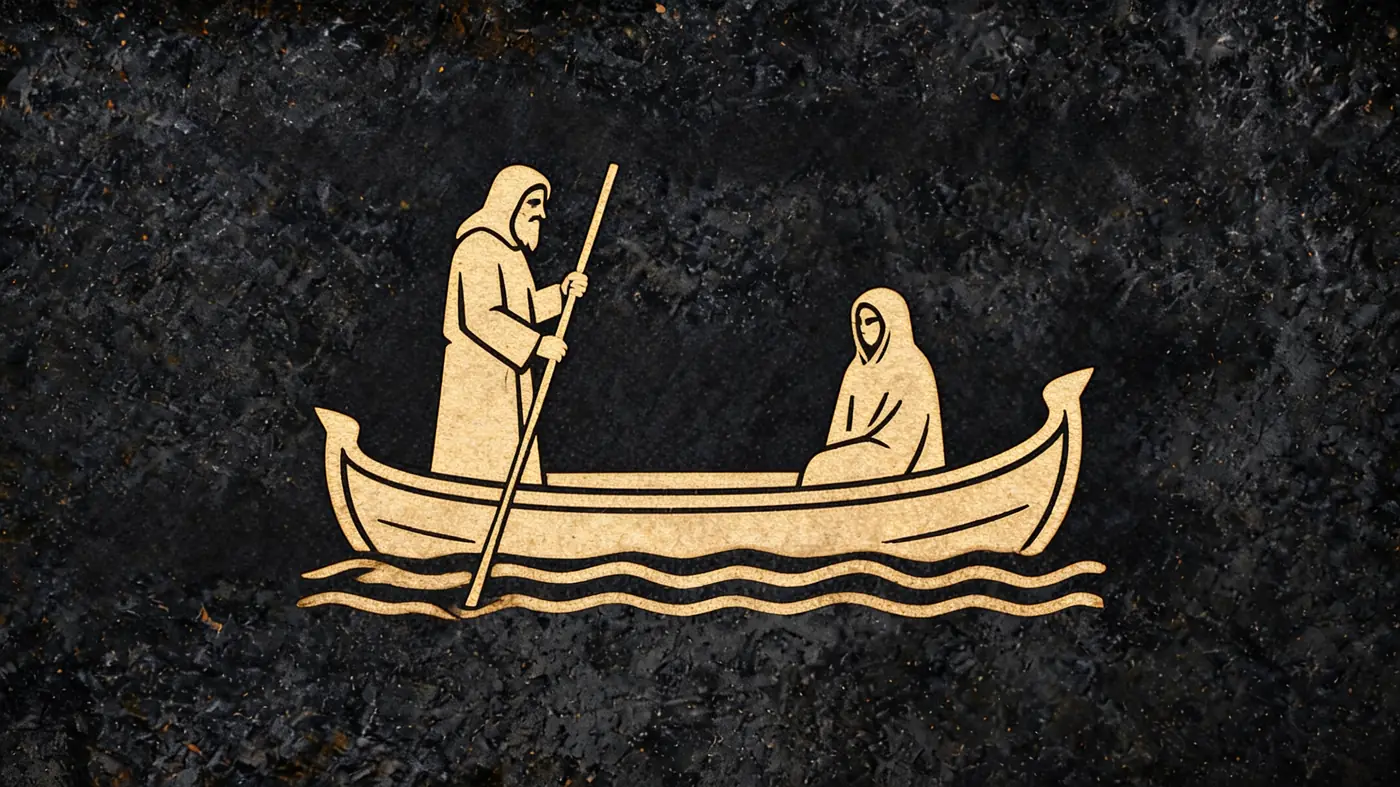
For the dead, the Styx was a road with a toll. A grim old boatman named Charon ferried them across, and the price was a single coin, an obol, which the living placed in the mouth of the corpse. The dead who arrived unburied, or without the coin, could not cross. In Virgil’s account they wandered the near bank for a hundred years.
Charon turned the living away too. Almost no one living got past him. Aeneas crossed with a golden bough as his pass. Heracles crossed by force. And Orpheus crossed because he sang, and the ferryman could not refuse a song like that.
THE WATER THAT MAKES AND BREAKS
Other stories treat the water as a power that could be used. In a later Roman telling, the sea-goddess Thetis dipped her infant son Achilles in the Styx to make him invincible. She held him by one heel, and the water never touched it. Homer never mentions this. It was added to the legend centuries afterwards, and it became the best-known detail of the story.
In another tale, Psyche was ordered to fill a crystal flask with water from the Styx, from the top of a cliff no mortal could climb. Ancient writers claimed the water ate through every vessel except a horse’s hoof. A rumor in the ancient world even held that it had killed Alexander the Great.
WHAT THE STYX MEANS
The Styx is the river of consequence. Everything else in the Greek world could bend. Fate bent, gods bent, even death was cheated now and then. But a word sworn on the Styx stayed sworn.
That is why it matters to the Greeks, and to everyone who has read the stories since. A world with no binding promise has no trust in it, even among the gods. The Greeks needed something that could not be argued with. They made it a river, black and cold, at the edge of the dead.
THE NEOLITHIC CONNECTION
Every bloodline has a river between the living and the dead. In our Greek Legends collection, it is the Styx, crossed by Odysseus in his long road home, by Orpheus with a lyre, and by the dead with a coin on the tongue.
The Norse have their own, the Gjöll, which runs on the road to Hel. The Maya descend through Xibalba, past rivers of blood and pus. In Egypt the dead sail toward the weighing of the heart. Each mythology asks the same question at the water’s edge: what do you owe, and who is keeping count?
— Neolithic Store