SEKHMET — THE LIONESS WHO NEARLY ENDED MANKIND
Ra sent his Eye to end mankind, and the Eye became a lioness. The myth of Sekhmet, the blood-red beer, and the mercy that stopped her.
Ra was a king who grew old, and old kings get tested.
In Egypt’s oldest account of the end of the world, the sun god has ruled so long that his bones have turned to silver and his flesh to gold. Mankind, watching him age, begins to whisper of rebellion. Ra hears it. He calls the gods together, asks what should be done, and is told: send your Eye.
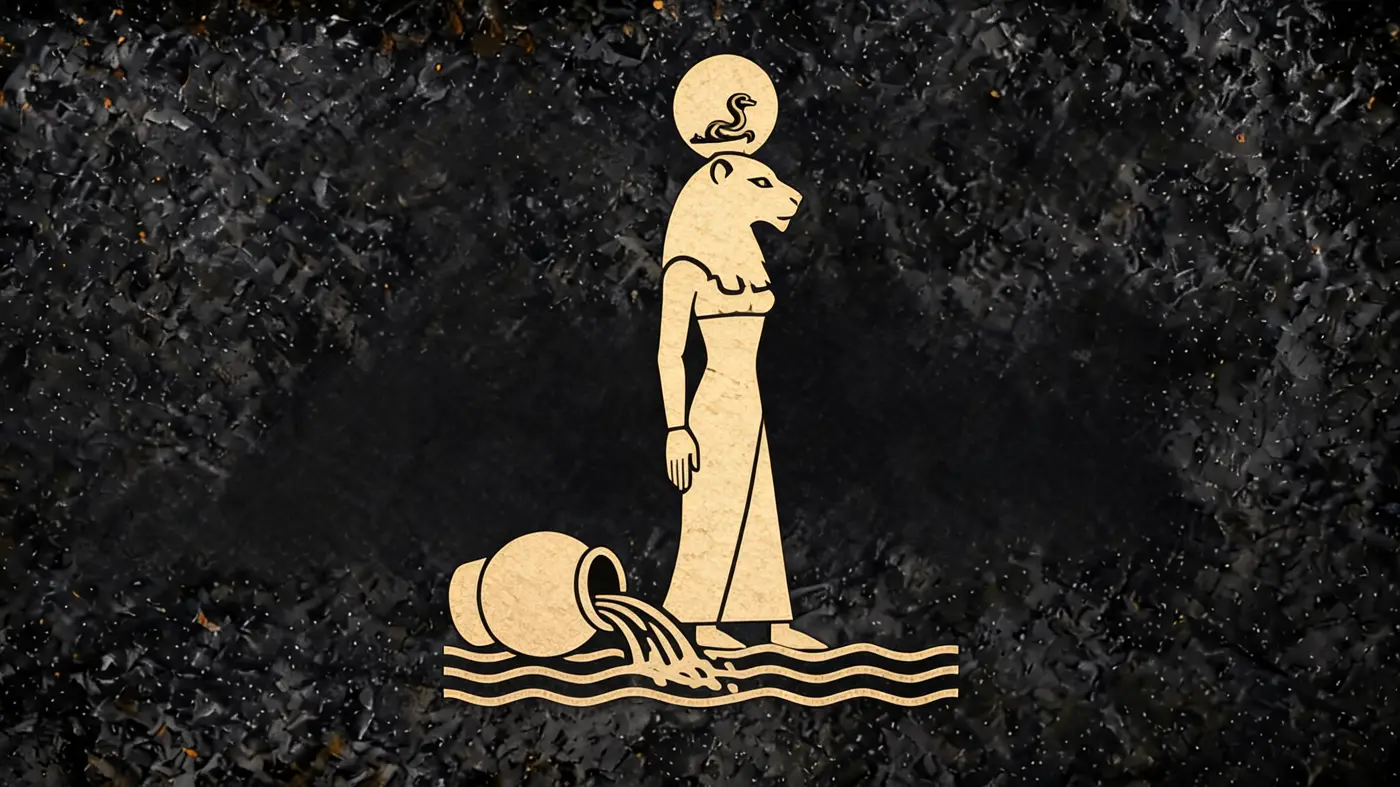
The Eye took the form of a lioness. Her name was Sekhmet — the Powerful One.
THE EYE THAT HUNTS
The Eye of Ra is not an ornament. It is the sun god’s own power given a body: his gaze, his fire, his anger, able to walk. Egyptian texts call it a daughter and a weapon. It rides his brow as the rearing cobra, spitting flame at his enemies — and when he sends it out, it can take other forms.
Hathor, the gentle goddess of music and love, is one of them. Sekhmet is the same Eye in its other face. The difference between the two is only whether she has been asked to be kind.
THE SLAUGHTER AT THE DESERT’S EDGE
The story is told in the Book of the Heavenly Cow, carved inside royal tombs of the New Kingdom, including the shrine of Tutankhamun and the tomb of Seti I. Sekhmet went down into the desert and began to kill. The text says she waded in blood and that it pleased her heart.
By the time Ra felt pity, she no longer felt any. The hunt had its own will. At the end of that night she would have finished mankind entirely.
THE BEER THE COLOUR OF BLOOD
Ra’s answer was not an army. It was a trick.
He ordered red ochre brought down from Elephantine, ground fine, and mixed into barley beer until seven thousand jars ran the colour of blood. In the dark they were poured out across the fields where she would pass at dawn.
Sekhmet found the flooded land, took the red for a river of the slain, and drank. She drank until she could not stand, and slept. When she woke, the lioness was gone. She returned to the sun god as Hathor — and Egypt kept the story as a festival, when the city poured red beer and drank until morning.
THE LADY OF PLAGUE AND HEALING
Egypt did not make her a villain. It made her something harder: a goddess who could send the plague and lift it. Her priests were physicians, trained to treat the very sicknesses she carried. The one who could end a life was the one you prayed to for yours.
Around 1370 BCE, Amenhotep III raised some seven hundred statues of her in his mortuary temple at Thebes — two for every day of the year, so she would be appeased morning and night. Many of them survive in museums across the world.
WHAT SEKHMET ACTUALLY MEANS
The Egyptians did not tell this story to make a monster. They told it to say what the sun’s justice is made of: a power that could end everything, held back by one act of cunning and one act of mercy.
Ra did not defeat Sekhmet. He turned her. The mercy in this story is not the absence of the lioness. It is the lioness, choosing to stop.
A gentle face means nothing if it is the only face you have.
THE NEOLITHIC CONNECTION
At Neolithic Store, she is carried by What the Eye Became, in our Egypt Mythos collection. On the back, a black lioness walks straight at you, a golden cobra rising from her crown, a slash of oxblood torn open behind her: the Eye, mid-hunt. On the chest, her head alone, mid-roar, a serpent coiled behind the mane. Ink and oxblood with a thread of gold, on Bone White.
The cobra at her crown is the same fire-spitting guardian that rides Ra’s brow through the night — read how it holds the dark in Ra and Apep. For the other god Egypt aimed at its enemies, read Seth.
Made for those who know mercy only means something from someone who could have finished it.
Available now at neolithicstore.com.
Forged from ancient bloodline. Worn by the modern warrior.
Neolithic Store is a premium mythology-inspired streetwear brand rooted in the stories that shaped human civilization. Every design begins with research, every piece carries a story, and every stitch is made for those who wear their beliefs on their skin.
[…] For those who don’t chase balance — they impose it. For the other power Egypt aimed at its enemies, the Eye of Ra that became a lioness, read Sekhmet. […]