SETH — THE GOD OF CHAOS WHO GUARDED THE SUN
Every mythology has a villain. Egypt’s refused to stay one.
Seth murdered his brother. He tore out his nephew’s eye. He is the god of the desert that devours the fields, the storm that flattens the harvest, the chaos that stalks the edges of every ordered thing. By every rule of storytelling, he should be Egypt’s devil.
And yet: pharaohs named themselves after him. Armies marched under his strength. And every single night, in the most important battle in the Egyptian cosmos, the gods put their survival in his hands — because when annihilation itself rose from the dark, Seth was the only one strong enough to face it.
Egypt did not worship Seth despite what he was.
Egypt worshipped him because of it.
THE GOD NO ANIMAL WOULD CLAIM
Almost every Egyptian god wears the head of a known creature. The falcon for Horus. The jackal for Anubis. The crocodile for Sobek.
Seth wears the head of an animal that does not exist.
The “Set animal” — the curved snout, the tall squared ears, the stiff forked tail — has been puzzled over for two centuries. Aardvark, donkey, greyhound, okapi; no identification has ever held. The likeliest answer is the one the Egyptians intended: it is no animal at all. A god of what does not belong was given a face that belongs to nothing.
His domain was everything outside the ordered world. The Red Land — the desert beyond the Nile’s black soil. Storms and thunder in a country where rain itself was a disturbance. Foreign lands and foreign gods. The wild, the borderless, the uninvited.
Egypt was a thin green line of order drawn through a continent of chaos. Seth was everything on the other side of the line — and, as we will see, the reason the line survived.
THE MURDER AND THE WAR
Seth’s crime is the founding tragedy of Egyptian mythology.
He murdered his brother Osiris, the good king — sealed him in a coffin fitted to his body, then cut the body into pieces and scattered them across Egypt. When Osiris’s son Horus came of age, the two fought for the throne for eighty years: trials before the gods, transformations, open battle. In the worst of it, Seth tore out Horus’s left eye and ripped it apart — the wound that became the Eye of Horus, Egypt’s great symbol of restoration.
Horus won. The tribunal of the gods gave him the throne, and order was restored.
But here is where Egypt breaks the storytelling rules: Seth was not destroyed. He was not cast into a pit or chained under the earth. In the old telling, the earth god Geb divides the country between them — Horus the fertile Black Land, Seth the desert Red Land — and in temple reliefs the two of them stand together, binding the lotus and the papyrus around the sign of union, jointly tying the Two Lands into one kingdom.
The murderer and the avenger, holding opposite ends of the same knot. Egypt looked at chaos and order and concluded that a kingdom needs both — that a throne held only by gentleness will not hold.
THE NIGHTLY BATTLE — CHAOS DEFENDING THE SUN
Now the part of Seth’s story almost nobody knows — the part that redeems everything.
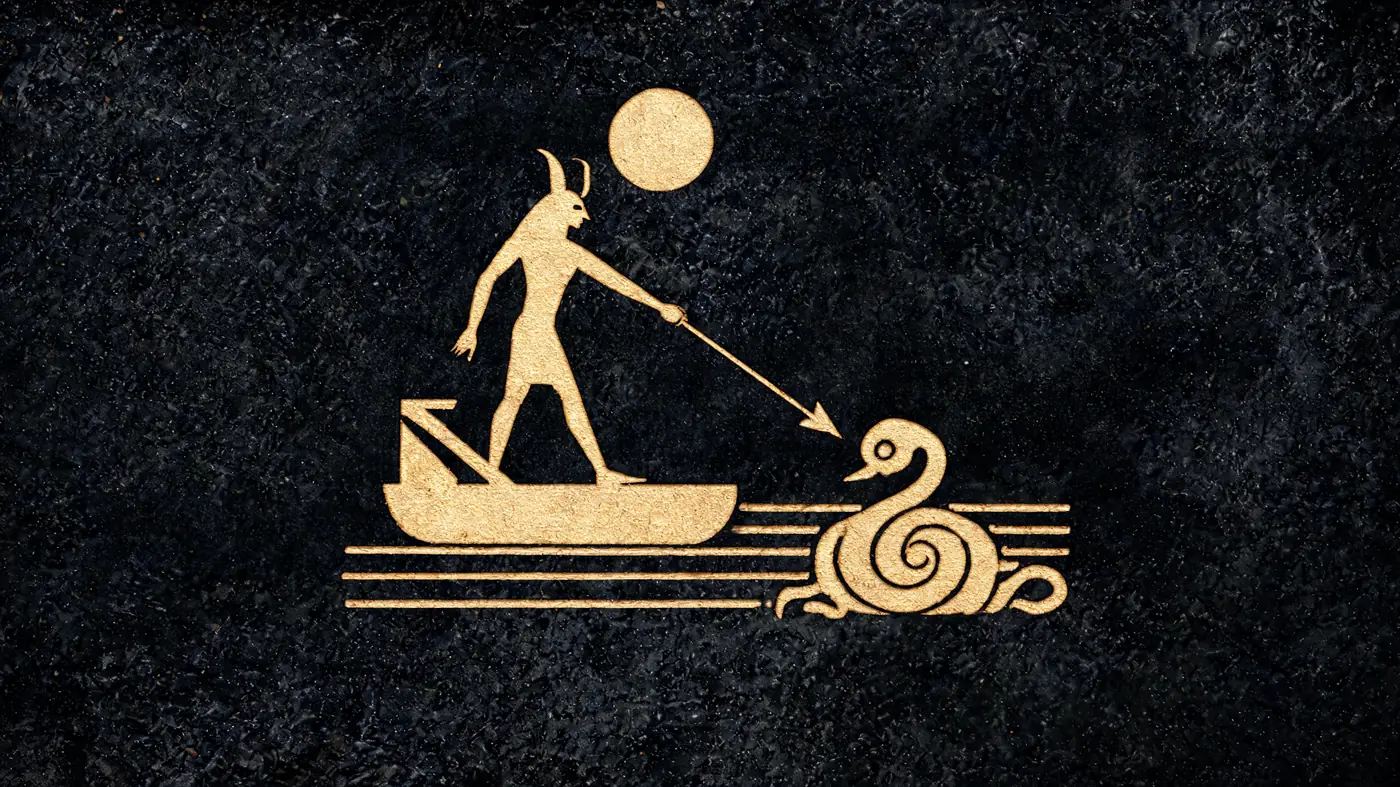
Every night, the sun god Ra sails his barque through the underworld, carrying the sun itself through the dark toward morning. And every night the boat is attacked by Apep — the great serpent of pure annihilation, older than the gods, vast enough to swallow the sun. Apep is not evil the way Seth is unruly. Apep is un-creation: the end of light, time, gods, and everything.
And the god who stands at the prow of the sun boat, spear in hand, the one being fierce enough to hold the serpent off — is Seth.
The texts are explicit: where other gods quail before Apep, Seth alone withstands his hypnotic gaze, and it is Seth’s strength that drives the spear home so the sun can rise. The storm god defends the dawn. The murderer guards the light. Chaos — turned outward, aimed, given a purpose — becomes the shield of creation itself.
This is the Egyptian mind at full depth. They did not want a cosmos guarded by the mild. Against the serpent that ends everything, they posted the most dangerous god they had.
THE PHARAOHS OF SETH
Seth’s fierceness made him royal.
As early as the Second Dynasty, King Peribsen set the Set animal above his royal name where every other king placed the falcon of Horus. Two thousand years later, the greatest warrior dynasty Egypt ever produced — the family of Ramesses the Great, northern soldiers from Seth’s own cult city of Avaris — named its founders for him: Seti, “Man of Seth.” The king who built Egypt’s empire carried the chaos god’s name into every battle, and the army’s divisions marched under Seth’s standard alongside those of Amun and Ra.
In the royal ideology, the pharaoh embodied both brothers at once — the Two Lords, Horus and Seth, reconciled in one person. Legitimacy from Horus. Ferocity from Seth. A king, Egypt understood, must be rightful and dangerous, or he will not remain king.
Only late in Egypt’s long history, after centuries of foreign invasion had made the god of foreigners unforgivable, was Seth finally demonized — his statues defaced, his name hacked from the walls. The villain modern readers know is the last chapter of his story, not the substance of it.
WHAT SETH ACTUALLY MEANS
Strip away three thousand years of retelling, and Seth is Egypt’s hardest and most honest idea.
Chaos cannot be destroyed. The desert will not become a garden; the storm will not be reasoned with; the wild thing in human nature does not die. Every civilization must decide what to do with that fact. Most mythologies answer with a war that ends in chaos chained forever.
Egypt answered with a truce — and a job. Chaos was given a throne beside order, a half of the kingdom, and a post at the prow of the sun boat. Not chaos unleashed, and not chaos denied: chaos with intent. Disorder bound into form and aimed at the only enemy that matters.
Seth is not the god of losing control.
He is the god of what control is actually made of.
THE NEOLITHIC CONNECTION
At Neolithic Store, Seth holds two pieces in our Egypt Mythos collection — two readings of the same dangerous god.
The Sigil of Chaos is the raw form: Seth’s power as a sealed sigil in muted gold on deep forest green, the fractured texture carrying his untamed nature — chaos contained, but only just. The Sigil of Contained Chaos is the resolution: the angular Seth figure emerging from a cracked emblem, disorder bound into a circle — destruction mastered rather than unleashed.
One is the storm. The other is the storm, aimed.
Both are for those who don’t chase balance — they impose it.
Available now at neolithicstore.com.
Forged from ancient bloodline. Worn by the modern warrior.
Neolithic Store is a premium mythology-inspired streetwear brand rooted in the stories that shaped human civilization. Every design begins with research, every piece carries a story, and every stitch is made for those who wear their beliefs on their skin.
[…] Egypt’s tombs. And at the prow stands the one god who can hold Apep’s gaze without flinching: Seth, spear in hand, driving it home so the boat can […]