CAMAZOTZ – THE DEATH BAT WHO RULES THE MAYA UNDERWORLD

Before the world had superheroes, it had gods.
And not the benevolent kind.
The Maya did not create gods to comfort them. They created gods to explain the darkness — the parts of existence that reason cannot reach, that light cannot penetrate, that even the bravest among us cannot walk through without flinching.
Camazotz was one of those gods.
He did not offer salvation. He did not answer prayers. He ruled the fifth house of Xibalba — the Maya underworld — and he asked only one thing of those who entered his domain.
Survival.
Most did not manage it.
WHO IS CAMAZOTZ
The name comes from the Kʼicheʼ Maya language. Kame means death. Sotz means bat. Put them together and you have something that does not require translation — a death bat, lord of the night, ruler of the House of Bats, one of the most feared supernatural beings in all of Mesoamerican mythology.
He appears in the Popol Vuh — the sacred creation epic of the Kʼicheʼ Maya, written in the 16th century but rooted in oral traditions stretching back thousands of years. The Popol Vuh is not just a myth. It is a cosmological document, a record of how the Maya understood the universe, life, death, and the forces that governed both.
Camazotz lives in that document like a shadow at the edge of firelight. You know he is there before you see him.
THE HOUSE OF BATS
To understand Camazotz, you must first understand Xibalba.
The Maya underworld was not a vague afterlife. It was a specific place with a specific geography, ruled by specific lords, organized into specific houses of trial. Twelve lords of death governed Xibalba — Hun-Camé and Vucub-Camé at the top, and beneath them, lords who specialized in particular forms of suffering.
There was the House of Cold. The House of Fire. The House of Razors. The House of Darkness.
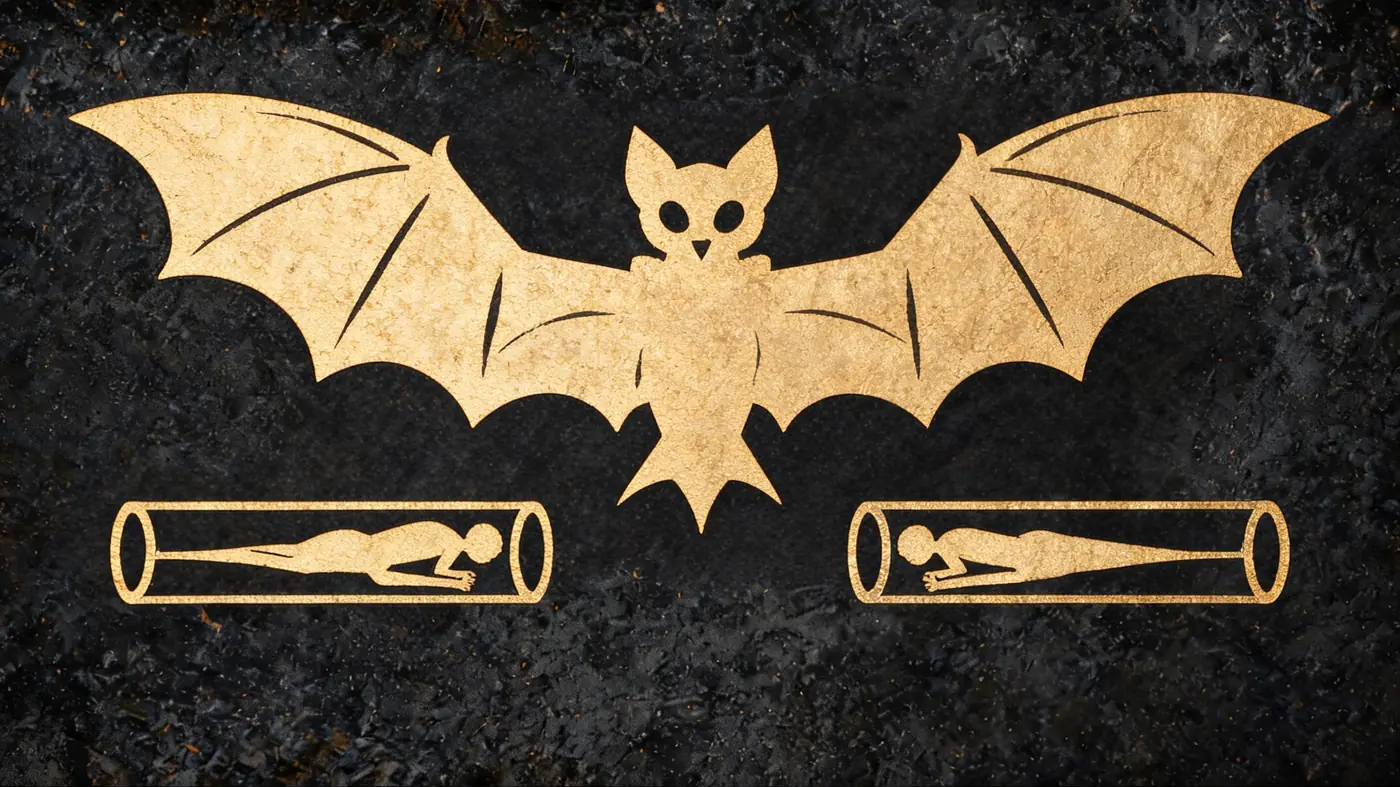
And then there was the House of Bats — Zotzilaha — where Camazotz waited.
The trials of Xibalba were not random tortures. They were tests. The Maya believed that death was not an ending but a passage — and that passage required courage, intelligence, and an unwillingness to be broken. The lords of the underworld existed to break you. Most who entered Xibalba never found their way back to the surface.
Camazotz was the gatekeeper of one of the deepest trials.
THE NIGHT THE HERO TWINS FELL
The most famous story involving Camazotz comes from the journey of Hunahpu and Xbalanque — the Hero Twins of Maya mythology.
These were not ordinary men. They were demigods, born of a severed head and a maiden who had been cast out of Xibalba. They were clever, fearless, and had already survived trials that had destroyed their father and uncle before them.
They descended into Xibalba deliberately. Not because they had to — because they chose to face the lords of death and defeat them.
They survived the House of Cold. They survived the House of Fire. They survived the House of Razors.
Then they entered the House of Bats.
The strategy was simple — hide inside their blowguns through the night and wait for dawn. Do not move. Do not look out. Let the darkness pass.
Hunahpu made a mistake.
He looked out to check if dawn had arrived. In that single moment of impatience, Camazotz was there. The death bat swooped and took his head cleanly from his shoulders.
Even heroes fall in Xibalba.
The story does not end there — Xbalanque recovered his brother through cunning, replacing the head with a carved squash until the real head could be restored. The twins ultimately defeated the lords of Xibalba and ascended to become the sun and the moon.
But the lesson Camazotz delivered is carved permanently into the mythology.
Even the greatest among us has a moment of weakness. Even the hero who has survived everything can be undone by a single lapse. The darkness does not wait for you to be ready.
THE ARCHAEOLOGY OF A GOD
Camazotz was not only a literary figure. He was worshipped.
Archaeological evidence of bat deity worship in Mesoamerica stretches back over 3000 years. The Zapotec civilization — contemporaries of the early Maya — produced bat deity urns as early as 300 BCE. The image of the death bat, with its distinctive nose blade and outstretched wings, appears across pottery, jade carvings, temple reliefs, and codices throughout the region.
In the Maya site of Copán in modern Honduras, bat iconography appears in association with death and sacrifice. At various sites across the Yucatán and Guatemala, the bat god’s imagery marks thresholds — doorways, passages, entrances to sacred spaces.
This makes sense. The bat lives between worlds. It sleeps where the dead sleep — in caves, in darkness, in the earth. It emerges at night when the boundary between the living world and the underworld grows thin. For the Maya, the bat was not just an animal. It was a symbol of liminality — of existing at the threshold between what is seen and what is not.
Camazotz was the divine embodiment of that threshold.
WHY CAMAZOTZ STILL MATTERS
There is something about Camazotz that refuses to stay buried in history.
He has appeared in modern literature, video games, comics, and popular culture — often misidentified, often simplified, but always carrying that unmistakable energy of something ancient and undefeated. The shape of his wings, the downward curve of his nose blade, the spread of darkness he represents — these images have a power that transcends their origin.
Because what Camazotz represents is not culture-specific.
Every human tradition has a version of the same truth — that the darkness is real, that the underworld is not metaphor but experience, that there are forces in life that will take your head if you look out at the wrong moment. The Maya gave that truth a name, a face, and a set of wings.
They did not do this to frighten themselves. They did it to prepare themselves.
To know Camazotz is to know that the darkness has a shape. And once you know its shape, you can face it.
THE NEOLITHIC CONNECTION
At Neolithic Store, Camazotz belongs to the Mayan Legacy collection — the pieces drawn from a civilization that never looked away from the dark.
The Camazotz — The Death Bat pendant carries the wings and the blade at the throat, worn close to where the descent was always said to begin.
Camazotz — House of Bats carries the death bat across the back, wings open the way they opened over Hunahpu, with THE UNDERWORLD marked at the chest.